
Free Safe Operating Procedure (Child Play Area Cleaning) Template
Download our free Safe Operating Procedure (Child Play Area Cleaning) Template to manage hygiene and safety risks. Customise our DOCX & PDF to get started.
Free Safe Operating Procedure (Child Play Area Cleaning) Template
DOCX • 126 KB + PDF
Updated Oct 2026
No signup required
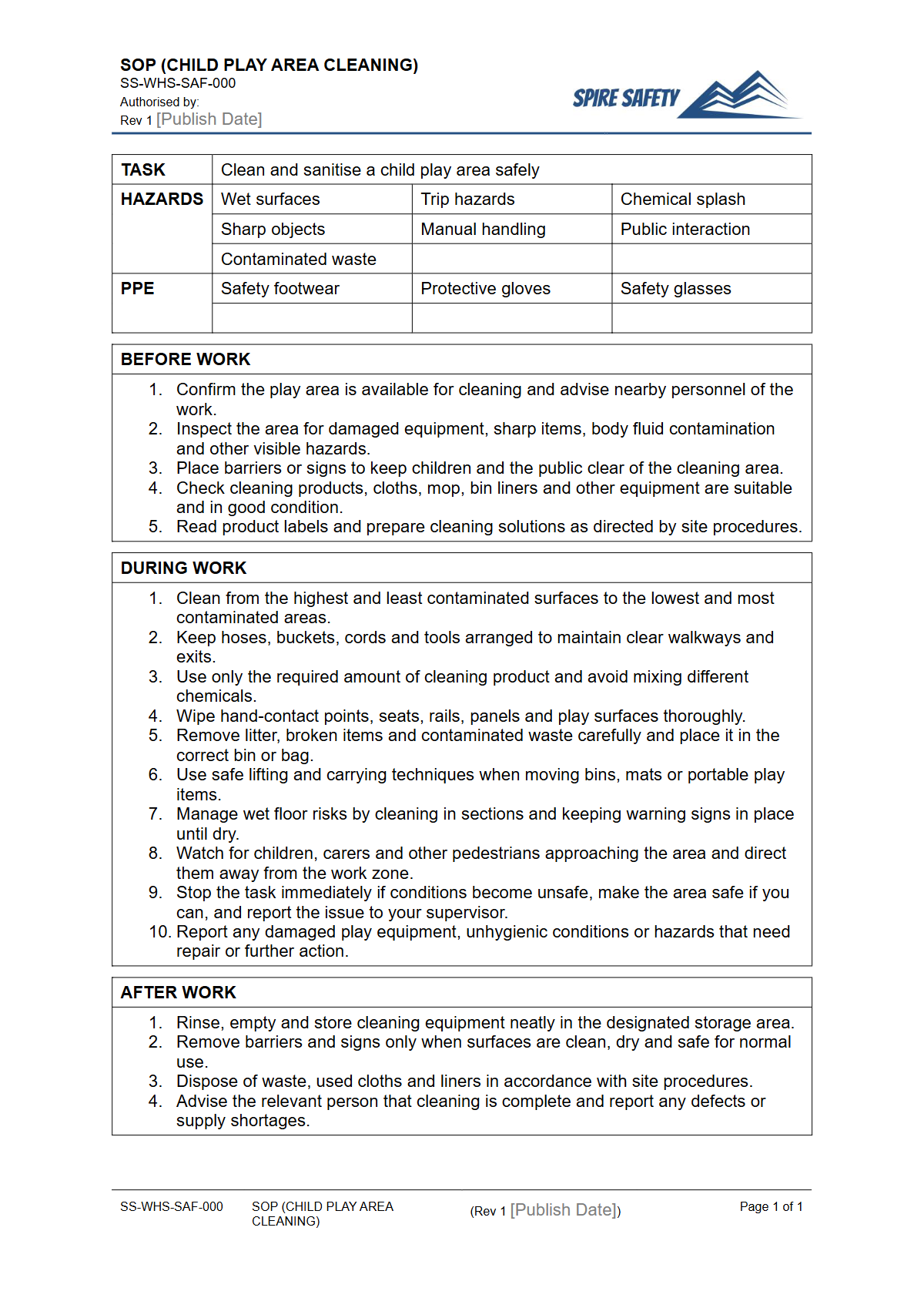
Purpose of the Free Safe Operating Procedure (Child Play Area Cleaning) Template
Download our free Safe Operating Procedure (Child Play Area Cleaning) Template to establish a clear, safe, and consistent process for maintaining hygiene in your facility. This customisable DOCX and PDF resource is designed for businesses like childcare centres, indoor play centres, and community halls.
It provides a structured framework to help you manage the specific risks associated with cleaning tasks, from chemical handling to slip hazards, ensuring a safer environment for both staff and children.
This document outlines the essential steps for safely cleaning and sanitising child play areas, equipment, and associated facilities. A formal SOP helps standardise your cleaning processes, which is crucial for preventing the spread of infection and ensuring a consistently high level of hygiene.
It serves as a vital training tool for new and existing staff, clarifying expectations around tasks, required Personal Protective Equipment (PPE), and emergency procedures. Formalising these procedures is a fundamental component of effective WHS management systems, demonstrating a commitment to health and safety.
Video walkthrough
How to use the Free Safe Operating Procedure (Child Play Area Cleaning) Template
To get started, simply download the template in your preferred format (DOCX or PDF). The document is structured as a ready-to-use framework, but it is not a complete, off-the-shelf solution.
Important: We are not WHS consultants for your business, and this template is a starting point. You must customise this Safe Operating Procedure to reflect the specific equipment, chemicals, layouts, and risks unique to your workplace. This includes adding site-specific details, company branding, and having it reviewed by relevant personnel before implementation. If you need assistance tailoring safety documentation, our WHS consulting team can provide expert support.
Key Information to Customise
- Hazardous Chemicals: List every cleaning product used, referencing its Safety Data Sheet (SDS). Specify dilution ratios, contact times, and required PPE (e.g., gloves, safety glasses).
- Step-by-Step Process: Detail the cleaning sequence, from preparing the area (e.g., 'wet floor' signs) to cleaning high-touch surfaces and final inspection.
- Equipment: Specify all tools required, such as colour-coded cloths, mops, buckets, and vacuums, including pre-use checks and post-use cleaning instructions.
- Emergency Procedures: Outline the response for incidents like chemical splashes to the eyes or skin, and major spills.
Regularly reviewing that these customised procedures are being followed is a key part of maintaining safety standards. This can be achieved through routine workplace inspections or more formal WHS compliance auditing.
When to use this Safe Operating Procedure
This SOP should be used as the primary reference for all routine and non-routine cleaning of the designated child play area. This includes daily, weekly, and deep-cleaning schedules.
It is also a critical document to reference during staff induction and refresher training to ensure everyone understands the correct procedures. The SOP should be readily accessible in the work area and reviewed after any incident, such as a chemical spill or a change in cleaning products. For tasks that involve additional hazards, like cleaning high play structures, it should be used alongside other relevant procedures, such as a FREE Step Ladder SOP Template.
Who should use this Safe Operating Procedure
This procedure is intended for all workers assigned to cleaning tasks in child play areas. This includes dedicated cleaning staff, facility maintenance teams, or general employees in a childcare or hospitality setting.
Supervisors and managers are responsible for ensuring the SOP is understood, followed correctly, and that staff have received adequate training. They must also verify that workers are competent in the tasks described.
In public-facing venues, having clear safety procedures for various scenarios is vital, which might even extend to a defibrillator operation SOP being available for emergencies.
By implementing a thorough SOP, your organisation can significantly improve safety and hygiene outcomes. Explore our comprehensive free WHS resources library for more templates to support your safety management system.
Common mistakes
Common mistakes to avoid
- Using incorrect dilution ratios for cleaning chemicals, reducing their effectiveness or creating a chemical hazard.
- Failing to use 'wet floor' signs during and after cleaning, creating a serious slip risk for staff and visitors.
- Overlooking high-touch surfaces like gate latches, buttons on electronic toys, and shared equipment handles.
- Not allowing adequate contact time for disinfectants to work effectively before wiping them away.
Legal references
Legal considerations
The following legal requirements may be relevant to this type of work.
- Work Health and Safety Act (Harmonised) — Provides the primary duties for protecting workers and other people from work health and safety risks.
- Work Health and Safety Regulations (Harmonised) — Sets out requirements supporting the management of workplace hazards and risks.
The following codes may be relevant to this type of work.
- Managing WHS Risks Code of Practice — Provides practical guidance on identifying hazards, assessing risks and applying effective controls.
- Work Health and Safety Consultation, Cooperation and Coordination Code of Practice — Provides practical guidance on consulting workers and coordinating with other duty holders.
- Managing the Work Environment and Facilities Code of Practice — Provides practical guidance on safe work environments, workplace facilities and related controls.
Did you know
High-Touch Hotspots
In a typical play area, the most contaminated surfaces are often not the floor but items at a child's head height, such as climbing grips, steering wheels, and interactive panels.
The 5-Second Rule?
Studies show that bacteria can transfer to surfaces in less than a second. Germs like norovirus can survive on uncleaned surfaces for days, making regular, thorough cleaning essential for preventing outbreaks.
FAQ
Frequently asked questions
01What should be included in an SOP for cleaning a play area?
02How often should child play areas be cleaned?
03Are there specific WHS risks associated with cleaning play areas?
04Can this template be used for outdoor playgrounds?
Share this resource
Free Safe Operating Procedure (Child Play Area Cleaning) Template
Browse Categories
How To Use It
- 1Download and open in Word or PDF.
- 2Replace the placeholders with your business details.
- 3Get it reviewed by a WHS specialist before rollout.
Need it customised?
Our WHS consultants can adapt this template to your site, run a gap analysis, or audit what you already have in place.
Book a Free Consultation WHS consulting servicesor call 1300 156 382
Related templates
- Free Safe Operating Procedure (Chiller Plant Operation) Template
- Free Safe Operating Procedure (Chip Spreader) Template
- Free Safe Operating Procedure (Chlorine Handling) Template
- Free Safe Operating Procedure (Chocolate Melter) Template
- Free Safe Operating Procedure (Chocolate Tempering) Template
- Free Safe Operating Procedure (Chute Clearing) Template