
Free Safe Operating Procedure (Chiller Plant Operation) Template
Download our free Safe Operating Procedure (Chiller Plant Operation) template. This customisable DOCX and PDF helps define safe work methods.
Free Safe Operating Procedure (Chiller Plant Operation) Template
DOCX • 126 KB + PDF
Updated Oct 2026
No signup required
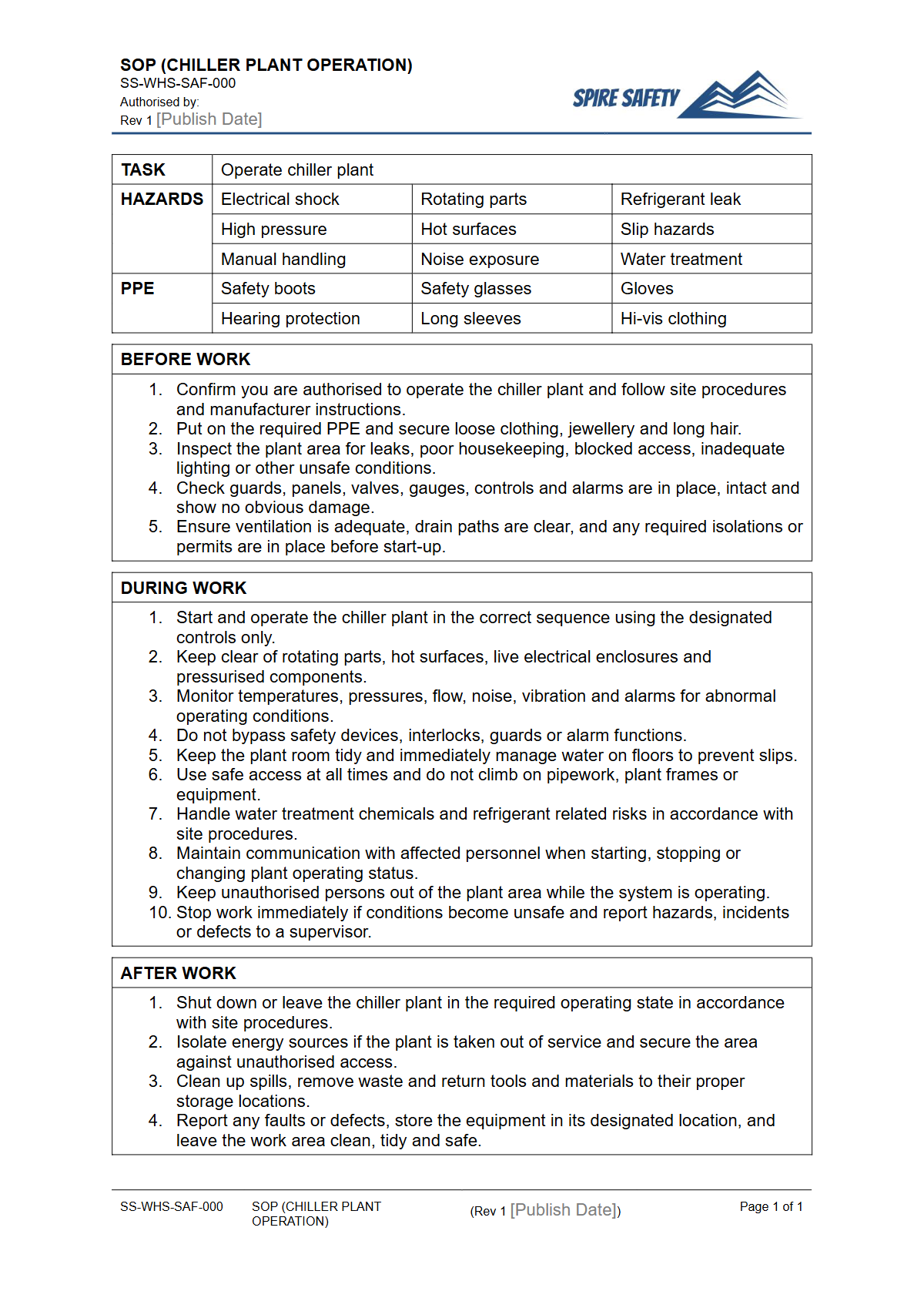
Purpose of the Free Safe Operating Procedure (Chiller Plant Operation) Template
Operating a chiller plant involves significant risks, including high-pressure systems, hazardous refrigerants, electrical energy, and rotating machinery. A Safe Operating Procedure (SOP) is a critical document that provides clear, step-by-step instructions for workers to perform tasks safely and efficiently.
This free Safe Operating Procedure (Chiller Plant Operation) template provides a structured starting point for your organisation to formalise its processes, manage risks, and demonstrate due diligence. By documenting procedures for start-up, routine operation, shutdown, and emergency response, you create a consistent standard of work that minimises the chance of incidents, equipment damage, and costly downtime.
A well-developed SOP is a cornerstone of a compliant safety framework, outlining the known hazards and the control measures required to mitigate them. It serves as an essential training tool for new operators and a reference for experienced personnel.
Integrating specific SOPs into your broader safety framework is a key function of effective WHS management systems, ensuring that documented procedures are actively used, monitored, and improved over time.
Video walkthrough
How to use the Free Safe Operating Procedure (Chiller Plant Operation) Template
This template is designed for easy customisation to reflect the unique aspects of your workplace. After downloading the DOCX or PDF file, you should systematically work through each section, replacing the placeholder text with information specific to your chiller plant model, configuration, and operational context.
It is vital to consult with the people who actually operate and maintain the equipment—the plant operators, HVAC technicians, and maintenance staff. Their direct experience is invaluable for creating a procedure that is practical, accurate, and effective.
The final document should detail all required personal protective equipment (PPE), pre-start checks, operational steps, shutdown sequences, and emergency protocols.
Important: This document is a template and does not constitute a complete or compliant Safe Operating Procedure in its current form. We have provided a structured foundation aligned with Australian WHS practice, but you must take responsibility for adapting it to your specific equipment, chemicals, workplace environment, and legal obligations under the WHS Act and Regulations.
Failure to customise this document thoroughly can result in an ineffective procedure that does not adequately control risks. This process is similar for any piece of fixed plant, such as documented in our free Air Compressor SOP template.
When to use a Safe Operating Procedure
An SOP for chiller plant operation should be a living document integrated into your daily operations. It must be used during the induction and training of any new worker assigned to the plant area.
It serves as a practical checklist before starting the plant and a guide for performing routine operational tasks and checks. Furthermore, the SOP is a critical reference during maintenance planning, particularly for ensuring correct isolation and de-energisation procedures are followed.
In the event of an incident or near miss, the SOP should be reviewed as part of the investigation to identify any procedural gaps or weaknesses. Regular reviews, typically on an annual basis or whenever changes are made to the plant or processes, are essential to ensure the SOP remains current and relevant. This kind of documentation review is a standard part of a thorough WHS compliance audit.
Who should use this Safe Operating Procedure
This Safe Operating Procedure is intended for all personnel who interact with the chiller plant. This includes, but is not limited to, qualified plant operators, building services managers, maintenance fitters, refrigeration mechanics, and electricians.
Supervisors and managers are responsible for ensuring that the SOP is implemented, understood, and consistently followed by their teams. WHS advisors and officers will also use the document to assist in risk assessments, training development, and workplace inspections.
Involving a diverse team in its creation and review helps ensure the procedure is comprehensive and respected by all users. The principles apply to other complex industrial machinery, as shown in our Free Safe Operating Procedure (Screening Plant Operation) Template.
Chiller plants often involve complex water treatment and chemical handling, particularly for managing corrosion, scale, and biological growth. These tasks carry their own set of hazards, such as chemical burns or toxic fume inhalation.
Procedures for safely handling these substances must be clearly defined. For guidance on documenting similar processes, you can reference our Safe Operating Procedure for a Pool Chemical Dosing System, which addresses comparable risks in a different context. If your safety documentation needs are extensive, you may find other useful documents in our free WHS resources library.
Common mistakes
Common mistakes to avoid
- Failing to customise the template with site-specific equipment details and procedures.
- Neglecting to consult with and train operators on the SOP's contents.
- Not reviewing or updating the procedure after equipment modifications or incidents.
- Writing procedures that are too complex or do not reflect how the work is actually done.
Legal references
Legal considerations
The following legal requirements may be relevant to this type of work.
- Work Health and Safety Act (Harmonised) — Provides the primary duties for protecting workers and other people from work health and safety risks.
- Work Health and Safety Regulations (Harmonised) — Sets out requirements supporting the management of workplace hazards and risks.
The following codes may be relevant to this type of work.
- Managing WHS Risks Code of Practice — Provides practical guidance on identifying hazards, assessing risks and applying effective controls.
- Work Health and Safety Consultation, Cooperation and Coordination Code of Practice — Provides practical guidance on consulting workers and coordinating with other duty holders.
- Managing the Work Environment and Facilities Code of Practice — Provides practical guidance on safe work environments, workplace facilities and related controls.
Did you know
Refrigerant Regulations
Australia has strict regulations for handling and disposing of refrigerants under the Ozone Protection and Synthetic Greenhouse Gas Management Act, as many are potent greenhouse gases.
Energy Hogs
Chiller plants can account for 40-50% of a large commercial building's total electricity consumption, making efficient and safe operation crucial for both environmental and financial reasons.
FAQ
Frequently asked questions
01What are the main hazards in chiller plant operation?
02How often should a Chiller Plant SOP be reviewed?
03Is this template suitable for all types of chiller plants?
04Who is responsible for enforcing the SOP?
Share this resource
Free Safe Operating Procedure (Chiller Plant Operation) Template
Browse Categories
How To Use It
- 1Download and open in Word or PDF.
- 2Replace the placeholders with your business details.
- 3Get it reviewed by a WHS specialist before rollout.
Need it customised?
Our WHS consultants can adapt this template to your site, run a gap analysis, or audit what you already have in place.
Book a Free Consultation WHS consulting servicesor call 1300 156 382
Related templates
- Free Safe Operating Procedure (Chip Spreader) Template
- Free Safe Operating Procedure (Chlorine Handling) Template
- Free Safe Operating Procedure (Chocolate Melter) Template
- Free Safe Operating Procedure (Chocolate Tempering) Template
- Free Safe Operating Procedure (Chute Clearing) Template
- Free Safe Operating Procedure (Cinema Floor Cleaning) Template