
Free Safe Operating Procedure (Chip Spreader) Template
Download our free Safe Operating Procedure (Chip Spreader) Template. This customisable DOCX and PDF is aligned with Australian WHS practice.
Free Safe Operating Procedure (Chip Spreader) Template
DOCX • 126 KB + PDF
Updated Oct 2026
No signup required
Purpose of the Free Safe Operating Procedure (Chip Spreader) Template
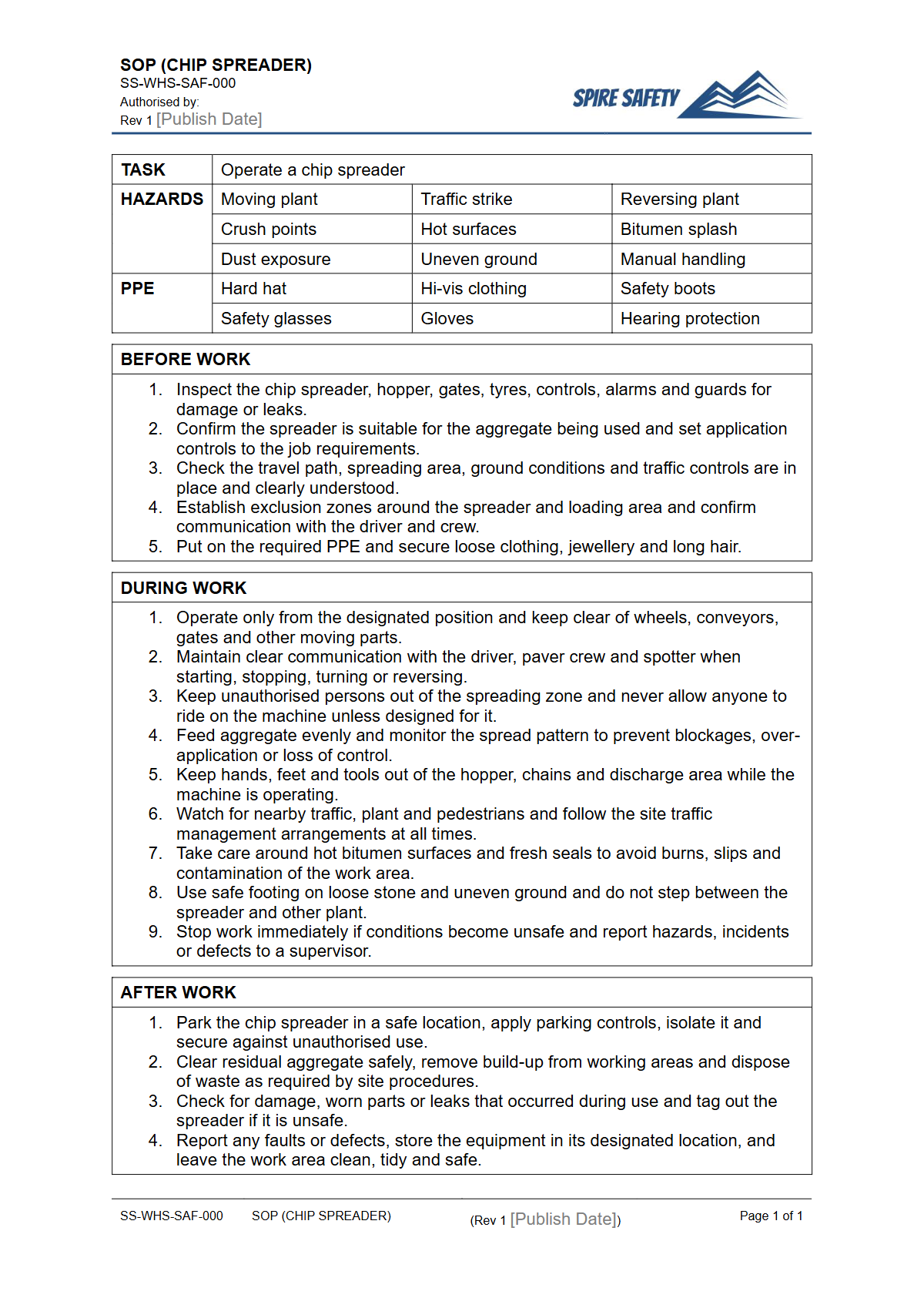
Operating a chip spreader involves significant risks, including traffic interaction, moving parts, hot materials, and dust exposure. This free Safe Operating Procedure (Chip Spreader) Template provides a structured framework for documenting the key steps to perform this task safely.
Using a detailed SOP is a fundamental part of fulfilling your duties under Australian WHS legislation to provide and maintain a safe system of work. It helps your organisation systematically identify hazards and implement effective control measures before work begins.
This template is designed to guide you through creating a comprehensive document specific to your operations. It covers critical safety aspects from pre-start checks to shutdown procedures, ensuring operators have a clear reference for safe work behaviour.
For businesses managing various types of spreading equipment, our free Spreader SOP template offers a more general starting point that can be adapted for different machinery.
Key Elements of a Chip Spreader SOP
A robust Safe Operating Procedure for a chip spreader should contain several key sections, all of which are included in our downloadable template:
- Required PPE: Lists personal protective equipment needed, such as high-visibility clothing, steel-capped boots, gloves, and respiratory protection.
- Hazard Identification: Identifies potential hazards like moving vehicles, uneven surfaces, airborne dust (silica), hot bitumen, and mechanical failures.
- Pre-Operational Checks: Outlines visual inspections and function tests for critical components like brakes, tyres, lights, and the spreading mechanism.
- Operating Steps: A step-by-step guide for the entire task, from positioning the vehicle to applying the aggregate at the correct rate.
- Shutdown and Cleaning: Details the correct sequence for powering down the machine, cleaning equipment safely, and parking.
Documenting these elements is a key part of developing a robust WHS management system that protects your workers and ensures operational consistency.
Video walkthrough
How to use the Free Safe Operating Procedure (Chip Spreader) Template
This template is provided in both DOCX and PDF formats. Download the DOCX file to edit and tailor the document to your specific needs.
The PDF version can be used as a non-editable reference or for quick printing.
Important: This is a template, not a finished document. We have provided a structured starting point, but you must adapt it to reflect the unique aspects of your workplace.
To be effective, the final SOP must be customised with details of your specific chip spreader model, site conditions, types of aggregate used, and your company's established safety protocols. Involve experienced operators and supervisors in the customisation process to ensure the procedure is practical and accurate.
Once customised, the SOP should be used as a primary document for training and competency assessments. It serves as an on-the-job reference for workers and a tool for supervisors to monitor safe work practices.
If your operations involve other heavy earthmoving equipment, you might also find value in creating an SOP for operating a dozer to maintain consistency in your documentation.
When to use it
A Safe Operating Procedure for a chip spreader should be developed and implemented before any operator uses the machinery. It is a proactive tool used in several scenarios:
- Induction and Training: For new operators to learn the approved, safe method of operation.
- Refresher Training: For existing staff to reinforce correct procedures and introduce any updates.
- Pre-Task Planning: As a reference during toolbox talks or pre-start meetings to discuss the day's specific risks.
- Incident Investigation: To review whether established procedures were followed and if they need revision.
If you need expert assistance in developing or reviewing your safety documentation to ensure it aligns with best practice, consider engaging our WHS consulting team.
Who should use it
This template is intended for anyone with responsibility for workplace health and safety in industries like civil construction, road building, and council works. This includes:
- Safety Managers, Advisors, and Coordinators
- Project Managers and Site Supervisors
- Persons Conducting a Business or Undertaking (PCBUs)
- Operations Managers responsible for plant and equipment
Essentially, if you are tasked with creating, implementing, or overseeing safe work documentation for heavy machinery, this template is a valuable resource. SOPs for other mobile plant, such as the procedure documented in our free Scraper SOP Template, follow a similar structure and purpose. For a wider selection of safety templates and checklists, browse our complete free WHS resources library.
Common mistakes
Common mistakes to avoid
- Failing to customise the template with site-specific hazards and machinery details.
- Not involving experienced operators and supervisors in the drafting and review process.
- Treating the SOP as a paper exercise without providing adequate training and supervision.
- Neglecting to review and update the SOP after process changes, new equipment, or incidents.
Legal references
Legal considerations
The following legal requirements may be relevant to this type of work.
- Work Health and Safety Act (Harmonised) — Provides the primary duties for protecting workers and other people from work health and safety risks.
- Work Health and Safety Regulations (Harmonised) — Sets out requirements supporting the management of workplace hazards and risks.
The following codes may be relevant to this type of work.
- Managing WHS Risks Code of Practice — Provides practical guidance on identifying hazards, assessing risks and applying effective controls.
- Work Health and Safety Consultation, Cooperation and Coordination Code of Practice — Provides practical guidance on consulting workers and coordinating with other duty holders.
- Managing the Work Environment and Facilities Code of Practice — Provides practical guidance on safe work environments, workplace facilities and related controls.
Did you know
Hot Bitumen Hazard
The aggregate chips are spread onto a layer of hot bitumen binder, which can be over 160°C, posing a significant thermal burn risk to workers.
Silica Dust Risk
The aggregate used in chip sealing can contain crystalline silica. Handling this aggregate can generate respirable dust, a serious long-term health hazard if inhaled without appropriate controls.
FAQ
Frequently asked questions
01What is a Safe Operating Procedure (SOP) for a chip spreader?
02Is this chip spreader SOP template free to use?
03Who is responsible for creating a chip spreader SOP?
04How often should an SOP be reviewed?
Share this resource
Free Safe Operating Procedure (Chip Spreader) Template
Browse Categories
How To Use It
- 1Download and open in Word or PDF.
- 2Replace the placeholders with your business details.
- 3Get it reviewed by a WHS specialist before rollout.
Need it customised?
Our WHS consultants can adapt this template to your site, run a gap analysis, or audit what you already have in place.
Book a Free Consultation WHS consulting servicesor call 1300 156 382
Related templates
- Free Safe Operating Procedure (Chlorine Handling) Template
- Free Safe Operating Procedure (Chocolate Melter) Template
- Free Safe Operating Procedure (Chocolate Tempering) Template
- Free Safe Operating Procedure (Chute Clearing) Template
- Free Safe Operating Procedure (Cinema Floor Cleaning) Template
- Free Safe Operating Procedure (Cinema Screen Cleaning) Template