
Free Safe Operating Procedure (Chemical Dropoff Intake) Template
Download our free Safe Operating Procedure (Chemical Dropoff Intake) template.
Free Safe Operating Procedure (Chemical Dropoff Intake) Template
DOCX • 126 KB + PDF
Updated Oct 2026
No signup required
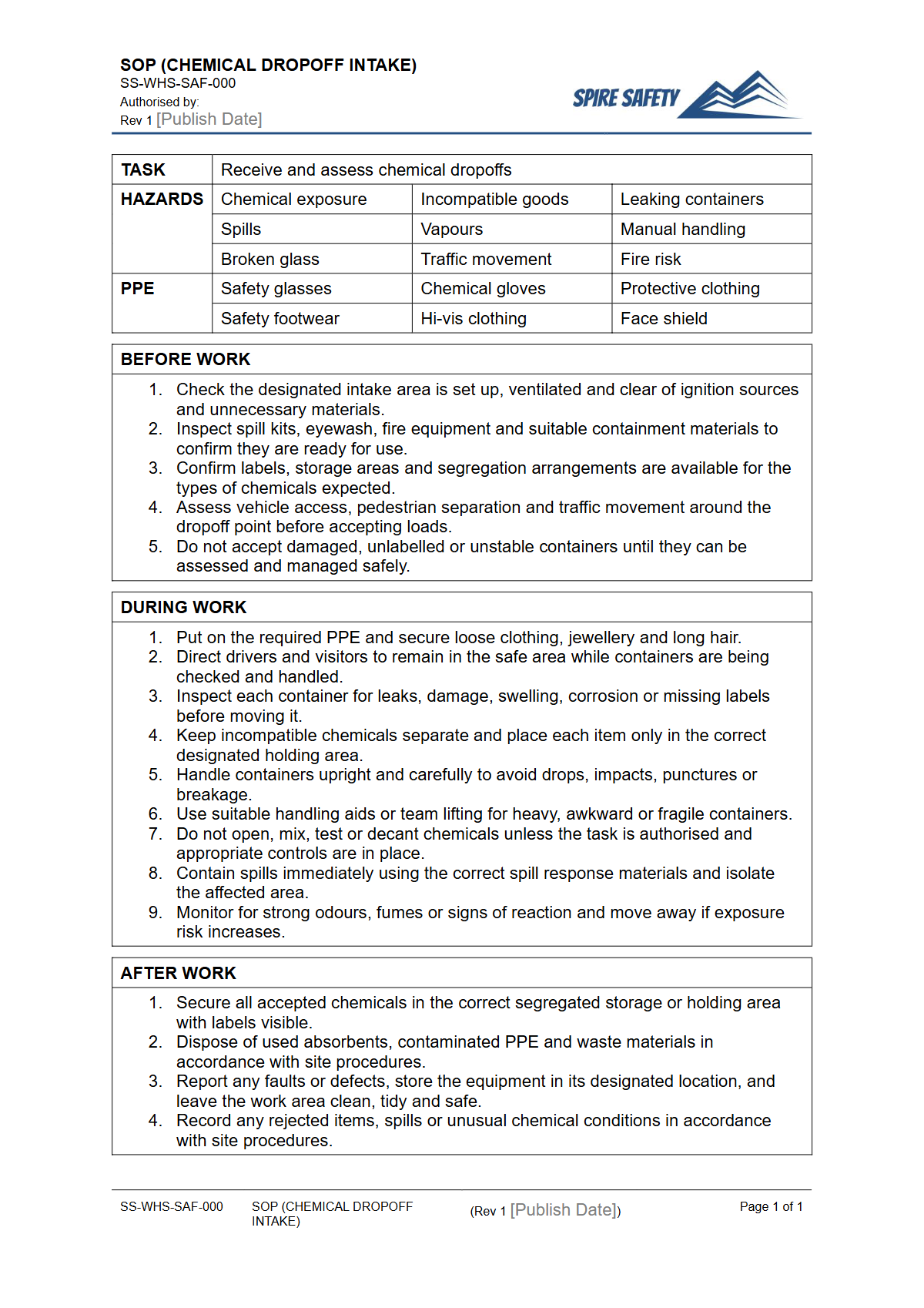
Purpose of the Free Safe Operating Procedure (Chemical Dropoff Intake) Template
Managing the intake of hazardous chemicals is a critical control point for workplace safety. This free Safe Operating Procedure (Chemical Dropoff Intake) template provides a structured starting point for documenting the process of receiving, inspecting, and transferring chemicals upon delivery.
Using a formalised procedure helps minimise risks such as spills, chemical exposure, incorrect storage, and adverse reactions. This SOP is designed to be integrated into a broader WHS management system, ensuring that every chemical delivery is handled with consistent care and diligence.
This resource, based on the model Australian WHS framework, guides you in establishing clear, step-by-step instructions for workers. A documented SOP serves as a vital training tool and a reference for supervisors, helping to ensure that safety responsibilities are clearly understood and consistently followed.
It formalises the controls identified during your risk assessment process for handling hazardous substances at the point of entry into your facility.
Video walkthrough
How to use the Free Safe Operating Procedure (Chemical Dropoff Intake) Template
This Safe Operating Procedure is available for download in both DOCX and PDF formats for your convenience. The DOCX file is fully editable, allowing for comprehensive customisation to suit your organisation's specific needs.
Important: This is a template that must be customised for your specific workplace. We are not familiar with your operational context, so you must add, remove, and amend the content to reflect your specific site, equipment, substances, and control measures.
A generic document will not meet your legal obligations. Effective implementation involves consultation with your workers who perform the task, incorporating their valuable on-the-ground experience.
To adapt the template effectively:
- Conduct a thorough risk assessment for your chemical intake process.
- Incorporate specific details from the Safety Data Sheets (SDS) for the chemicals you handle.
- Clearly define the required Personal Protective Equipment (PPE) for each step.
- Specify the location of spill kits and emergency response equipment.
- Outline your site-specific emergency procedures for spills, fires, or medical incidents.
- Ensure the final document is reviewed and approved before being issued for use. The effectiveness of your procedures can be verified through processes like WHS compliance auditing.
When to use this SOP
This Safe Operating Procedure should be used every time a delivery of hazardous chemicals is received at your workplace. It is applicable across a wide range of industries, including manufacturing, agriculture, cleaning services, laboratories, transport and logistics, and waste management.
It serves as a foundational document for training new employees involved in logistics or materials handling and as a refresher for existing team members. Documenting procedures for specific tasks, like the intake process, is just as important as having a Safe Operating Procedure for pool chemical dosing systems or other specialised equipment.
Who should use it
This SOP is intended for multiple roles within an organisation. Persons Conducting a Business or Undertaking (PCBUs) and managers can use it to fulfil their duty of care by implementing a safe system of work.
WHS officers and supervisors are responsible for customising the template, training workers on the finalised procedure, and monitoring its correct application. Most importantly, workers who are directly involved in receiving, unloading, and handling chemical dropoffs must use the SOP as their guide to perform the task safely.
Key Elements of an Effective Chemical Intake SOP
A comprehensive SOP for chemical intake should cover several key phases of the process to ensure end-to-end safety. Your customised document should address:
- Pre-Arrival: Procedures for scheduling deliveries, confirming SDS availability, and preparing the receiving area.
- Unloading: Instructions for safely directing delivery vehicles, chocking wheels, and using appropriate equipment (e.g., forklifts, pallet jacks) to unload containers. This section should reference separate SOPs for any plant used.
- Inspection: A clear checklist for inspecting containers for damage, leaks, or incorrect labelling before acceptance. It should define the protocol for rejecting a delivery.
- Documentation: Steps for signing off on delivery dockets and updating chemical registers and inventories.
- Transfer & Storage: Instructions for immediately moving chemicals to their designated, compliant storage area, paying close attention to segregation requirements for incompatible substances. For guidance on complex chemical management challenges, consider engaging with WHS consulting experts.
- Spill Response: Immediate actions to take in the event of a spill during the intake process, including containment, cleanup, and reporting.
Using a template like this provides a solid foundation, but diligence in customisation and implementation is what truly creates a safe working environment. If workers need to access high shelves or the top of large containers during inspection, ensure a relevant step ladder SOP is also followed to manage risks of falling from height.
Explore Further WHS Resources
Developing robust safety documentation is an ongoing process. As you build out your safety management system, you may need procedures for a variety of tasks and equipment.
You can find many other templates and guides in our free WHS resources library to support your commitment to a safer workplace.
Common mistakes
Common mistakes to avoid
- Failing to obtain and review the Safety Data Sheet (SDS) before the chemical arrives.
- Accepting damaged or incorrectly labelled chemical containers from the supplier.
- Not having a designated, signed, and equipped dropoff area clear of other traffic.
- Storing new chemicals in a temporary, non-compliant location instead of moving them directly to designated storage.
Legal references
Legal considerations
The following legal requirements may be relevant to this type of work.
- Work Health and Safety Act (Harmonised) — Provides the primary duties for protecting workers and other people from work health and safety risks.
- Work Health and Safety Regulations (Harmonised) — Sets out requirements supporting the management of workplace hazards and risks.
The following codes may be relevant to this type of work.
- Managing WHS Risks Code of Practice — Provides practical guidance on identifying hazards, assessing risks and applying effective controls.
- Work Health and Safety Consultation, Cooperation and Coordination Code of Practice — Provides practical guidance on consulting workers and coordinating with other duty holders.
- Managing the Work Environment and Facilities Code of Practice — Provides practical guidance on safe work environments, workplace facilities and related controls.
Did you know
Segregation is Key
Incompatible chemicals can react dangerously if stored together. For example, storing flammable liquids with oxidising agents can significantly increase fire risk, which is why chemical segregation charts are critical.
The GHS
The Globally Harmonized System (GHS) of Classification and Labelling of Chemicals provides standardised pictograms and hazard statements, making it easier for workers to quickly identify chemical risks anywhere in the world.
FAQ
Frequently asked questions
01What is a Safe Operating Procedure for chemical intake?
02Is this chemical dropoff intake SOP template compliant in Australia?
03What should be included in a chemical dropoff procedure?
04Who is responsible for creating a chemical intake SOP?
Share this resource
Free Safe Operating Procedure (Chemical Dropoff Intake) Template
Browse Categories
How To Use It
- 1Download and open in Word or PDF.
- 2Replace the placeholders with your business details.
- 3Get it reviewed by a WHS specialist before rollout.
Need it customised?
Our WHS consultants can adapt this template to your site, run a gap analysis, or audit what you already have in place.
Book a Free Consultation WHS consulting servicesor call 1300 156 382
Related templates
- Free Safe Operating Procedure (Chemical Shed Cleaning) Template
- Free Safe Operating Procedure (Chemical Spill Cleanup) Template
- Free Safe Operating Procedure (Chemical Transfer) Template
- Free Safe Operating Procedure (Chicken Coop Cleaning) Template
- Free Safe Operating Procedure (Child Play Area Cleaning) Template
- Free Safe Operating Procedure (Chiller Plant Operation) Template