
Free Safe Operating Procedure (Chemical Dilution) Template
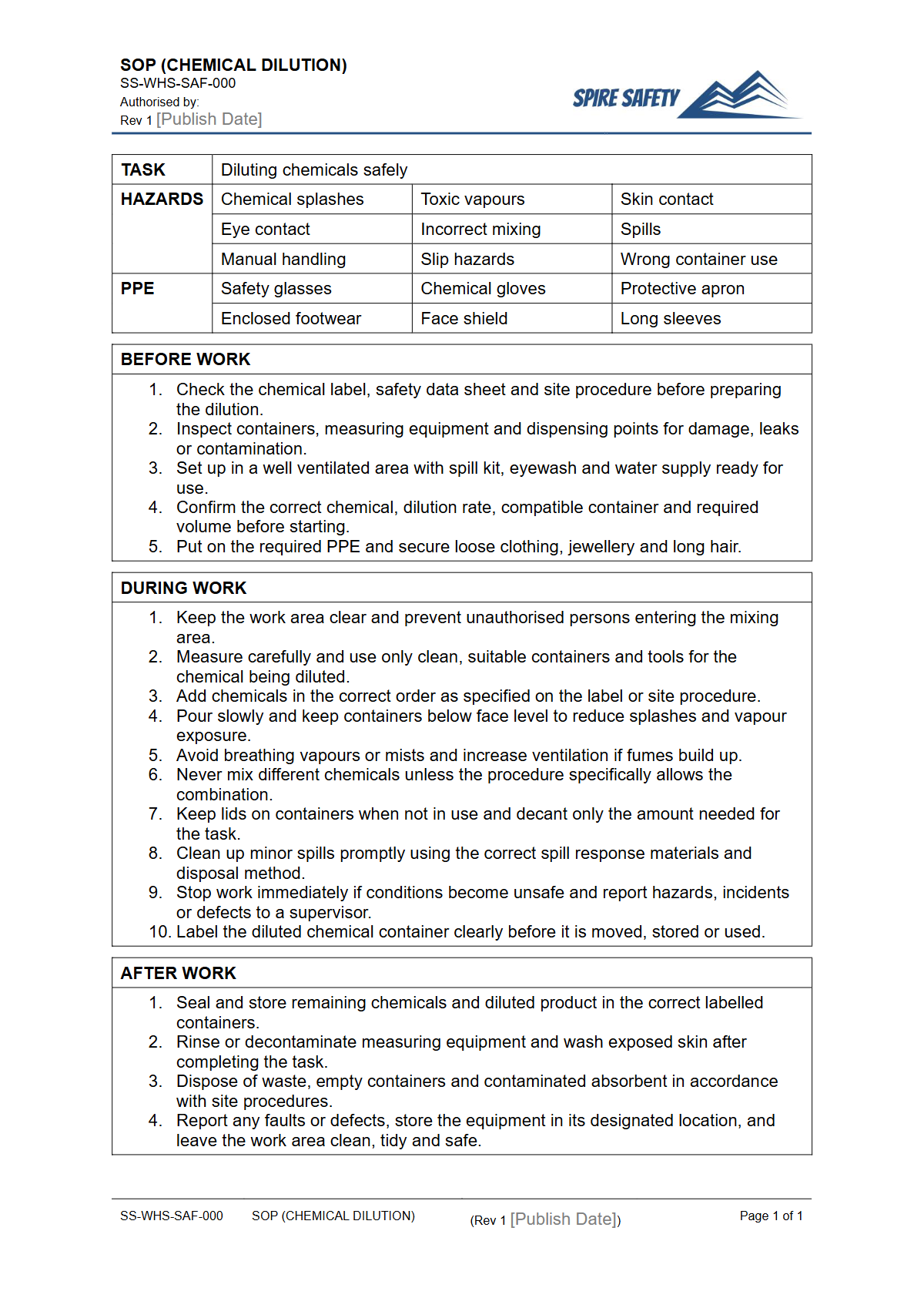
Download our free Safe Operating Procedure (Chemical Dilution) template. This Word & PDF resource helps you outline safe work steps for diluting chemicals.
Free Safe Operating Procedure (Chemical Dilution) Template
DOCX • 126 KB + PDF
Updated Oct 2026
No signup required
Purpose of the Free Safe Operating Procedure (Chemical Dilution) Template
Handling and diluting concentrated chemicals is a high-risk activity common in many Australian workplaces. Without clear, documented instructions, workers are exposed to significant hazards like chemical burns, toxic fume inhalation, and even fires or explosions.
This Free Safe Operating Procedure (Chemical Dilution) Template provides a structured framework for documenting the required steps to perform this task safely and consistently.
A well-developed SOP is a fundamental component of a safe system of work. It helps your organisation meet its primary duty of care under WHS legislation by identifying hazards and implementing effective control measures.
Using this template helps standardise your process, reduce the likelihood of incidents, and provides a crucial tool for worker training and supervision. It forms a key part of your overall safety framework, which is vital for developing comprehensive WHS management systems.
Video walkthrough
How to use the Free Safe Operating Procedure (Chemical Dilution) Template
This downloadable document is a starting point, designed to be adapted to your specific operational needs. After downloading the DOCX or PDF file, you must populate it with information relevant to your workplace, the specific chemicals being used, and the environment in which the task is performed.
This includes detailing the exact chemical names, required dilution ratios, specific Personal Protective Equipment (PPE), and emergency procedures.
Before finalising the SOP, consult the Safety Data Sheet (SDS) for each chemical. The SDS contains critical information on hazards, handling, storage, and first aid measures that must be incorporated into your procedure.
It is also essential to conduct a risk assessment for the task to ensure all potential hazards are identified and controlled.
Please note: This is a template that we have developed to be a starting point. You MUST customise it to reflect the specific chemicals, equipment, PPE, and control measures used in your workplace.
For expert guidance on adapting this template or conducting risk assessments, consider engaging professional WHS consulting services.
When to Use an SOP for Chemical Dilution
A Safe Operating Procedure for chemical dilution should be used whenever a worker is required to mix a concentrated chemical with water or another substance. It serves as a practical, on-the-job reference guide to reinforce training and ensure the correct sequence of actions is followed every time.
This SOP should be a core document for worker inductions, task-specific training, and regular refresher courses. It should be readily accessible in the area where chemical dilution occurs, such as in a cleaning supplies storeroom, workshop, or laboratory.
For tasks involving automated systems, you might find our Safe Operating Procedure for pool chemical dosing systems provides a more relevant example.
Who Should Use This Template
This template is designed for use by Persons Conducting a Business or Undertaking (PCBUs), WHS managers, supervisors, and team leaders across a variety of industries. Any business where employees handle concentrated chemicals—including commercial cleaning, manufacturing, hospitality, agriculture, automotive repair, and healthcare—will benefit from implementing a formal SOP.
Supervisors can use the finalised SOP to train workers and to conduct workplace observations and competency checks. WHS managers can integrate it into the organisation's overall safety management system, using it as evidence of risk management during safety inspections. The existence and effective implementation of such procedures are key focus areas for WHS compliance auditing services.
Developing a Library of Procedures
A chemical dilution SOP is just one of many procedures your business might need. Standardising the format across all high-risk tasks creates consistency and makes training more effective.
For example, while the hazards are different, the structured approach is similar to what you would find in a free Air Compressor SOP. Building a comprehensive set of procedures ensures all known risks are systematically managed. You can browse our complete free WHS resources library to find templates for other common workplace tasks and equipment.
Common mistakes
Common mistakes to avoid
- Failing to read or understand the Safety Data Sheet (SDS) before starting.
- Using incorrect or damaged Personal Protective Equipment (PPE), such as the wrong type of gloves.
- Adding water to a concentrated substance (especially acid) instead of the other way around.
- Performing the task in a poorly ventilated area, leading to the buildup of hazardous fumes.
Legal references
Legal considerations
The following legal requirements may be relevant to this type of work.
- Work Health and Safety Act (Harmonised) — Provides the primary duties for protecting workers and other people from work health and safety risks.
- Work Health and Safety Regulations (Harmonised) — Sets out requirements supporting the management of workplace hazards and risks.
The following codes may be relevant to this type of work.
- Managing WHS Risks Code of Practice — Provides practical guidance on identifying hazards, assessing risks and applying effective controls.
- Work Health and Safety Consultation, Cooperation and Coordination Code of Practice — Provides practical guidance on consulting workers and coordinating with other duty holders.
- Managing the Work Environment and Facilities Code of Practice — Provides practical guidance on safe work environments, workplace facilities and related controls.
Did you know
Always Add Acid
The 'AAA' rule (Always Add Acid) is a critical safety principle. Adding concentrated acid to water allows the heat generated by the exothermic reaction to dissipate safely through the larger volume of water, preventing dangerous splashing.
The SDS is Your Guide
The Safety Data Sheet (SDS) is the most important source of information for creating a chemical SOP. Section 8 (Exposure Controls/Personal Protection) and Section 7 (Handling and Storage) are particularly vital for your procedure.
FAQ
Frequently asked questions
01What is a Safe Operating Procedure for chemical dilution?
02Why is an SOP for diluting chemicals so important?
03What key information must be included in a chemical dilution SOP?
04Who is responsible for creating and implementing the chemical dilution SOP?
Share this resource
Free Safe Operating Procedure (Chemical Dilution) Template
Browse Categories
How To Use It
- 1Download and open in Word or PDF.
- 2Replace the placeholders with your business details.
- 3Get it reviewed by a WHS specialist before rollout.
Need it customised?
Our WHS consultants can adapt this template to your site, run a gap analysis, or audit what you already have in place.
Book a Free Consultation WHS consulting servicesor call 1300 156 382
Related templates
- Free Safe Operating Procedure (Chemical Dosing Pump) Template
- Free Safe Operating Procedure (Chemical Dropoff Intake) Template
- Free Safe Operating Procedure (Chemical Shed Cleaning) Template
- Free Safe Operating Procedure (Chemical Spill Cleanup) Template
- Free Safe Operating Procedure (Chemical Transfer) Template
- Free Safe Operating Procedure (Chicken Coop Cleaning) Template