
Free Safe Operating Procedure (Cheese Vat) Template
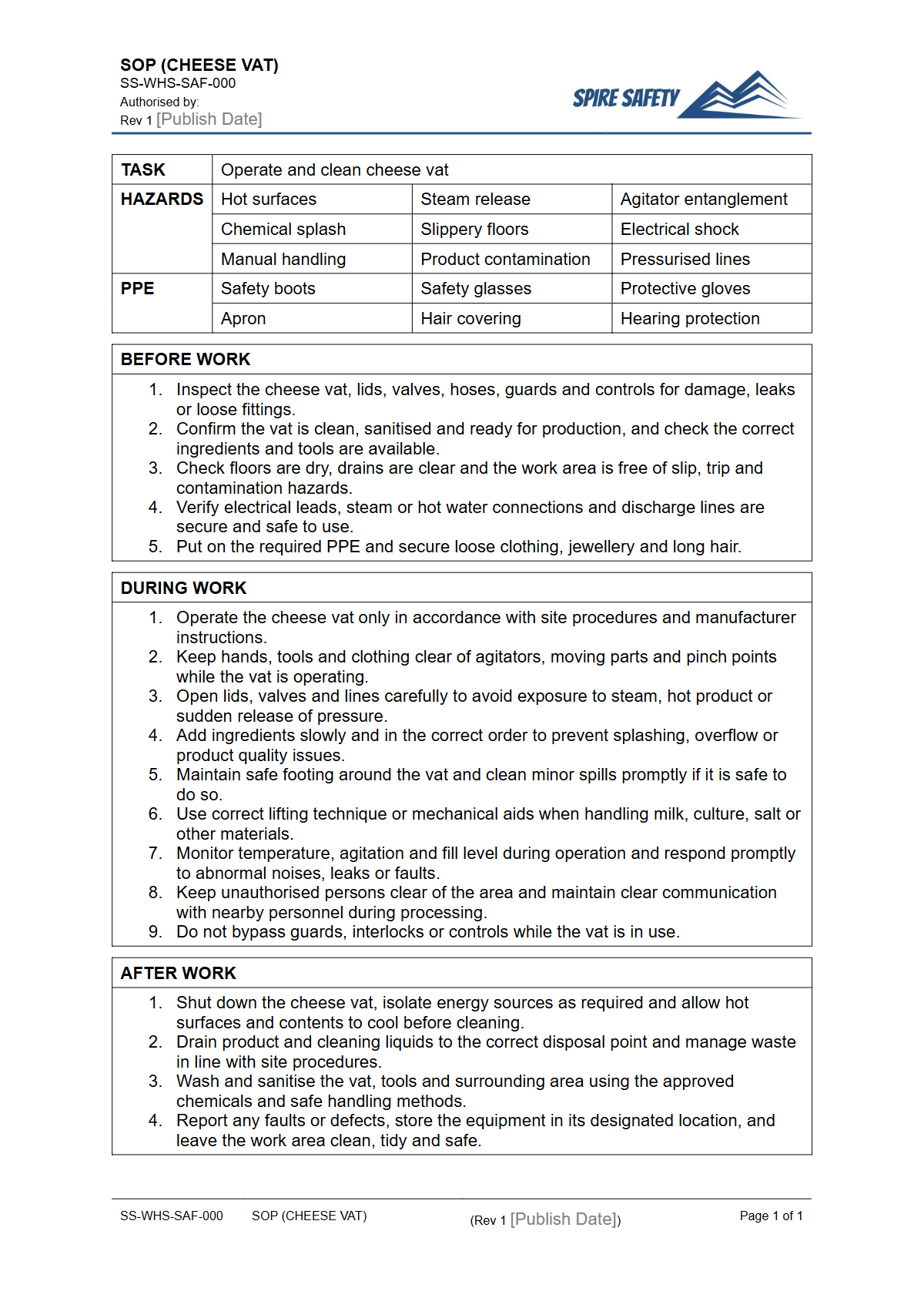
Download our free Safe Operating Procedure (Cheese Vat) template. This DOCX and PDF resource helps outline safe work practices for food processing.
Free Safe Operating Procedure (Cheese Vat) Template
DOCX • 126 KB + PDF
Updated Oct 2026
No signup required
Purpose of the Free Safe Operating Procedure (Cheese Vat) Template
Operating a cheese vat involves significant risks, including exposure to extreme heat, steam, mechanical moving parts, and cleaning chemicals. This free Safe Operating Procedure (Cheese Vat) template provides a structured framework to help your organisation document safe work methods, control hazards, and meet your work health and safety (WHS) obligations.
By clearly defining the steps for pre-operational checks, operation, cleaning, and shutdown, an SOP serves as a vital tool for worker training and competency management.
A documented procedure ensures that tasks are performed consistently and safely by all operators, reducing the likelihood of incidents, injuries, or equipment damage. It forms a key part of your overall safety framework, demonstrating a systematic approach to risk management.
Implementing clear, written instructions is a fundamental component of effective WHS management systems and helps foster a proactive safety culture within your food processing or dairy facility.
Video walkthrough
How to use the Free Safe Operating Procedure (Cheese Vat) Template
This downloadable template provides a comprehensive starting point, but it must be adapted to your specific circumstances. It is not a complete, ready-to-use document.
The layout prompts you to detail essential safety information, including required Personal Protective Equipment (PPE), potential hazards, and risk control measures relevant to your specific cheese vat model and production process.
To use this Safe Operating Procedure template effectively, follow these steps:
- Consult with Workers: Involve the operators who use the cheese vat daily. Their direct experience is invaluable for identifying practical hazards and effective controls.
- Customise Content: Populate each section with information specific to your workplace. This includes the make and model of the vat, the types of cleaning chemicals used, specific energy isolation points, and your unique emergency procedures.
- Review and Approve: Have a supervisor or WHS manager review and approve the finalised document before it is put into use.
Please note: This document is a template designed as a guide. We stress that you must customise it to accurately reflect your specific equipment, chemicals, processes, and workplace environment to ensure it is effective.
When to Use This Safe Operating Procedure
An SOP for a cheese vat should be a live document, integrated into your daily operations. It is not a file to be completed and forgotten.
Its primary use is during the training and induction of new operators, ensuring they learn the correct, safe method from the outset. It should also be used for refresher training to prevent complacency and bad habits from developing over time.
The procedure must be kept in a location where it is easily accessible to all operators, such as in a folder near the equipment. Furthermore, the SOP serves as a critical reference point during incident investigations and should be reviewed and updated as part of any formal WHS compliance auditing program.
A review is mandatory whenever a process is modified, the equipment is altered, or a near-miss or incident occurs.
Who Should Use This Procedure
This Safe Operating Procedure is intended for several key roles within a dairy or food production environment. Primarily, it is for the equipment operators who are directly responsible for running the cheese vat.
It provides them with clear, step-by-step instructions to perform their tasks safely.
Supervisors and team leaders must also use the SOP to oversee work, conduct competency assessments, and ensure that established safety protocols are being followed consistently. Finally, WHS managers and business owners will use the template as a tool to fulfil their duty of care by systematically identifying risks and implementing documented control measures.
General workplace safety preparedness is also critical, which includes readiness for medical emergencies; our Free Safe Operating Procedure (Defibrillator Operation) Template can assist with this.
Integrating SOPs into Your Safety Framework
A single SOP is only one part of a comprehensive safety system. To be truly effective, it must be supported by broader WHS processes.
This includes providing adequate training on the finalised procedure, ensuring workers understand not just the 'how' but also the 'why' behind each step. Many food processing facilities rely on multiple pieces of equipment, each requiring its own procedure. For example, the safe use of compressed air for cleaning or pneumatic functions should be documented with a resource like our Free Air Compressor SOP (Safe Operating Procedure) Template.
Your safety framework should also cover hazard reporting, regular workplace inspections, and emergency preparedness drills. By creating a library of task-specific SOPs and integrating them into your management system, you build a robust and defensible approach to workplace safety.
If you need assistance developing these broader systems, engaging professional WHS consulting services can provide expert guidance and support tailored to your business needs.
Common mistakes
Common mistakes to avoid
- Using a generic template without customising it for the specific model of cheese vat.
- Failing to include details about cleaning chemicals, their specific hazards, and required safety precautions.
- Not training operators on the finalised procedure or ensuring it is easily accessible in the work area.
- Forgetting to review and update the SOP after an equipment modification or process change.
Legal references
Legal considerations
The following legal requirements may be relevant to this type of work.
- Work Health and Safety Act (Harmonised) — Provides the primary duties for protecting workers and other people from work health and safety risks.
- Work Health and Safety Regulations (Harmonised) — Sets out requirements supporting the management of workplace hazards and risks.
The following codes may be relevant to this type of work.
- Managing WHS Risks Code of Practice — Provides practical guidance on identifying hazards, assessing risks and applying effective controls.
- Work Health and Safety Consultation, Cooperation and Coordination Code of Practice — Provides practical guidance on consulting workers and coordinating with other duty holders.
- Managing the Work Environment and Facilities Code of Practice — Provides practical guidance on safe work environments, workplace facilities and related controls.
Did you know
Burn and Scald Risks
Water heated to just 60°C can cause a third-degree burn in as little as five seconds. Cheese vats operate at high temperatures, making procedural controls and appropriate PPE absolutely critical for preventing serious injuries.
Manual Task Injuries
In the Australian food processing industry, hazardous manual tasks are a leading cause of musculoskeletal disorders. A well-designed SOP helps standardise actions to minimise awkward postures and forceful exertions.
FAQ
Frequently asked questions
01What should be included in a Safe Operating Procedure for a cheese vat?
02How often do I need to review my Cheese Vat SOP?
03Is this template enough for WHS compliance?
04What are the main hazards of operating a cheese vat?
Share this resource
Free Safe Operating Procedure (Cheese Vat) Template
Browse Categories
How To Use It
- 1Download and open in Word or PDF.
- 2Replace the placeholders with your business details.
- 3Get it reviewed by a WHS specialist before rollout.
Need it customised?
Our WHS consultants can adapt this template to your site, run a gap analysis, or audit what you already have in place.
Book a Free Consultation WHS consulting servicesor call 1300 156 382
Related templates
- Free Safe Operating Procedure (Chemical Decanting) Template
- Free Safe Operating Procedure (Chemical Dilution) Template
- Free Safe Operating Procedure (Chemical Dosing Pump) Template
- Free Safe Operating Procedure (Chemical Dropoff Intake) Template
- Free Safe Operating Procedure (Chemical Shed Cleaning) Template
- Free Safe Operating Procedure (Chemical Spill Cleanup) Template