
Free Safe Operating Procedure (Cheese Slicer) Template
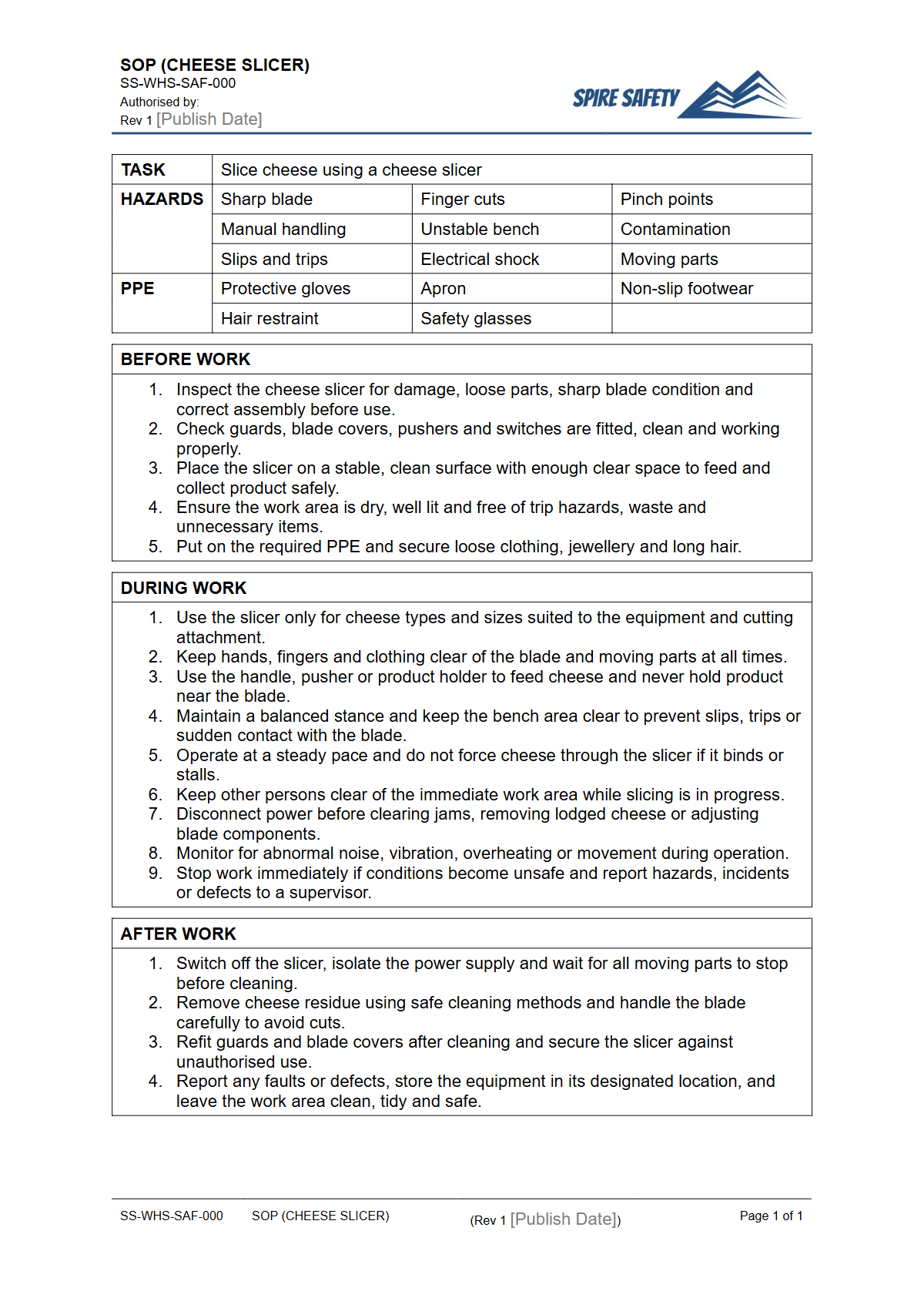
Download our free Safe Operating Procedure (Cheese Slicer) Template. This customisable DOCX and PDF provides a structured framework for safe slicer operation.
Free Safe Operating Procedure (Cheese Slicer) Template
DOCX • 126 KB + PDF
Updated Oct 2026
No signup required
Purpose of the Free Safe Operating Procedure (Cheese Slicer) Template
Operating a commercial cheese slicer, or any food slicer, introduces significant risks into the workplace, primarily severe cuts and amputations from the sharp, fast-moving blade. Electrical hazards and poor ergonomic practices also pose a threat.
This Free Safe Operating Procedure (Cheese Slicer) Template provides a structured framework for documenting and standardising the safe use of this equipment in your business. A documented SOP is a fundamental component of effective WHS management systems, demonstrating your organisation's commitment to eliminating or minimising risks so far as is reasonably practicable.
Using this template helps you to systematically identify hazards, establish robust control measures, and provide clear, step-by-step instructions for workers. This ensures everyone understands the correct procedures for pre-operational checks, safe operation, cleaning, and maintenance, significantly reducing the likelihood of incidents and injuries in kitchens, delicatessens, and food preparation areas.
Video walkthrough
How to use the Free Safe Operating Procedure (Cheese Slicer) Template
This document is a template and must be customised to your specific workplace. Generic procedures are insufficient; your SOP must reflect the actual make and model of the slicer, the specific work environment, and your organisation's established safety protocols.
Download the DOCX file to edit and add your company logo and details.
Crucial Customisation Note: We have provided a structured starting point, but you MUST review and amend this document to align with your unique operational risks. This includes adding specific details for your equipment (brand, model, serial number), defining the required personal protective equipment (e.g., specific type of cut-resistant gloves), detailing site-specific emergency contacts, and incorporating any unique cleaning chemicals or procedures used at your facility.
We strongly recommend taking photos of your machine's key components, like the guard, on/off switch, and blade, and inserting them into the document.
Key Sections to Customise
- Hazard Identification: While common hazards are listed, you should conduct a risk assessment on your specific slicer to identify any others.
- Personal Protective Equipment (PPE): Specify the exact type of PPE required, such as AS/NZS-compliant cut-resistant gloves and safety glasses.
- Pre-operational Checks: Customise the checklist to match the features of your slicer model, ensuring guards are secure and the machine is stable.
- Step-by-Step Operating Instructions: Write clear, simple steps for how to operate your specific machine safely. Avoid technical jargon.
- Cleaning and Sanitising: This is a high-risk activity. Detail your lockdown and tagout (LOTO) procedure for de-energising the slicer before cleaning. Provide explicit instructions on how to safely remove, clean, and reinstall the blade.
- Emergency Procedures: Outline the specific steps to take in case of an injury, including first aid response, emergency stop activation, and who to contact. Your emergency response plan should include immediate first aid actions, potentially referencing equipment covered in documents like our Free Safe Operating Procedure (Defibrillator Operation) Template.
When to use a Safe Operating Procedure
An SOP for a cheese slicer should be used as a core component of your safety management. It is not a document to be filed away and forgotten.
It should be actively used during worker induction and training, as a reference for refresher training, and as a guide for pre-start checks before each use. Supervisors can use it to conduct safety observations and ensure correct procedures are being followed.
The SOP also serves as a critical benchmark document during WHS compliance auditing to verify that established safety practices are being implemented effectively.
Who should use this Safe Operating Procedure
This Safe Operating Procedure is intended for all individuals who interact with the cheese slicer. This includes:
- Workers/Operators: To understand how to use the equipment safely and correctly.
- Supervisors and Managers: To train staff, monitor compliance, and conduct safety checks.
- WHS Representatives and Personnel: As a tool for risk assessment, incident investigation, and promoting a safe system of work.
- Maintenance Staff: To understand the safe procedures for de-energising and servicing the equipment.
Even equipment that appears simple can pose significant risks, requiring formal procedures to manage them. This principle applies to many common workplace items, as outlined in resources like our FREE Step Ladder SOP Template, reinforcing the need for clear instructions for all hazardous tasks.
By implementing and enforcing this SOP, your organisation helps meet its primary duty of care under WHS legislation. For more tools to build out your safety framework, explore our comprehensive free WHS resources library for additional templates and checklists.
Common mistakes
Common mistakes to avoid
- Failing to de-energise and lock out the slicer before cleaning or maintenance.
- Operating the machine with the safety guard or product pusher removed.
- Not wearing appropriate, task-specific PPE such as certified cut-resistant gloves.
- Assuming workers know how to use it without providing specific training on the SOP.
Legal references
Legal considerations
The following legal requirements may be relevant to this type of work.
- Work Health and Safety Act (Harmonised) — Provides the primary duties for protecting workers and other people from work health and safety risks.
- Work Health and Safety Regulations (Harmonised) — Sets out requirements supporting the management of workplace hazards and risks.
The following codes may be relevant to this type of work.
- Managing WHS Risks Code of Practice — Provides practical guidance on identifying hazards, assessing risks and applying effective controls.
- Work Health and Safety Consultation, Cooperation and Coordination Code of Practice — Provides practical guidance on consulting workers and coordinating with other duty holders.
- Managing the Work Environment and Facilities Code of Practice — Provides practical guidance on safe work environments, workplace facilities and related controls.
Did you know
Slicer Injuries
Lacerations from food slicers are among the most common and preventable injuries in the hospitality and food retail industries, often resulting from improper cleaning procedures or missing safety guards.
Beyond the Blade
While the blade is the most obvious hazard, electrical safety is also critical. Faulty wiring or exposure to water during cleaning can create a risk of electric shock, which must be addressed in your risk assessment.
FAQ
Frequently asked questions
01What should be included in a cheese slicer SOP?
02Is a Safe Operating Procedure legally required for a cheese slicer in Australia?
03How often should we review our cheese slicer SOP?
04Can this template be used for other types of food slicers?
Share this resource
Free Safe Operating Procedure (Cheese Slicer) Template
Browse Categories
How To Use It
- 1Download and open in Word or PDF.
- 2Replace the placeholders with your business details.
- 3Get it reviewed by a WHS specialist before rollout.
Need it customised?
Our WHS consultants can adapt this template to your site, run a gap analysis, or audit what you already have in place.
Book a Free Consultation WHS consulting servicesor call 1300 156 382
Related templates
- Free Safe Operating Procedure (Cheese Vat) Template
- Free Safe Operating Procedure (Chemical Decanting) Template
- Free Safe Operating Procedure (Chemical Dilution) Template
- Free Safe Operating Procedure (Chemical Dosing Pump) Template
- Free Safe Operating Procedure (Chemical Dropoff Intake) Template
- Free Safe Operating Procedure (Chemical Shed Cleaning) Template