
Free Safe Operating Procedure (Checkout Till Operation) Template
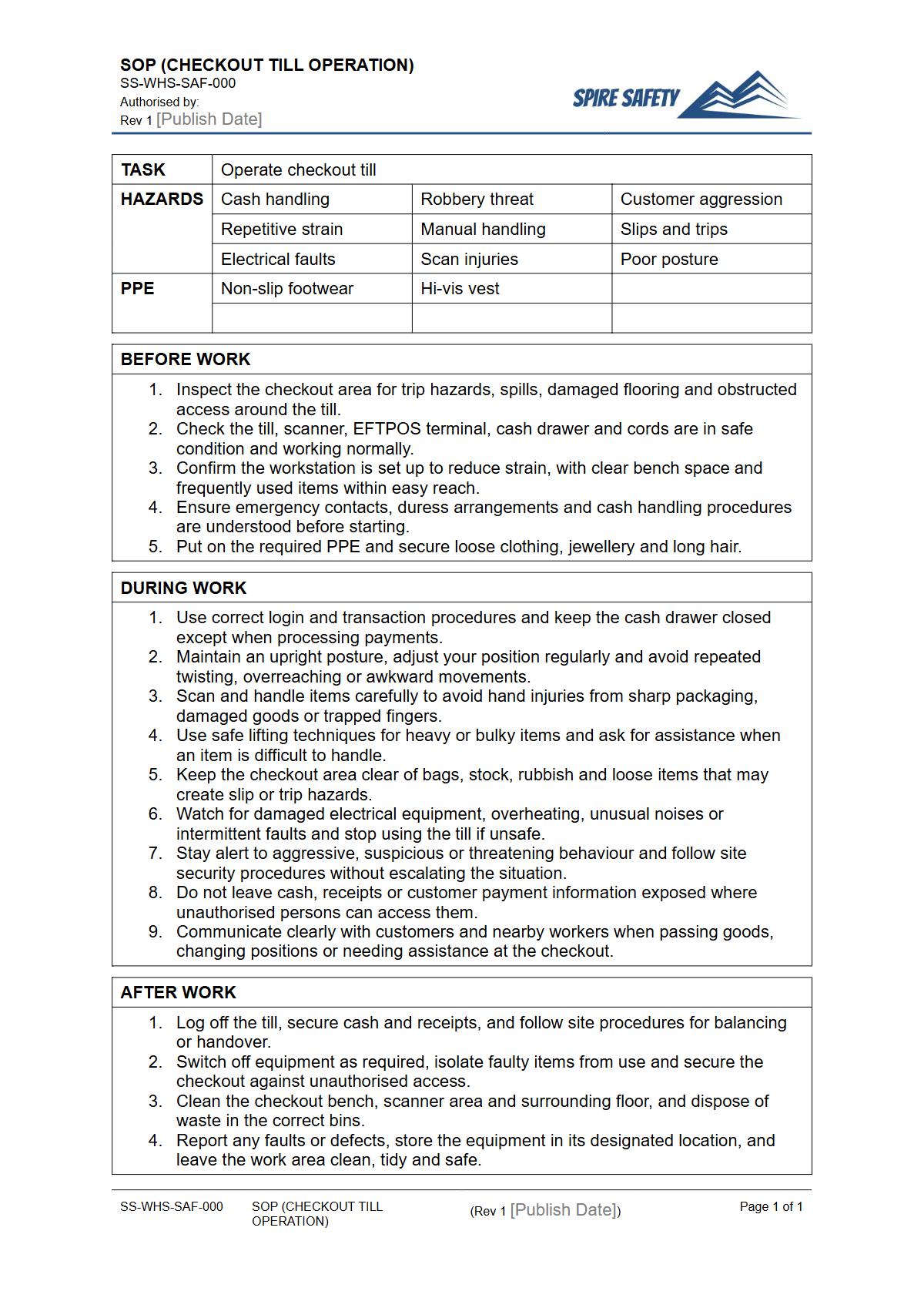
Download our free Safe Operating Procedure for checkout till operation. This DOCX & PDF template helps you manage risks and document safe work steps.
Free Safe Operating Procedure (Checkout Till Operation) Template
DOCX • 126 KB + PDF
Updated Oct 2026
No signup required
Purpose of the Free Safe Operating Procedure (Checkout Till Operation) Template
Operating a checkout till involves more than just processing payments. It exposes workers to a range of hazards, including ergonomic strain, psychological stress from customer interactions, and security risks.
This Free Safe Operating Procedure (Checkout Till Operation) Template provides a structured framework for documenting the safest way to perform this common retail task. By outlining clear, step-by-step instructions, you can minimise risks, ensure consistent training, and demonstrate a commitment to workplace health and safety.
The template is designed to be a starting point, helping you meet your duty of care by formalising procedures for everything from daily setup to handling difficult situations.
A well-developed SOP is a cornerstone of effective safety management. It serves as a vital training tool for new employees and a reference for experienced staff, ensuring everyone understands the expected safe work behaviours.
Formalising these processes helps create a proactive safety culture and can be a key component within broader WHS management systems. This document encourages a systematic approach to identifying hazards and implementing controls specific to your retail environment.
Video walkthrough
How to use the Free Safe Operating Procedure (Checkout Till Operation) Template
This template is provided in both DOCX and PDF formats for your convenience. The DOCX file is fully editable, allowing you to tailor the content to your specific needs.
To use it effectively, you must conduct a site-specific risk assessment for checkout operations in your workplace. This involves identifying all potential hazards associated with your tills, cash handling procedures, and store layout.
Use the findings from your risk assessment to populate and modify the sections within the template.
Important: This document is a template and must be customised. We have provided a structured foundation based on common industry practices, but it is your responsibility to add, remove, and amend the content to reflect the unique risks, equipment (e.g., specific scanner or cash drawer models), and procedures of your business.
Involve your checkout operators in the customisation process to ensure the final SOP is practical and reflects how the work is actually done. Once finalised, the SOP should be used to train all relevant staff.
When to use this Safe Operating Procedure
An SOP for checkout till operation should be developed before any employee begins work at the checkout. It is a critical document for induction and training.
It should also be readily accessible in the work area for easy reference. The SOP must be reviewed and updated regularly, particularly when there are changes in the workplace.
This includes the introduction of new equipment, changes to the store layout, updates to cash handling or security procedures, or following an incident or near-miss. Regular reviews ensure the document remains relevant and effective in controlling risks.
For other common retail and hospitality tasks, you may need additional specific procedures. For example, if your business also uses commercial kitchen equipment, a deep fryer operation SOP would be essential for back-of-house staff safety.
A comprehensive approach ensures all high-risk tasks are covered by documented safe work methods.
Who should use it
This Safe Operating Procedure should be used by anyone involved in checkout operations. This primarily includes checkout operators and cashiers who perform the task daily.
It is also an essential tool for managers and supervisors responsible for training staff and overseeing retail operations. They use the SOP to ensure training is consistent and to monitor that safe work practices are being followed.
WHS managers and safety representatives will also use this document as part of their risk management and compliance activities.
To ensure your procedures are effective, it is vital to perform regular checks and audits. Periodic workplace inspections can confirm that the steps outlined in your SOP are being followed correctly, helping to maintain high safety standards.
For assistance with this, consider professional WHS compliance auditing to get an independent assessment of your safety systems.
What hazards should the SOP address?
A comprehensive checkout till SOP should address a variety of physical and psychological hazards. Key areas to cover include:
- Ergonomics: Repetitive movements (scanning, keying), awkward postures (reaching, twisting), and prolonged standing or sitting. The SOP should detail correct posture, workstation setup, and the importance of micro-breaks.
- Manual Tasks: Lifting or moving heavy or awkward items for customers.
- Psychosocial Hazards: Dealing with difficult, aggressive, or abusive customers. Procedures for de-escalation and seeking assistance should be clear.
- Security Risks: Procedures for cash handling, opening and closing the till, and what to do in the event of a robbery.
- Slips, Trips, and Falls: Housekeeping standards around the checkout area to keep it clear of clutter and spills.
For related procedures, such as maintaining cleanliness in public areas, you can adapt our floor scrubber operation SOP to suit your specific equipment. Similarly, in the event of a medical emergency, having a clear procedure like a defibrillator operation SOP is crucial for a prepared workplace.
This document is just one of many resources designed to help Australian businesses improve their safety practices. You can explore our complete free WHS resources library for more templates, checklists, and guides covering a wide range of industries and tasks.
Common mistakes
Common mistakes to avoid
- Ignoring ergonomic setup and just focusing on cash handling procedures.
- Failing to include clear steps for managing aggressive customers or robbery attempts.
- Writing the SOP without consulting the checkout operators who perform the task daily.
- Not providing adequate training on the finalised SOP, leaving it unused in a binder.
Legal references
Legal considerations
The following legal requirements may be relevant to this type of work.
- Work Health and Safety Act (Harmonised) — Provides the primary duties for protecting workers and other people from work health and safety risks.
- Work Health and Safety Regulations (Harmonised) — Sets out requirements supporting the management of workplace hazards and risks.
The following codes may be relevant to this type of work.
- Managing WHS Risks Code of Practice — Provides practical guidance on identifying hazards, assessing risks and applying effective controls.
- Work Health and Safety Consultation, Cooperation and Coordination Code of Practice — Provides practical guidance on consulting workers and coordinating with other duty holders.
- Managing the Work Environment and Facilities Code of Practice — Provides practical guidance on safe work environments, workplace facilities and related controls.
Did you know
Ergonomic Risk
Repetitive strain injuries (RSIs) are a significant risk for checkout operators. Factors like scanner type, counter height, and the lack of item-weight restrictions can dramatically increase the likelihood of developing musculoskeletal disorders.
Customer Aggression
According to studies, a high percentage of retail workers experience customer aggression or abuse. A clear procedure in an SOP for managing these psychosocial hazards is a critical control measure.
FAQ
Frequently asked questions
01What are the main hazards of checkout till operation?
02Why is an SOP important for a seemingly simple task like using a till?
03Who is responsible for writing a checkout till SOP in Australia?
04How often should a Safe Operating Procedure for a checkout be reviewed?
Share this resource
Free Safe Operating Procedure (Checkout Till Operation) Template
Browse Categories
How To Use It
- 1Download and open in Word or PDF.
- 2Replace the placeholders with your business details.
- 3Get it reviewed by a WHS specialist before rollout.
Need it customised?
Our WHS consultants can adapt this template to your site, run a gap analysis, or audit what you already have in place.
Book a Free Consultation WHS consulting servicesor call 1300 156 382
Related templates
- Free Safe Operating Procedure (Checkweigher) Template
- Free Safe Operating Procedure (Cheese Grater) Template
- Free Safe Operating Procedure (Cheese Slicer) Template
- Free Safe Operating Procedure (Cheese Vat) Template
- Free Safe Operating Procedure (Chemical Decanting) Template
- Free Safe Operating Procedure (Chemical Dilution) Template