
Free Safe Operating Procedure (Checkout Belt Cleaning) Template
Download our free Safe Operating Procedure (Checkout Belt Cleaning) template.
Free Safe Operating Procedure (Checkout Belt Cleaning) Template
DOCX • 126 KB + PDF
Updated Oct 2026
No signup required
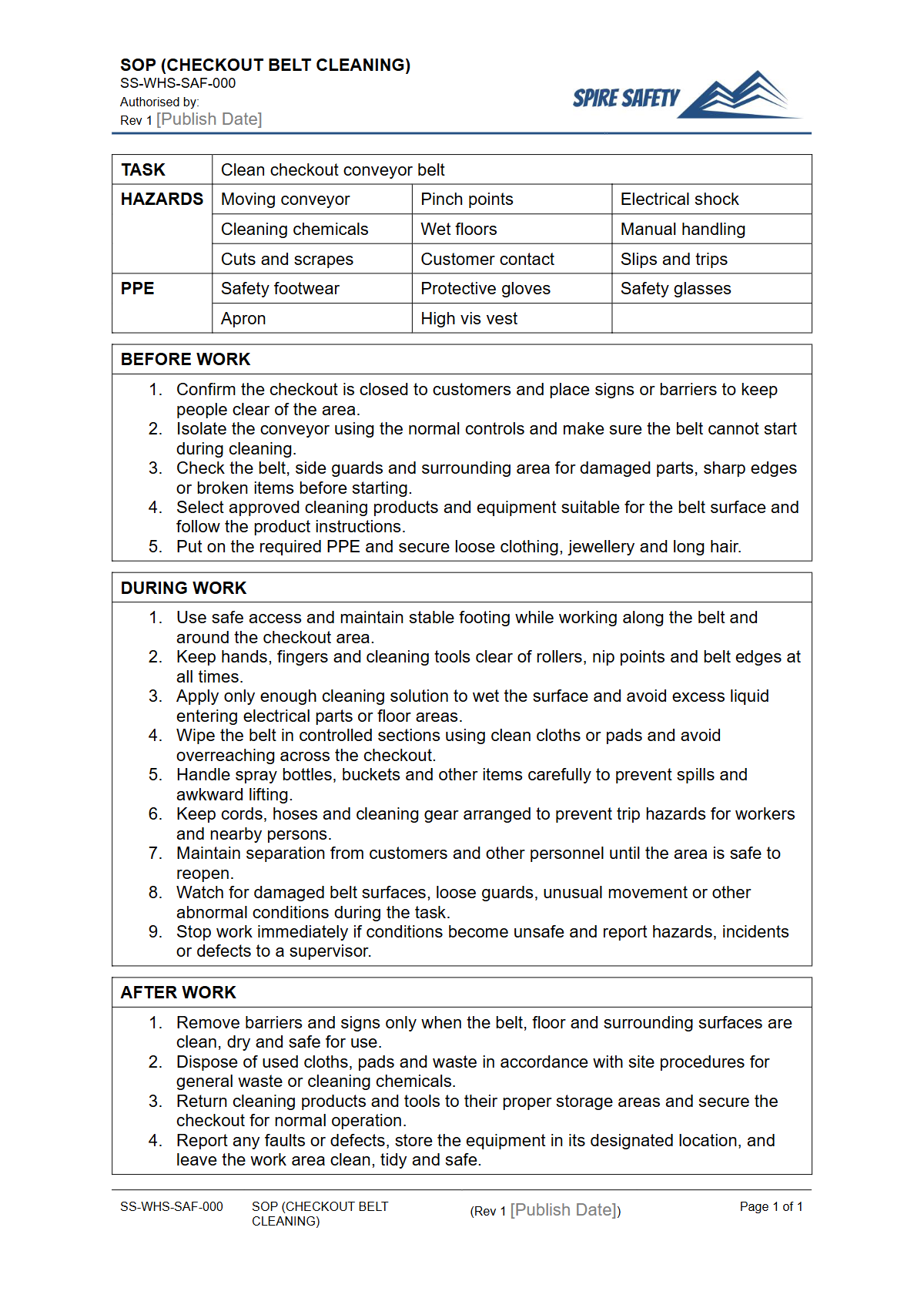
Purpose of this Free Safe Operating Procedure (Checkout Belt Cleaning) Template
Maintaining a clean and hygienic retail environment is essential, but the process itself must be safe for workers. Our free Safe Operating Procedure (Checkout Belt Cleaning) template provides a structured starting point for documenting the process of cleaning checkout conveyor belts.
This task, while seemingly simple, involves a combination of potential hazards including electrical, mechanical, chemical, biological, and ergonomic risks. This SOP template helps you systematically address these risks, outline clear step-by-step instructions, and ensure the task is performed consistently and safely every time.
It is designed to assist your business in meeting its duty of care under Australian WHS legislation.
Using a documented procedure helps formalise training, sets clear expectations for safe behaviour, and provides a critical reference point for supervisors and staff. A comprehensive SOP is a fundamental component of effective WHS management systems, demonstrating a proactive approach to risk management in the retail sector.
Video walkthrough
How to Use the Free Safe Operating Procedure (Checkout Belt Cleaning) Template
This template is available for download as a fully editable DOCX file and a print-ready PDF. It is pre-filled with common steps, hazards, and controls relevant to cleaning checkout belts, but it is not a finished document.
To be effective, you must adapt it to the specific equipment, chemicals, and environment in your workplace.
Important note: We have drafted this document as a starting point based on common industry practices. You must customise this Safe Operating Procedure by conducting your own site-specific risk assessment, consulting with your workers, and incorporating details of your specific checkout models and approved cleaning agents.
This ensures the final SOP is a practical and relevant tool for your team.
Key Hazards in Checkout Belt Cleaning
A thorough risk assessment is the first step in creating a useful SOP. The process of cleaning a checkout belt can expose workers to several hazards that must be controlled. These include:
- Electrical Hazards: Risk of electric shock if liquids enter electrical components or if the equipment is not correctly de-energised.
- Mechanical Hazards: Entanglement or crushing risks from moving parts if the belt is activated during cleaning. This is a critical risk shared with larger systems detailed in our Free Safe Operating Procedure for Conveyor Belt Operation.
- Chemical Hazards: Skin irritation, respiratory issues, or eye damage from incorrect use, mixing, or handling of cleaning chemicals.
- Ergonomic Hazards: Musculoskeletal injuries from awkward postures, repetitive motions, or over-reaching to clean all parts of the unit.
- Biological Hazards: Exposure to bacteria, viruses, and other pathogens from dirt, debris, and food spills on the belt.
Essential Control Measures to Include
Your customised SOP should detail the specific control measures your workplace has implemented to mitigate the identified hazards. Key controls for this task typically include:
- Isolation and Lockout-Tagout: The most critical step. The procedure must clearly define how to isolate the checkout belt from its power source before any cleaning begins. This prevents accidental startup.
- Correct Chemical Handling: Specify the approved cleaning chemicals, dilution rates, and required Personal Protective Equipment (PPE) such as gloves and safety glasses. Reference the relevant Safety Data Sheets (SDS).
- Appropriate Tools and Equipment: List the correct tools for the job, such as designated cloths, brushes, and buckets. If reaching is required, the procedure should reference your policy on safe access, which may involve using equipment covered by a specific Safe Operating Procedure for step ladder use.
- Training and Competency: Ensure all staff are trained in the final, approved SOP and their understanding is verified before they perform the task unsupervised. Just as with other equipment, having a documented procedure like a free Air Compressor SOP ensures consistency and safety across all workplace tasks.
When to Use This Safe Operating Procedure
This SOP should be used as the primary guide whenever routine or scheduled cleaning of a checkout conveyor belt is performed. It serves as a practical tool for workers carrying out the task and a reference for supervisors monitoring safe work practices.
It is also an essential document for inducting and training new retail staff. Furthermore, the documented procedure becomes a benchmark for performance and can be reviewed during incident investigations or regular WHS compliance audits to ensure it remains current and effective. For more templates and guides, explore our complete free WHS resources library.
Common mistakes
Common mistakes to avoid
- Cleaning the belt while it is still energised or capable of moving.
- Using incorrect, unapproved, or improperly diluted cleaning chemicals.
- Failing to wear appropriate PPE, particularly gloves and eye protection.
- Not training staff on the procedure or verifying their competency.
Legal references
Legal considerations
The following legal requirements may be relevant to this type of work.
- Work Health and Safety Act (Harmonised) — Provides the primary duties for protecting workers and other people from work health and safety risks.
- Work Health and Safety Regulations (Harmonised) — Sets out requirements supporting the management of workplace hazards and risks.
The following codes may be relevant to this type of work.
- Managing WHS Risks Code of Practice — Provides practical guidance on identifying hazards, assessing risks and applying effective controls.
- Work Health and Safety Consultation, Cooperation and Coordination Code of Practice — Provides practical guidance on consulting workers and coordinating with other duty holders.
- Managing the Work Environment and Facilities Code of Practice — Provides practical guidance on safe work environments, workplace facilities and related controls.
Did you know
Conveyor Injury Stats
Most injuries involving conveyors occur during maintenance or cleaning when the machine is not properly isolated from its power source through a lockout-tagout procedure.
Retail Sector Injuries
Slips, trips and falls are a leading cause of non-fatal injuries in the retail sector, often resulting from spills or inadequate cleaning procedures that create wet or slippery floors.
FAQ
Frequently asked questions
01Why do I need a specific SOP for cleaning a checkout belt?
02What are the main hazards of cleaning a checkout conveyor?
03Can't my staff just use common sense to clean the belt?
04What PPE is typically required for cleaning a checkout belt?
Share this resource
Free Safe Operating Procedure (Checkout Belt Cleaning) Template
Browse Categories
How To Use It
- 1Download and open in Word or PDF.
- 2Replace the placeholders with your business details.
- 3Get it reviewed by a WHS specialist before rollout.
Need it customised?
Our WHS consultants can adapt this template to your site, run a gap analysis, or audit what you already have in place.
Book a Free Consultation WHS consulting servicesor call 1300 156 382
Related templates
- Free Safe Operating Procedure (Checkout Till Operation) Template
- Free Safe Operating Procedure (Checkweigher) Template
- Free Safe Operating Procedure (Cheese Grater) Template
- Free Safe Operating Procedure (Cheese Slicer) Template
- Free Safe Operating Procedure (Cheese Vat) Template
- Free Safe Operating Procedure (Chemical Decanting) Template