
Free Safe Operating Procedure (Chain of Custody Check) Template
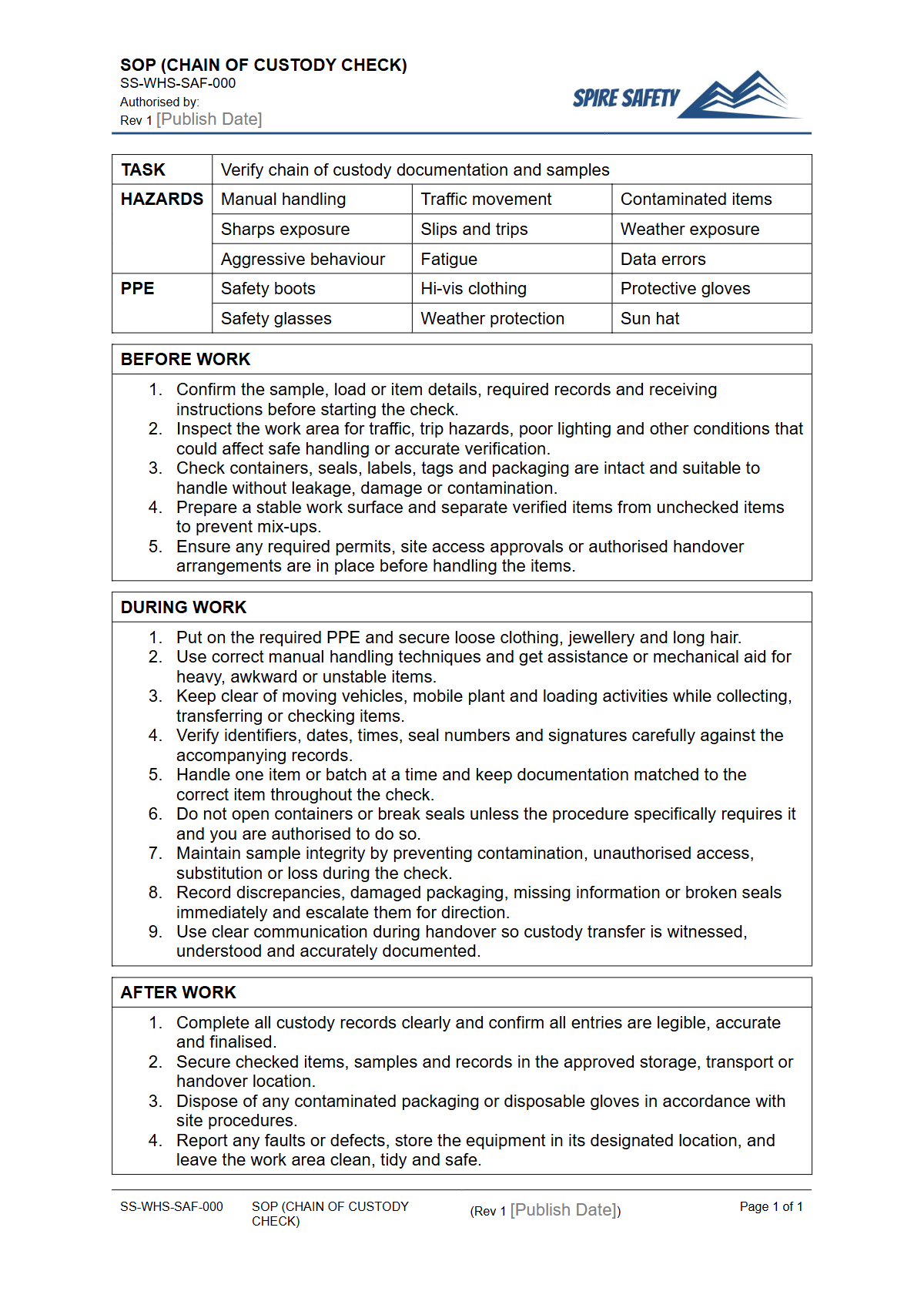
Download our free Safe Operating Procedure (Chain of Custody Check) template. This customisable DOCX & PDF helps document the transfer of evidence or samples.
Free Safe Operating Procedure (Chain of Custody Check) Template
DOCX • 126 KB + PDF
Updated Oct 2026
No signup required
Purpose of the Free Safe Operating Procedure (Chain of Custody Check) Template
A chain of custody is the chronological documentation or paper trail that records the sequence of custody, control, transfer, analysis, and disposition of physical or electronic evidence. Maintaining an unbroken chain is critical in legal, medical, and quality control contexts to ensure the integrity of an item.
This Free Safe Operating Procedure (Chain of Custody Check) Template provides a structured framework for documenting these transfers, helping your organisation minimise the risk of tampering, contamination, or loss. It is a vital tool for any process where the authenticity and integrity of a sample or item must be proven.
Implementing formal procedures like this is a cornerstone of developing and maintaining robust WHS management systems. This SOP helps establish a clear, repeatable process that guides personnel on how to correctly handle, label, store, and transfer sensitive items. It outlines the necessary steps, required personal protective equipment (PPE), and the specific information that must be recorded at every handover point.
By creating a verifiable record, your organisation can confidently demonstrate due diligence and procedural soundness.
Video walkthrough
How to use the Free Safe Operating Procedure (Chain of Custody Check) Template
This Safe Operating Procedure template is designed as a starting point. To implement it effectively, you must first identify the specific items or samples that require a chain of custody within your operations.
This could range from biological samples for drug and alcohol testing to environmental soil samples or critical evidence collected during an incident investigation.
Follow these steps to get started:
- Download the template in your preferred format (DOCX for easy editing or PDF).
- Customise the document with your company name, logo, and relevant site details.
- Adapt the procedural steps to match your specific context. Define the types of samples, the required containers, labelling standards, and storage conditions (e.g., refrigeration).
- Clearly list the roles and responsibilities of all personnel involved in the chain, from collection to final analysis or disposal.
- Train all relevant employees on the procedure to ensure they understand their obligations and the importance of each step. This training should be documented.
- Integrate this SOP with other relevant safety documents, such as your Safe Operating Procedure for defibrillator operation if handling medical incident data.
Important: This template provides a foundational structure. To ensure it is effective and relevant, you must customise it to reflect the specific items, personnel, and procedures unique to your workplace.
We cannot guarantee its suitability for your specific circumstances without customisation.
When to use it
A chain of custody procedure is not required for every item in a workplace, but it is essential in specific, high-stakes situations where integrity and accountability are paramount. Its use provides an auditable record that can withstand scrutiny during legal challenges or quality reviews.
Implementing this SOP is recommended whenever you are handling items that could be used as evidence, require controlled access, or have significant legal, financial, or safety implications.
Key scenarios for use include:
- Workplace Drug and Alcohol Testing: To ensure urine or saliva samples are not tampered with between collection and laboratory testing.
- Incident Investigation: For securing and documenting evidence collected from an accident scene, such as faulty equipment parts or witness statements.
- Environmental Sampling: When collecting soil, water, or air samples for contamination analysis to ensure results are legally defensible.
- High-Value Asset Management: Tracking the movement of expensive equipment, sensitive data drives, or controlled substances within a facility.
The documentation produced by following this SOP is often a key point of review during WHS compliance auditing, providing clear evidence of procedural control.
Who should use it
The responsibility for maintaining a chain of custody falls on every individual who handles the item. This Safe Operating Procedure should be understood and used by a range of personnel across different departments.
It formalises a process that is often more complex than a standard equipment-based procedure, like a plasma cutter SOP, as it focuses on process integrity rather than machine operation.
Roles that will typically use or be governed by this SOP include:
- WHS Advisors and Officers: For overseeing incident investigations and managing safety-critical processes.
- Laboratory Technicians and Collectors: For handling biological or environmental samples.
- Security Personnel: For managing evidence or controlling access to secured items.
- Site Supervisors and Managers: To ensure procedures are followed correctly by their teams.
- Logistics and Asset Managers: For tracking the movement of high-value goods.
Unlike a simple procedural guide for common tasks like a step ladder SOP, a chain of custody document requires strict adherence from multiple parties. If your team needs guidance on implementing complex procedures, seeking specialist WHS consulting can help align your processes with best practice.
You can also explore our wider free WHS resources library for more templates and guides.
Common mistakes
Common mistakes to avoid
- Leaving gaps in the log or recording illegible information.
- Failing to properly secure the item or sample in a sealed, tamper-evident bag or container.
- Not documenting every single person who handles the item, even for brief periods.
- Using a generic procedure without customising it for the specific item type, risk, and context.
Legal references
Legal considerations
The following legal requirements may be relevant to this type of work.
- Work Health and Safety Act (Harmonised) — Provides the primary duties for protecting workers and other people from work health and safety risks.
- Work Health and Safety Regulations (Harmonised) — Sets out requirements supporting the management of workplace hazards and risks.
The following codes may be relevant to this type of work.
- Managing WHS Risks Code of Practice — Provides practical guidance on identifying hazards, assessing risks and applying effective controls.
- Work Health and Safety Consultation, Cooperation and Coordination Code of Practice — Provides practical guidance on consulting workers and coordinating with other duty holders.
- Managing the Work Environment and Facilities Code of Practice — Provides practical guidance on safe work environments, workplace facilities and related controls.
Did you know
Legal Precedent
The concept of chain of custody is fundamental in legal proceedings. A broken or poorly documented chain can render crucial evidence, such as DNA samples or seized items, inadmissible in court.
Digital Forensics
Chain of custody is not just for physical items. It's a critical process in digital forensics to prove that electronic evidence has not been altered from the moment of collection through to its presentation.
FAQ
Frequently asked questions
01What is a chain of custody and why is it important in WHS?
02Can this template be used for drug and alcohol testing procedures?
03Does this SOP replace the need for specific laboratory or legal protocols?
04How often should our chain of custody procedure be reviewed?
Share this resource
Free Safe Operating Procedure (Chain of Custody Check) Template
Browse Categories
How To Use It
- 1Download and open in Word or PDF.
- 2Replace the placeholders with your business details.
- 3Get it reviewed by a WHS specialist before rollout.
Need it customised?
Our WHS consultants can adapt this template to your site, run a gap analysis, or audit what you already have in place.
Book a Free Consultation WHS consulting servicesor call 1300 156 382
Related templates
- Free Safe Operating Procedure (Chain Sling Use) Template
- Free Safe Operating Procedure (Chainsaw - Standard Operation) Template
- Free Safe Operating Procedure (Change Room Inspection) Template
- Free Safe Operating Procedure (Chargrill Operation) Template
- Free Safe Operating Procedure (Checkout Belt Cleaning) Template
- Free Safe Operating Procedure (Checkout Till Operation) Template