
Free Safe Operating Procedure (Chain Block) Template
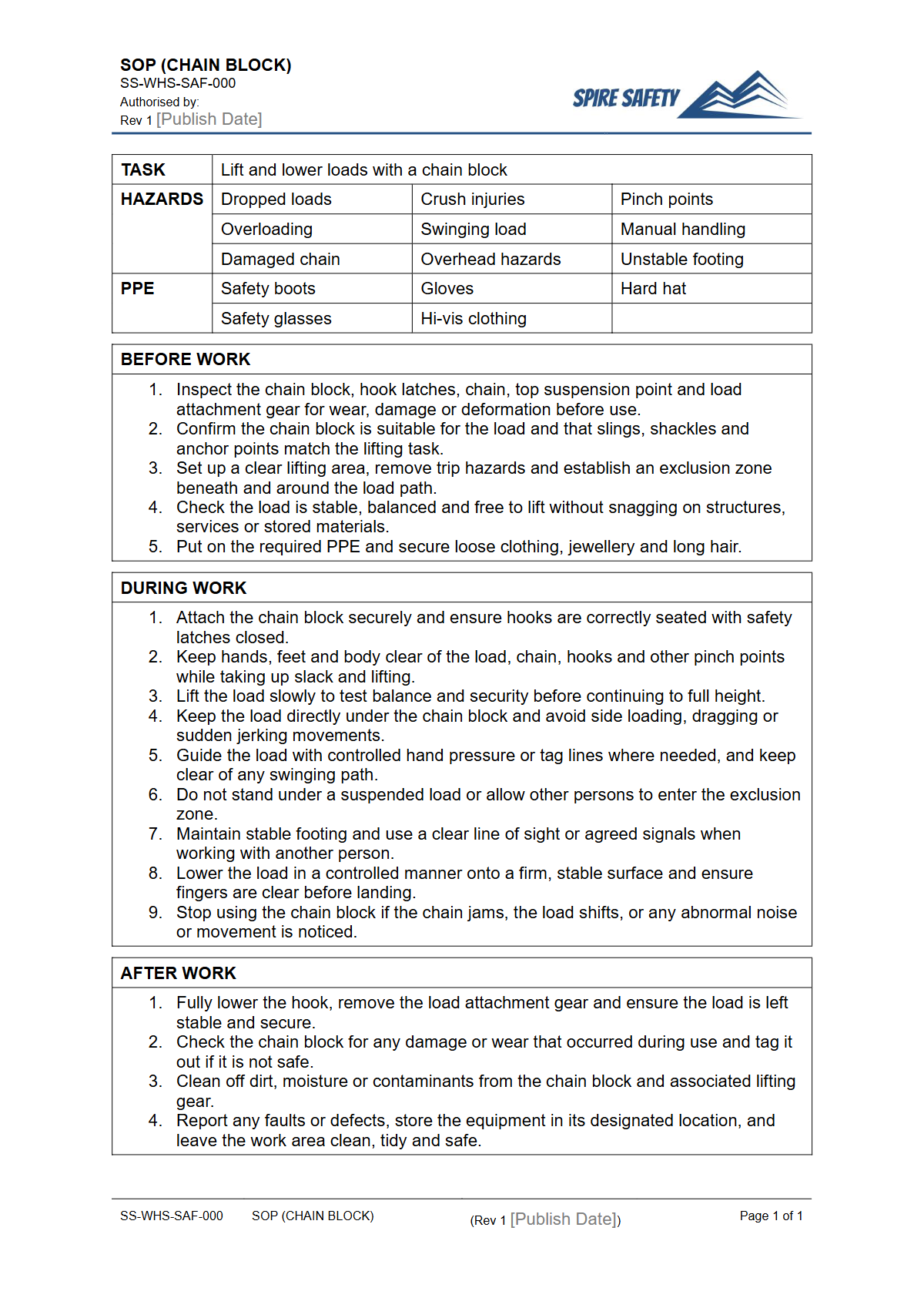
Download our free Safe Operating Procedure (Chain Block) template. This customisable DOCX and PDF helps you outline safe work steps for chain block use.
Free Safe Operating Procedure (Chain Block) Template
DOCX • 126 KB + PDF
Updated Oct 2026
No signup required
Purpose of the Free Safe Operating Procedure (Chain Block) Template
This Free Safe Operating Procedure (Chain Block) Template provides a structured framework for documenting the safe use of chain blocks and other manual lifting equipment in your workplace. Developing a clear SOP is a critical step in managing the risks associated with lifting operations, helping to prevent incidents such as dropped loads, equipment failure, and musculoskeletal injuries.
It helps your organisation standardise procedures, ensuring every worker performs the task safely and consistently, which is a key part of providing a safe system of work under Australian WHS laws.
A well-defined Safe Operating Procedure for a chain block identifies hazards like overloading, improper rigging, and mechanical wear. By outlining specific controls—such as pre-start checks, weight limits, and correct lifting techniques—it serves as a vital administrative control measure.
Using this template helps formalise your risk management process for lifting equipment, which is just as important as it is for larger plant like mobile cranes or telehandlers. For other heavy machinery, you might also require documents like our FREE Telehandler SOP (Safe Operating Procedure) Template.
What is a Safe Operating Procedure?
A Safe Operating Procedure (SOP) is a written document that provides step-by-step instructions on how to safely perform a specific task or operate a piece of equipment. It details potential hazards and the control measures required to eliminate or minimise them.
An SOP is an essential tool for training, competency assessment, and daily operational guidance, forming a core component of an effective safety management system.
Video walkthrough
How to use the Free Safe Operating Procedure (Chain Block) Template
This template is designed as a starting point, delivered in both DOCX and PDF formats for your convenience. To effectively implement it, you must adapt the content to the unique context of your workplace.
Download the DOCX file and methodically work through each section, adding details specific to your chain blocks, tasks, and operational environment. This includes specifying the make and model of the equipment, the exact location of use, and any site-specific emergency procedures.
Please note: This document is a template and must be customised to suit the specific equipment, environment, and tasks in your workplace. We recommend a consultation process with workers who use the equipment, as their direct experience is invaluable for creating a practical and effective procedure. A periodic review of all your safety documents is also a cornerstone of good safety governance, which can be validated through professional WHS compliance auditing.
When to use this Safe Operating Procedure
A chain block SOP should be a central part of your daily operations and safety framework. It is used during worker induction and training to ensure new team members understand the correct procedures from day one.
It should also be readily available at the point of use as a quick reference for operators before they begin a lift. Furthermore, the SOP serves as a benchmark for supervisors conducting safety observations and is an essential document to review during incident investigations to identify any procedural gaps or non-conformance.
The SOP should be treated as a living document. It must be reviewed and updated regularly, particularly when new chain blocks are purchased, when a task changes, or following any near miss or incident.
Integrating this SOP review process into your broader safety framework ensures it remains relevant and effective. For businesses looking to establish a more comprehensive safety framework, Spire Safety offers expert support in developing complete WHS management systems.
Who should use this document
This Safe Operating Procedure is intended for a range of personnel within an organisation. Workers and operators are the primary users, relying on it to guide their actions and reinforce safe work habits.
Supervisors and team leaders use it as a tool for training their teams, monitoring compliance, and conducting pre-start safety talks. WHS and safety managers use the SOP as a key document within the overall safety management system, ensuring that documented procedures are in place for managing plant-related risks.
Documenting safe procedures is crucial for all workplace equipment, not just items used for heavy lifting. Simple equipment can also pose significant risks if used incorrectly.
As an example, our FREE Step Ladder SOP Template addresses hazards associated with a very common but often misused piece of equipment. Having documented procedures ensures a consistent approach to safety across the board.
If your team requires assistance in customising this or other safety documents, Spire Safety's WHS consulting services can provide tailored support.
Your organisation is responsible for creating and maintaining SOPs for all potentially hazardous plant and equipment. This includes everything from hand-operated tools to complex machinery.
For other high-risk thermal or cutting tasks, you may need a resource like our FREE Plasma Cutter SOP (Safe Operating Procedure) Template to control different sets of hazards. You can browse our extensive free WHS resources library to find more templates to support your safety management system.
Common mistakes
Common mistakes to avoid
- Exceeding the Working Load Limit (WLL) clearly marked on the block's identification tag.
- Using the chain block for 'side pulling' or 'drifting' loads instead of a straight, vertical lift.
- Failing to conduct and document regular pre-use inspections for wear, damage, or deformation on the hook, chain, and safety latch.
- Neglecting to ensure the load is balanced and the anchor point is secure and rated for the full weight of the lift.
Legal references
Legal considerations
The following legal requirements may be relevant to this type of work.
- Work Health and Safety Act (Harmonised) — Provides the primary duties for protecting workers and other people from work health and safety risks.
- Work Health and Safety Regulations (Harmonised) — Sets out requirements supporting the management of workplace hazards and risks.
The following codes may be relevant to this type of work.
- Managing WHS Risks Code of Practice — Provides practical guidance on identifying hazards, assessing risks and applying effective controls.
- Work Health and Safety Consultation, Cooperation and Coordination Code of Practice — Provides practical guidance on consulting workers and coordinating with other duty holders.
- Managing the Work Environment and Facilities Code of Practice — Provides practical guidance on safe work environments, workplace facilities and related controls.
Did you know
Mechanical Advantage
Chain blocks use a system of gears to provide a significant mechanical advantage, allowing a person to lift several tonnes with relatively little effort. The gear ratio determines how much force is multiplied.
Load Chain vs. Hand Chain
A chain block has two distinct chains. The smaller hand chain is pulled to operate the lifting mechanism, while the thicker, heat-treated alloy steel load chain is what holds the weight. They are not interchangeable and have different strength properties.
FAQ
Frequently asked questions
01What should be included in a chain block SOP?
02How often should a chain block be inspected?
03Is training required to use a chain block?
04What is the difference between an SOP and a SWMS?
Share this resource
Free Safe Operating Procedure (Chain Block) Template
Browse Categories
How To Use It
- 1Download and open in Word or PDF.
- 2Replace the placeholders with your business details.
- 3Get it reviewed by a WHS specialist before rollout.
Need it customised?
Our WHS consultants can adapt this template to your site, run a gap analysis, or audit what you already have in place.
Book a Free Consultation WHS consulting servicesor call 1300 156 382
Related templates
- Free Safe Operating Procedure (Chain of Custody Check) Template
- Free Safe Operating Procedure (Chain Sling Use) Template
- Free Safe Operating Procedure (Chainsaw - Standard Operation) Template
- Free Safe Operating Procedure (Change Room Inspection) Template
- Free Safe Operating Procedure (Chargrill Operation) Template
- Free Safe Operating Procedure (Checkout Belt Cleaning) Template