
Free Safe Operating Procedure (Cemetery Grounds Care) Template
Download our free Safe Operating Procedure for Cemetery Grounds Care. This customisable DOCX & PDF template helps you document safe work methods. Get started.
Free Safe Operating Procedure (Cemetery Grounds Care) Template
DOCX • 126 KB + PDF
Updated Oct 2026
No signup required
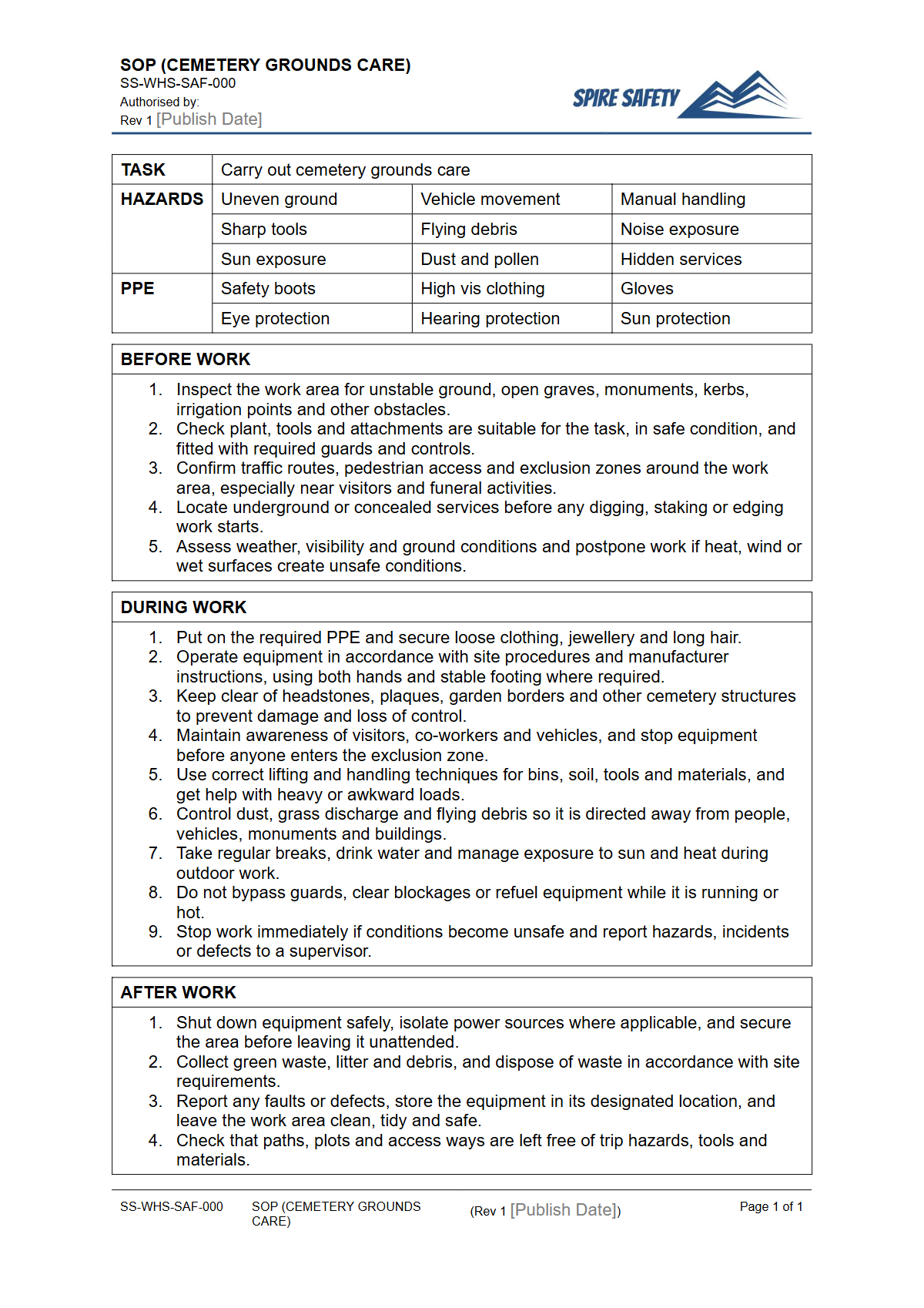
Purpose of the Free Safe Operating Procedure (Cemetery Grounds Care) Template
Cemetery grounds care involves a unique combination of tasks, from general horticulture and landscaping to sensitive excavation and public interaction. This work presents a variety of risks, including manual handling injuries, exposure to chemicals, operation of plant and equipment, and hazards from uneven or unstable ground.
This Free Safe Operating Procedure (Cemetery Grounds Care) Template provides a structured starting point for your organisation to formally document the safest way to perform these duties, helping to manage risks and meet your WHS obligations.
A Safe Operating Procedure (SOP) is a key administrative control that breaks down a task into a sequence of steps, outlining the known hazards and the specific controls required to keep workers safe. By implementing a clear SOP, you can standardise safe work practices, provide a valuable tool for worker training and induction, and demonstrate a systematic approach to safety.
For related tasks, you may also find our free Trencher SOP template useful for any excavation work.
Key Hazards in Cemetery Grounds Care
This SOP template prompts you to consider and control for common hazards, including:
- Operation of Plant and Equipment: Mowers (ride-on and push), whipper snippers, chainsaws, excavators, and backhoes.
- Manual Tasks: Lifting heavy items (memorials, soil, equipment), repetitive movements (weeding, pruning), and awkward postures.
- Chemicals: Use and storage of herbicides, pesticides, and fuels.
- Environmental Factors: Slips, trips, and falls on wet or uneven ground, working in heat or cold, and exposure to UV radiation.
- Biological Hazards: Contact with soil-borne bacteria, insects, and snakes.
- Excavation: Risks associated with grave digging, such as trench collapse or striking underground services.
Video walkthrough
How to Use the Free Safe Operating Procedure (Cemetery Grounds Care) Template
This document is provided in both DOCX and PDF formats for your convenience. The DOCX file is fully editable, allowing you to tailor it to the specific needs of your site.
To effectively implement this SOP, you should consult with your workers—the people who perform the tasks every day. Their direct input is invaluable for identifying all the practical risks and effective control measures.
When customising the template, ensure you replace the placeholder text with details relevant to your specific machinery, chemical products, site layout, and emergency procedures. Documenting equipment maintenance schedules and required Personal Protective Equipment (PPE) is crucial.
Regular use of common equipment like ladders should also be covered; our Step Ladder SOP provides a dedicated procedure for this task.
Important: This is a template, not a finished document. We have drafted it to align with Australian WHS principles, but it is not a substitute for professional WHS advice.
You must customise this Safe Operating Procedure to reflect the unique hazards and control measures applicable to your workplace and its specific operations.
When to Use This Safe Operating Procedure
An SOP for cemetery grounds care should be a living document integrated into your daily operations. It is not a 'set and forget' piece of paperwork. It should be used during:
- Worker Induction and Training: Introduce new workers to the established safe methods for each task.
- Pre-Task Planning: Review the SOP before starting a non-routine or high-risk job, such as operating new equipment or working near a deep excavation.
- Refresher Training: Periodically review the SOP with all relevant staff to reinforce safe behaviour and communicate any updates.
- Incident Investigation: Use the SOP as a benchmark to understand if a deviation from the procedure contributed to an incident or near miss.
These procedures are a cornerstone of effective safety management. Integrating them properly requires a systematic approach, which is a core focus when building or refining WHS management systems.
Who Should Use It
This Safe Operating Procedure is intended for use by a range of personnel within an organisation responsible for cemetery management and maintenance. Key users include:
- Groundskeepers and Maintenance Staff: The primary users who must understand and follow the procedures for their own safety.
- Supervisors and Team Leaders: Responsible for ensuring workers are trained on the SOP and adhere to it during work.
- WHS Managers and Advisors: Responsible for developing, reviewing, and updating the SOP as part of the overall safety framework.
- Contractors: Any external parties performing grounds care work on-site should be inducted on and expected to follow the site's SOPs.
The scope of safety planning can also extend to emergency response. Having a clear Safe Operating Procedure for defibrillator operation can be a vital part of your site’s overall emergency plan.
To ensure your documented procedures are being followed correctly in practice, consider undertaking periodic WHS compliance auditing. You can find many more helpful documents in our free WHS resources library to support your safety system.
Common mistakes
Common mistakes to avoid
- Failing to customise the template with site-specific machinery, chemicals, and hazards.
- Not consulting with workers who actually perform the tasks when drafting the procedure.
- Forgetting to train workers on the SOP and simply filing it away.
- Neglecting to review and update the SOP after an incident or when processes change.
Legal references
Legal considerations
The following legal requirements may be relevant to this type of work.
- Work Health and Safety Act (Harmonised) — Provides the primary duties for protecting workers and other people from work health and safety risks.
- Work Health and Safety Regulations (Harmonised) — Sets out requirements supporting the management of workplace hazards and risks.
The following codes may be relevant to this type of work.
- Managing WHS Risks Code of Practice — Provides practical guidance on identifying hazards, assessing risks and applying effective controls.
- Work Health and Safety Consultation, Cooperation and Coordination Code of Practice — Provides practical guidance on consulting workers and coordinating with other duty holders.
- Managing the Work Environment and Facilities Code of Practice — Provides practical guidance on safe work environments, workplace facilities and related controls.
Did you know
Groundskeeping Risks
According to Safe Work Australia, the agriculture, forestry, and fishing industry, which includes many groundskeeping activities, has one of the highest rates of serious injury claims. The most common causes are muscular stress and falls from height.
FAQ
Frequently asked questions
01Is a Safe Operating Procedure a legal requirement in Australia?
02How often should we review our Cemetery Grounds Care SOP?
03What is the difference between a SWMS and an SOP?
04Can this template be used for volunteer workers at a cemetery?
Share this resource
Free Safe Operating Procedure (Cemetery Grounds Care) Template
Browse Categories
How To Use It
- 1Download and open in Word or PDF.
- 2Replace the placeholders with your business details.
- 3Get it reviewed by a WHS specialist before rollout.
Need it customised?
Our WHS consultants can adapt this template to your site, run a gap analysis, or audit what you already have in place.
Book a Free Consultation WHS consulting servicesor call 1300 156 382
Related templates
- Free Safe Operating Procedure (Centrifugal Pump) Template
- Free Safe Operating Procedure (Centrifuge) Template
- Free Safe Operating Procedure (Chafing Dish) Template
- Free Safe Operating Procedure (Chain Block) Template
- Free Safe Operating Procedure (Chain of Custody Check) Template
- Free Safe Operating Procedure (Chain Sling Use) Template