
Free Safe Operating Procedure (Ceiling Hoist Check) Template
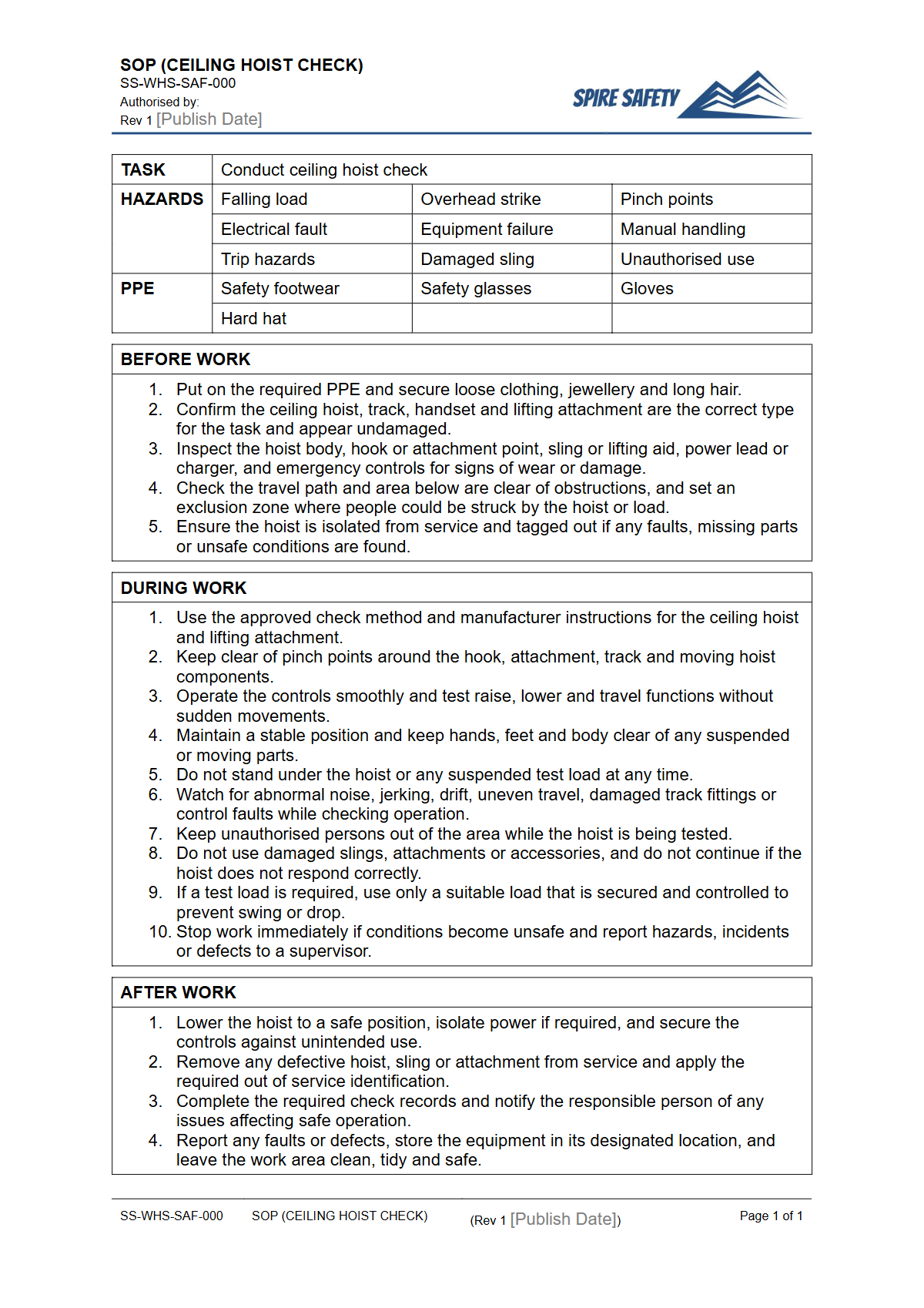
Need a Safe Operating Procedure for ceiling hoist checks? Our template provides a structured starting point for your workplace safety documentation.
Free Safe Operating Procedure (Ceiling Hoist Check) Template
DOCX • 126 KB + PDF
Updated Oct 2026
No signup required
Purpose of the Free Safe Operating Procedure (Ceiling Hoist Check) Template
This Free Safe Operating Procedure (Ceiling Hoist Check) Template provides a clear, structured framework for outlining the pre-use and periodic checks required for ceiling-mounted hoists. Ceiling hoists are critical pieces of equipment in healthcare, aged care, and disability support settings, used for lifting and transferring people with limited mobility.
Ensuring they are in safe working order is paramount to preventing catastrophic failures that could result in serious injury or death to both the person being lifted and the operator. This SOP template helps organisations document the required steps, from visual inspections of the hoist and sling to functional tests of the controls and safety features.
Implementing a formal procedure for these checks helps standardise the process, ensuring no steps are missed. It forms a key part of your risk management strategy for high-risk manual handling tasks, demonstrating a commitment to worker and client safety.
A documented SOP is also a fundamental component of larger, comprehensive WHS management systems, providing clear instructions and creating a record of safety-related activities. It helps meet your duty of care under Australian WHS legislation by providing a safe system of work.
Video walkthrough
How to use the Free Safe Operating Procedure (Ceiling Hoist Check) Template
This Safe Operating Procedure template is available for download as a fully editable DOCX file, with a PDF version also provided for easy printing and distribution. The template is designed as a starting point, pre-filled with common checks and safety considerations relevant to most ceiling hoist systems.
To make it effective for your workplace, you must conduct a thorough risk assessment and customise the document to reflect your specific equipment, environment, and operational procedures.
Pay close attention to the manufacturer’s operating manual for your specific hoist model and incorporate its unique requirements into the SOP. This includes details on weight limits, specific error codes, battery care, and emergency lowering procedures.
The process of tailoring this document is a valuable opportunity to engage with the workers who use the equipment daily. For organisations needing assistance with customisation or developing broader safety frameworks, our WHS consulting services can provide expert guidance.
Please note: this document is a template and must be customised for your specific workplace, equipment, and processes. We have included comments and placeholders to guide you in adapting the content to ensure it is relevant and effective for your organisation's needs.
When to use it
The procedures outlined in this SOP should be integrated into your daily and periodic safety routines. A competent operator must perform the pre-use checks specified in the SOP before the first lift of every shift or day.
This quick inspection ensures the equipment was not damaged or left in an unsafe state from previous use. More detailed periodic checks, also documented in the SOP, should be scheduled weekly or monthly, depending on frequency of use and manufacturer advice.
The SOP also serves as a critical training tool for new staff, ensuring they are competent in performing safety checks before being authorised to operate the equipment. Furthermore, the document is an essential reference during safety reviews and WHS compliance auditing to verify that procedures are established and followed.
Who should use it
This SOP is intended for use by all personnel involved with the use and maintenance of ceiling hoists. This includes, but is not limited to, nurses, personal care assistants (PCAs), disability support workers, and other healthcare professionals who operate the equipment.
Supervisors and managers should use the SOP to train staff and monitor compliance. Maintenance staff can use it to guide their inspection and servicing schedules.
WHS officers and safety committees will find the template useful for establishing and reviewing safety protocols as part of a wider safety management system. In a healthcare setting, having clear, accessible procedures is vital, just as it is for emergency equipment like having a Safe Operating Procedure for defibrillator operation.
All workers tasked with operating a ceiling hoist must receive training on the specific contents of the finalised SOP and be deemed competent before using the equipment unsupervised. The procedure should be readily accessible in the workplace, for instance, in a folder near the hoist charging station or in a digital document library.
For more guidance on documenting procedures for other common workplace equipment, you can explore our free WHS resources library for other templates and guides.
Common mistakes
Common mistakes to avoid
- Skipping pre-use visual inspections before a lift.
- Using a generic SOP without customising it for the specific hoist model and workplace environment.
- Neglecting to inspect or properly maintain lifting slings.
- Failing to document checks and maintenance activities, creating a gap in safety records.
Legal references
Legal considerations
The following legal requirements may be relevant to this type of work.
- Work Health and Safety Act (Harmonised) — Provides the primary duties for protecting workers and other people from work health and safety risks.
- Work Health and Safety Regulations (Harmonised) — Sets out requirements supporting the management of workplace hazards and risks.
The following codes may be relevant to this type of work.
- Managing WHS Risks Code of Practice — Provides practical guidance on identifying hazards, assessing risks and applying effective controls.
- Work Health and Safety Consultation, Cooperation and Coordination Code of Practice — Provides practical guidance on consulting workers and coordinating with other duty holders.
- Managing the Work Environment and Facilities Code of Practice — Provides practical guidance on safe work environments, workplace facilities and related controls.
Did you know
Lifting Slings Matter
Ceiling hoist slings have a limited lifespan and must be inspected before each use for frays, tears, and broken stitching. Using the wrong size or type of sling for a person or task can lead to serious injury.
Beyond the Hoist
The track and mounting system are just as critical as the hoist unit itself. Regular checks should include ensuring the track is securely fixed to its mounting points and is free from obstructions or damage.
FAQ
Frequently asked questions
01What is a Safe Operating Procedure for a ceiling hoist?
02How often should ceiling hoists be inspected?
03Is this ceiling hoist check SOP template suitable for my specific model?
04Who is responsible for ensuring ceiling hoist SOPs are followed?
Share this resource
Free Safe Operating Procedure (Ceiling Hoist Check) Template
Browse Categories
How To Use It
- 1Download and open in Word or PDF.
- 2Replace the placeholders with your business details.
- 3Get it reviewed by a WHS specialist before rollout.
Need it customised?
Our WHS consultants can adapt this template to your site, run a gap analysis, or audit what you already have in place.
Book a Free Consultation WHS consulting servicesor call 1300 156 382
Related templates
- Free Safe Operating Procedure (Ceiling Tile Cleaning) Template
- Free Safe Operating Procedure (Ceiling Track Check) Template
- Free Safe Operating Procedure (Cellar Cleaning) Template
- Free Safe Operating Procedure (Cellar Stock Handling) Template
- Free Safe Operating Procedure (Cemetery Grounds Care) Template
- Free Safe Operating Procedure (Centrifugal Pump) Template