
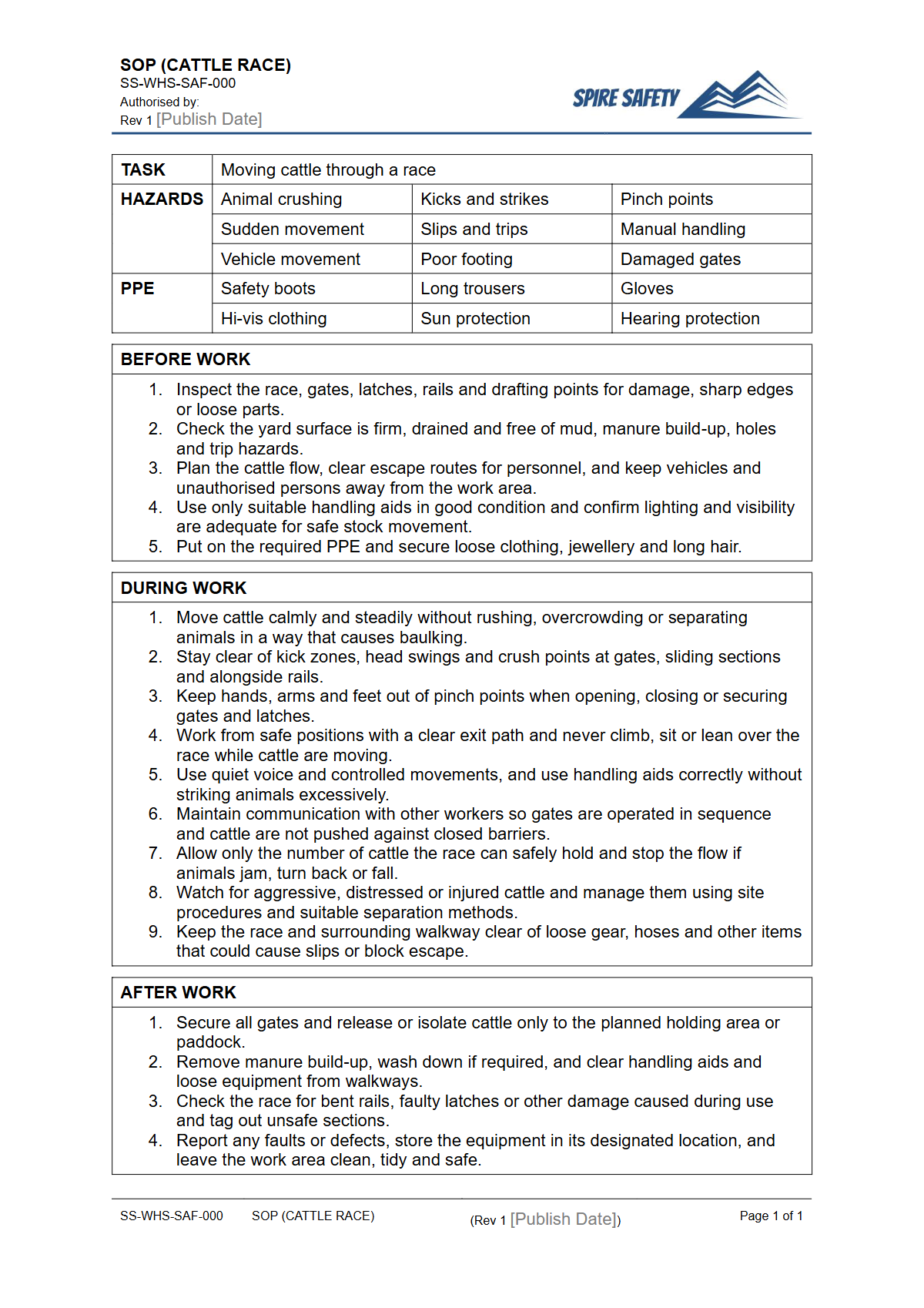
Free Safe Operating Procedure (Cattle Race) Template
Download our free Safe Operating Procedure (Cattle Race) Template for Australian agricultural businesses.
Free Safe Operating Procedure (Cattle Race) Template
DOCX • 126 KB + PDF
Updated Oct 2026
No signup required
Purpose of the Free Safe Operating Procedure (Cattle Race) Template
Working with livestock is inherently high-risk, and cattle races are a common site of serious incidents on Australian farms. This free Safe Operating Procedure (Cattle Race) Template provides a structured framework to document the hazards and control measures specific to your cattle handling operations.
A well-developed SOP is a critical tool for managing risks, ensuring workers understand safe work methods, and fulfilling your duty of care as a Person Conducting a Business or Undertaking (PCBU). By outlining step-by-step instructions, required Personal Protective Equipment (PPE), and emergency protocols, this document helps standardise safe behaviour and reduce the risk of injuries from crushing, kicking, or entrapment.
Using a documented procedure helps formalise your safety processes beyond verbal instructions. It serves as a consistent training resource for new and existing workers, ensuring everyone follows the same approved method for moving and handling cattle in the race.
This systematic approach is a cornerstone of effective on-farm safety and forms a vital part of broader comprehensive WHS management systems. It demonstrates a commitment to proactively managing risks associated with livestock handling, one of the leading causes of injury in the agricultural sector.
Video walkthrough
How to use the Free Safe Operating Procedure (Cattle Race) Template
This Safe Operating Procedure template is provided in both DOCX and PDF formats to serve as a starting point. It is not a complete, ready-to-use document.
To be effective and useful for your WHS obligations, you must customise it with details specific to your workplace. This includes identifying the make and model of your cattle race, detailing the specific hazards of your yard layout, and outlining the unique procedures your workers must follow.
Generic procedures are insufficient; your SOP must reflect the reality of your operations.
Important: This template is a guide. We are not your WHS consultants, and this document must be customised by a competent person to suit your specific site, equipment, and processes.
You must add your company name, ABN, and other details. Review the content and add or remove information to ensure it accurately reflects your work practices.
If you are unsure how to conduct a risk assessment or tailor this document, seeking specialist WHS consulting is strongly recommended to ensure your safety documentation is robust and fit for purpose.
When to use it
A Safe Operating Procedure for a cattle race should be used in several key situations. It is an essential tool for training new employees and for conducting periodic refresher training for experienced staff to prevent complacency.
It should be integrated into worker inductions for your farm or station. The SOP should be readily accessible near the cattle yards for quick reference before and during operations.
Furthermore, the development and review of the SOP are integral parts of the risk management process. It should be reviewed whenever you are conducting a WHS compliance audit, introducing a new cattle race system, modifying existing yards, or after any incident or near miss involving livestock handling.
Who should use it
This SOP is intended for all individuals involved in livestock handling on your property. This includes farm owners, station managers, supervisors, full-time and casual workers, contractors, and even family members who participate in yard work.
Managers and supervisors should use the SOP to train workers and monitor compliance with safe work practices. Workers and operators must use it to understand the approved, safe method for operating the cattle race, including pre-start checks, communication signals, and emergency shutdown procedures.
Everyone on site has a responsibility to follow established safety protocols to protect themselves and their workmates.
By ensuring everyone uses and understands the SOP, you create a consistent and predictable safety culture. This is crucial not just for cattle handling but for all high-risk tasks on a farm.
For example, similar documented procedures are vital for operating machinery, which is why we also offer resources like a free Grain Drill SOP template to help manage other common agricultural risks. Consistent documentation across different tasks reinforces the importance of a systematic approach to safety.
You can find more templates for various plant and equipment in our free WHS resources library to build a comprehensive set of safety documents for your business.
Common mistakes
Common mistakes to avoid
- Using the generic template without customising it for the specific cattle race and yard layout.
- Failing to train all workers, including casuals and contractors, on the finalised SOP.
- Not keeping the SOP in a location where workers can easily access it before a task.
- Forgetting to review and update the document after a near-miss or change in procedure.
Legal references
Legal considerations
The following legal requirements may be relevant to this type of work.
- Work Health and Safety Act (Harmonised) — Provides the primary duties for protecting workers and other people from work health and safety risks.
- Work Health and Safety Regulations (Harmonised) — Sets out requirements supporting the management of workplace hazards and risks.
The following codes may be relevant to this type of work.
- Managing WHS Risks Code of Practice — Provides practical guidance on identifying hazards, assessing risks and applying effective controls.
- Work Health and Safety Consultation, Cooperation and Coordination Code of Practice — Provides practical guidance on consulting workers and coordinating with other duty holders.
- Managing the Work Environment and Facilities Code of Practice — Provides practical guidance on safe work environments, workplace facilities and related controls.
Did you know
A High-Risk Industry
The agriculture, forestry and fishing industry has one of the highest rates of worker fatalities in Australia. According to Safe Work Australia, interactions with animals are a leading cause of serious injury claims on farms.
FAQ
Frequently asked questions
01What should be included in a Safe Operating Procedure for a cattle race?
02Is a SOP a legal requirement for using a cattle race in Australia?
03How often should a cattle race SOP be reviewed?
04Can I use this template for handling other livestock like sheep or horses?
Share this resource
Free Safe Operating Procedure (Cattle Race) Template
Browse Categories
How To Use It
- 1Download and open in Word or PDF.
- 2Replace the placeholders with your business details.
- 3Get it reviewed by a WHS specialist before rollout.
Need it customised?
Our WHS consultants can adapt this template to your site, run a gap analysis, or audit what you already have in place.
Book a Free Consultation WHS consulting servicesor call 1300 156 382
Related templates
- Free Safe Operating Procedure (Cattle Weighing) Template
- Free Safe Operating Procedure (Caustic Soda Handling) Template
- Free Safe Operating Procedure (CCTV Drain Camera) Template
- Free Safe Operating Procedure (CCTV Monitoring) Template
- Free Safe Operating Procedure (Ceiling Diffuser Clean) Template
- Free Safe Operating Procedure (Ceiling Grid Cleaning) Template