
Free Safe Operating Procedure (CCTV Monitoring) Template
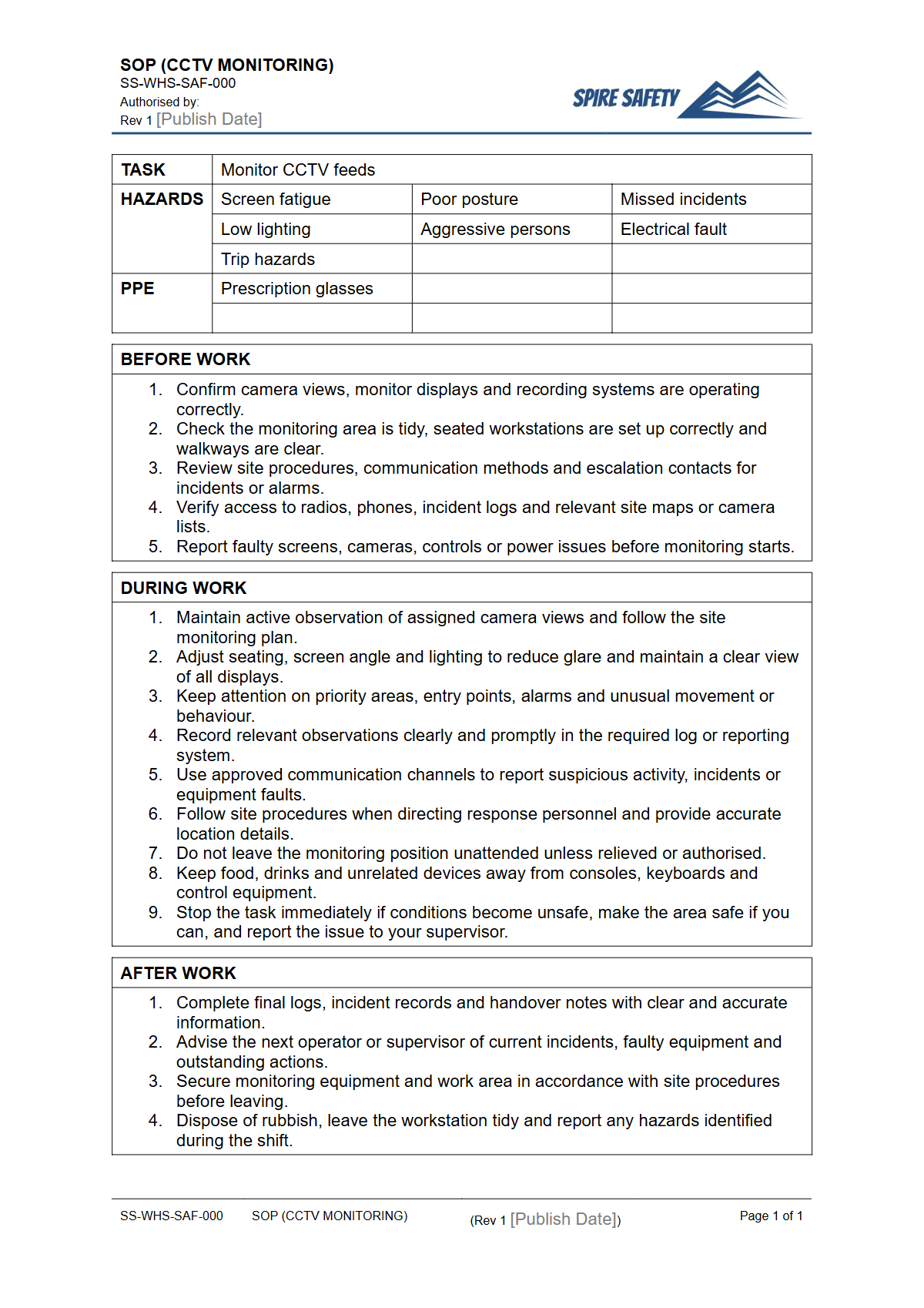
Download our free Safe Operating Procedure (CCTV Monitoring) template. This customisable DOCX & PDF provides a structured guide for Australian workplaces.
Free Safe Operating Procedure (CCTV Monitoring) Template
DOCX • 126 KB + PDF
Updated Oct 2026
No signup required
Purpose of the Free Safe Operating Procedure (CCTV Monitoring) Template
Effectively managing workplace surveillance requires clear, documented processes. This Free Safe Operating Procedure (CCTV Monitoring) Template provides a structured starting point for organisations to define the rules and responsibilities for using closed-circuit television systems.
It is designed to help you establish consistent practices for monitoring, data handling, and incident response, balancing security needs with crucial privacy obligations. A well-defined SOP ensures that CCTV is used ethically and lawfully, protecting both your people and your assets while minimising legal risks associated with workplace surveillance.
This document formalises the purpose of your CCTV system, whether for preventing theft, monitoring high-risk work areas, or ensuring public safety. It serves as a vital administrative control within your overall safety framework, outlining the 'how-to' for everyone involved.
Using this template helps create transparency and accountability, which are fundamental to building trust with employees and meeting regulatory expectations. It can be integrated into comprehensive WHS management systems to ensure alignment with broader safety goals and procedures.
Video walkthrough
How to use the Free Safe Operating Procedure (CCTV Monitoring) Template
Our Safe Operating Procedure template for CCTV monitoring is provided in both DOCX and PDF formats for your convenience. The DOCX file is fully editable, allowing you to tailor it to the specific context of your workplace, equipment, and legal environment. To effectively implement this SOP, follow these steps:
- Download and Review: Start by downloading the template and reviewing it with key stakeholders, such as security managers, WHS representatives, and department heads.
- Customise Key Details: Populate the document with specifics relevant to your organisation. This includes detailing camera locations, the explicit purpose for monitoring each area, authorised personnel who can access live and recorded footage, and the chain of command for reporting incidents.
- Define Data Handling Protocols: Clearly outline procedures for data storage duration, security measures to prevent unauthorised access, and the process for exporting or sharing footage for investigations, ensuring compliance with privacy laws.
- Train Relevant Personnel: Once finalised, ensure all personnel responsible for monitoring or managing the CCTV system are thoroughly trained on the procedures outlined in the SOP.
Important: This document is a template only. You must customise it to reflect your specific workplace hazards, state and territory regulations, and internal policies.
We are not responsible for the outcomes of its use; the person conducting a business or undertaking (PCBU) retains the responsibility to ensure a safe system of work.
When to use a CCTV Monitoring SOP
A Safe Operating Procedure for CCTV monitoring is essential whenever surveillance systems are deployed in a workplace. It formalises protocols for various scenarios, ensuring actions are consistent and justifiable.
Key situations include monitoring public-facing areas like entrances and reception desks to deter unauthorised access, and securing areas with high-value assets or sensitive information to prevent theft or damage. It is also critical for overseeing high-risk work environments where direct supervision is impractical, helping to review incidents and improve safety protocols.
Furthermore, an SOP governs the process for reviewing footage following a safety incident, workplace injury, or security breach. It provides a clear guide on how to access, save, and report on relevant footage without breaching privacy.
This documented process is invaluable during investigations, providing objective evidence. In the event of a medical emergency captured on camera, the SOP should also guide the response, which may include dispatching first aiders or activating equipment covered by a Safe Operating Procedure for defibrillator operation.
Who should use this Safe Operating Procedure
This SOP is intended for use by various personnel within an organisation to ensure a coordinated and compliant approach to CCTV management. The primary users are security personnel and control room operators who are tasked with the day-to-day monitoring of live feeds.
The SOP provides them with clear instructions on what to look for, how to respond to events, and how to escalate issues according to company policy. Their adherence to the procedure is critical for the system's effectiveness and legality.
WHS managers and officers should also use this document as a tool for risk management. They are often responsible for developing, implementing, and reviewing the SOP to ensure it aligns with WHS legislation and organisational goals.
Supervisors and line managers may also need to refer to the SOP when conducting incident investigations or addressing safety concerns in their teams. When monitoring high-risk plant like earthmoving equipment, this document should work in tandem with the equipment-specific guide, such as a dozer SOP, to provide a complete safety picture.
Finally, IT and data managers will use the SOP to guide their management of footage, ensuring secure storage and disposal.
Beyond equipment-specific instructions, many workplace procedures focus on common tasks and tools, and this SOP can be part of a library of documents that includes guides like a step ladder SOP. Regular reviews and WHS compliance audits can ensure all procedures, including this one, remain current and effective. You can find more templates like this in our free WHS resources library to build out your safety management documentation.
Common mistakes
Common mistakes to avoid
- Failing to install clear and visible signage informing people they are being recorded.
- Using recorded footage for a purpose other than what was stated (e.g., performance management).
- Implementing poor data security, leading to unauthorised access to sensitive footage.
- Neglecting to create, review, and update a formal CCTV policy or procedure.
Legal references
Legal considerations
The following legal requirements may be relevant to this type of work.
- Work Health and Safety Act (Harmonised) — Provides the primary duties for protecting workers and other people from work health and safety risks.
- Work Health and Safety Regulations (Harmonised) — Sets out requirements supporting the management of workplace hazards and risks.
The following codes may be relevant to this type of work.
- Managing WHS Risks Code of Practice — Provides practical guidance on identifying hazards, assessing risks and applying effective controls.
- Work Health and Safety Consultation, Cooperation and Coordination Code of Practice — Provides practical guidance on consulting workers and coordinating with other duty holders.
- Managing the Work Environment and Facilities Code of Practice — Provides practical guidance on safe work environments, workplace facilities and related controls.
Did you know
Privacy by Design
The Australian Privacy Act 1988 encourages a 'privacy by design' approach. This means organisations should build privacy considerations into their CCTV systems from the outset, rather than trying to add them on later.
State vs. Federal Law
While the federal Privacy Act applies to many private sector organisations, workplace surveillance is primarily governed by specific state and territory laws. This means compliance requirements can vary significantly depending on your location.
FAQ
Frequently asked questions
01What is the primary purpose of an SOP for CCTV monitoring?
02Are there legal requirements for displaying CCTV signs in Australia?
03How long should CCTV footage be kept?
04Can CCTV be used to monitor employee performance in Australia?
Share this resource
Free Safe Operating Procedure (CCTV Monitoring) Template
Browse Categories
How To Use It
- 1Download and open in Word or PDF.
- 2Replace the placeholders with your business details.
- 3Get it reviewed by a WHS specialist before rollout.
Need it customised?
Our WHS consultants can adapt this template to your site, run a gap analysis, or audit what you already have in place.
Book a Free Consultation WHS consulting servicesor call 1300 156 382
Related templates
- Free Safe Operating Procedure (Ceiling Diffuser Clean) Template
- Free Safe Operating Procedure (Ceiling Grid Cleaning) Template
- Free Safe Operating Procedure (Ceiling Hoist Check) Template
- Free Safe Operating Procedure (Ceiling Tile Cleaning) Template
- Free Safe Operating Procedure (Ceiling Track Check) Template
- Free Safe Operating Procedure (Cellar Cleaning) Template