
Free Safe Operating Procedure (CCTV Drain Camera) Template
Download our free Safe Operating Procedure (CCTV Drain Camera) template. This customisable DOCX & PDF helps you document safe work methods. Get started now.
Free Safe Operating Procedure (CCTV Drain Camera) Template
DOCX • 126 KB + PDF
Updated Oct 2026
No signup required
Purpose of the Free Safe Operating Procedure (CCTV Drain Camera) Template
Operating a CCTV drain camera involves navigating a unique set of workplace hazards. This equipment combines electrical components with work in potentially wet, confined, or biologically contaminated environments.
Our Free Safe Operating Procedure (CCTV Drain Camera) Template provides a structured starting point for your organisation to document a safe system of work for this task. It guides you in outlining the required steps, controls, and safety precautions to protect workers from risks such as electric shock, manual handling injuries, biological exposure, and slips, trips, and falls.
Developing a comprehensive SOP is a key part of demonstrating how your organisation meets its primary duty of care. This document helps standardise procedures, aids in worker training, and forms a critical component of your overall safety management framework.
By clearly defining the expected safe work practices, you reduce ambiguity and promote a consistent, safety-first approach to drain inspection tasks.
Video walkthrough
How to use the Free Safe Operating Procedure (CCTV Drain Camera) Template
This template is provided in both DOCX and PDF formats for your convenience. The DOCX file is fully editable, allowing you to tailor the content to your specific operational needs.
To use it effectively, download the document and methodically work through each section, adding or removing information to reflect your workplace's unique circumstances, the specific model of CCTV camera in use, and the types of environments your team operates in. For instance, procedures for inspecting a domestic sewer line will differ from those for a large-diameter stormwater drain on a construction site.
Important: This is a template, not a finished document. You must customise it to your specific equipment, site conditions, and legal obligations.
We are not liable for any incidents that may arise from the use of this document. It is your responsibility to ensure the final SOP is accurate, comprehensive, and suitable for your workplace.
Integrating this SOP into your broader WHS management systems ensures it doesn't exist in isolation but works alongside risk assessments and training records.
What's covered in the SOP template?
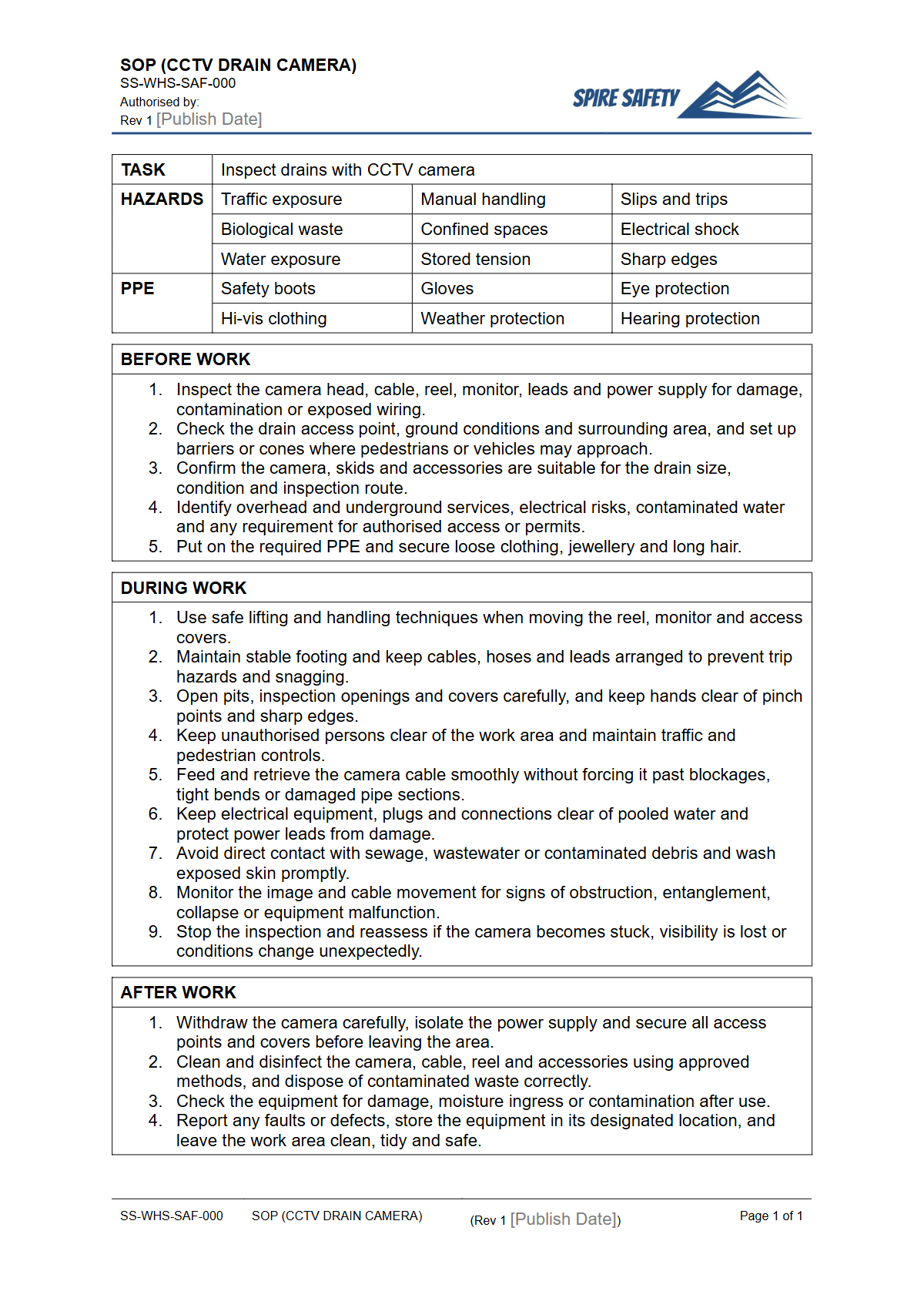
This Safe Operating Procedure template provides a logical structure for documenting the end-to-end process of using a CCTV drain camera. It is organised to be clear and easy for operators to follow. Key sections include:
- PPE Requirements: Lists the personal protective equipment necessary for the task, such as waterproof gloves, safety glasses, and non-slip, steel-capped boots.
- Pre-Operational Checks: Details the safety and functional checks to be completed before starting work. This includes inspecting the push rod for damage, checking the camera head, and verifying the functionality of the power source and any associated RCDs (Residual Current Devices).
- Step-by-Step Operating Sequence: Provides a logical flow for performing the task safely, from site assessment and setup to camera insertion, inspection, retrieval, and pack-up.
- Potential Hazards & Control Measures: A risk-focused section for you to outline specific hazards (e.g., electrical, biological, ergonomic, confined spaces) and the corresponding controls.
- Cleaning and Maintenance: Outlines procedures for cleaning and disinfecting the equipment after use to prevent cross-contamination and prolong its operational life.
- Emergency Procedures: Covers immediate actions to take in case of an incident, such as electric shock or exposure to hazardous substances. For serious medical events, having a clear plan is critical, which could include using equipment detailed in a Safe Operating Procedure for Defibrillator Operation.
When should you use this SOP?
A Safe Operating Procedure for CCTV drain cameras should be used every time the equipment is deployed. It serves as a practical guide for operators and a reference for supervisors. It is particularly important during:
- Routine preventative maintenance inspections of sewer and stormwater systems.
- Diagnostic work to identify the cause and location of blockages or pipe damage.
- Pre-purchase property inspections to assess the condition of underground drainage.
- Post-construction verification to confirm new drainage has been installed correctly.
- Any excavation work that may involve digging near existing pipes, where a similar documented process like a free Trencher SOP template would also be essential.
Who should use this Safe Operating Procedure?
This SOP is intended for any person required to operate CCTV drain inspection equipment. This includes, but is not limited to, licensed plumbers, drainage technicians, council maintenance workers, utility locators, and civil construction workers. Beyond the operator, the document is also a valuable tool for:
- Supervisors and Managers: To assist in monitoring compliance, conducting workplace inspections, and delivering toolbox talks. Regular reviews of procedures like this can be integrated into scheduled WHS compliance audits.
- Training Coordinators: To use as a foundational document for training and competency assessments for new and existing employees.
- WHS Professionals: To incorporate into the organisation’s overall risk management framework.
Using any equipment safely requires competence. Workers should always be trained not only on the SOP but also on the specific manufacturer's instructions for the camera model they are using.
In some situations, access to drainage pits or manholes may require the use of ladders, and a corresponding Step Ladder SOP template should also be consulted. For more templates and safety resources, feel free to browse our complete free WHS resources library.
Common mistakes
Common mistakes to avoid
- Failing to use a portable RCD (Residual Current Device) for mains-powered units, especially in wet areas.
- Neglecting to assess and control confined space risks before a person enters a manhole or deep pit.
- Inadequate cleaning and disinfection of the push rod and camera head after use, posing a biological hazard.
- Allowing untrained or inexperienced workers to operate the equipment without direct supervision.
Legal references
Legal considerations
The following legal requirements may be relevant to this type of work.
- Work Health and Safety Act (Harmonised) — Provides the primary duties for protecting workers and other people from work health and safety risks.
- Work Health and Safety Regulations (Harmonised) — Sets out requirements supporting the management of workplace hazards and risks.
The following codes may be relevant to this type of work.
- Managing WHS Risks Code of Practice — Provides practical guidance on identifying hazards, assessing risks and applying effective controls.
- Work Health and Safety Consultation, Cooperation and Coordination Code of Practice — Provides practical guidance on consulting workers and coordinating with other duty holders.
- Managing the Work Environment and Facilities Code of Practice — Provides practical guidance on safe work environments, workplace facilities and related controls.
Did you know
Early Innovation
The first 'drain camera' was developed in the 1950s by an English engineer, essentially a standard film camera in a waterproof housing that was pulled through pipes.
Preventative Value
Modern CCTV drain cameras can identify issues like root intrusion, pipe collapse, and developing blockages, saving property owners thousands in potential repair and excavation costs.
FAQ
Frequently asked questions
01What are the main hazards when using a CCTV drain camera?
02Is a Safe Operating Procedure legally required for CCTV drain cameras in Australia?
03How often should an SOP for a CCTV drain camera be reviewed?
04Can this template be used for other types of inspection cameras, like pole cameras?
Share this resource
Free Safe Operating Procedure (CCTV Drain Camera) Template
Browse Categories
How To Use It
- 1Download and open in Word or PDF.
- 2Replace the placeholders with your business details.
- 3Get it reviewed by a WHS specialist before rollout.
Need it customised?
Our WHS consultants can adapt this template to your site, run a gap analysis, or audit what you already have in place.
Book a Free Consultation WHS consulting servicesor call 1300 156 382
Related templates
- Free Safe Operating Procedure (CCTV Monitoring) Template
- Free Safe Operating Procedure (Ceiling Diffuser Clean) Template
- Free Safe Operating Procedure (Ceiling Grid Cleaning) Template
- Free Safe Operating Procedure (Ceiling Hoist Check) Template
- Free Safe Operating Procedure (Ceiling Tile Cleaning) Template
- Free Safe Operating Procedure (Ceiling Track Check) Template