
Free Verification of Competency (Concrete Scarifier) Template
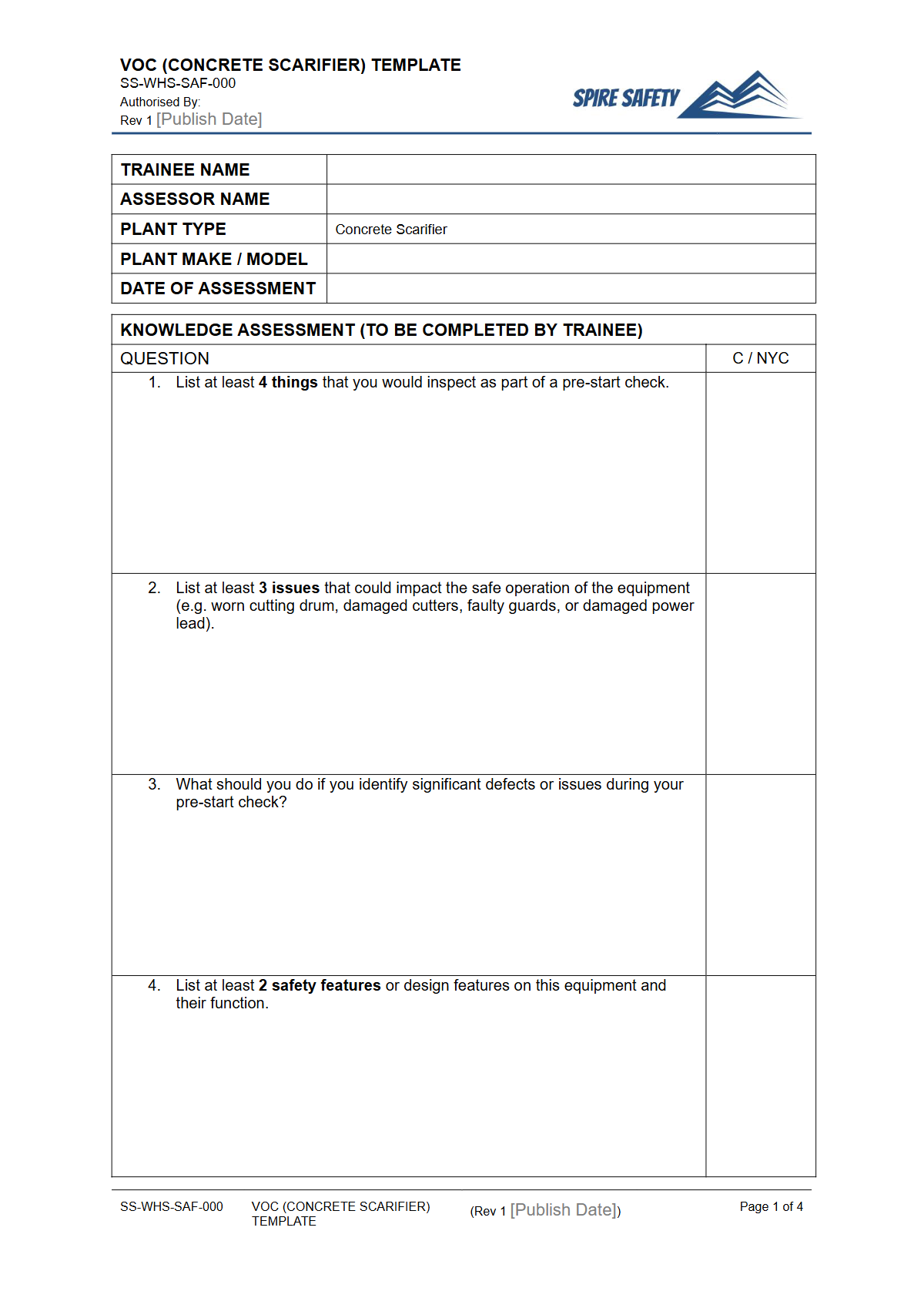
Download our Free Verification of Competency (Concrete Scarifier) Template. This DOCX and PDF resource helps assess operator skills and safety knowledge.
Free Verification of Competency (Concrete Scarifier) Template
DOCX • 138 KB + PDF
Updated Oct 2026
No signup required
Purpose of the Free Verification of Competency (Concrete Scarifier) Template
Operating a concrete scarifier, also known as a floor planer or milling machine, involves significant risks, including exposure to crystalline silica dust, high noise levels, and hand-arm vibration. This Free Verification of Competency (Concrete Scarifier) Template provides a structured framework for employers and Persons Conducting a Business or Undertaking (PCBUs) to confirm that their workers have the necessary skills and knowledge to operate this equipment safely.
A Verification of Competency (VOC) is a practical assessment used to verify that an individual can perform their tasks to the required standard in a work environment. It is a critical component of ensuring workplace safety and meeting WHS obligations.
The template is designed as a starting point, aligned with Australian WHS principles, to help you document the assessment process. It guides the assessor through key performance criteria, from pre-start inspections and hazard identification to correct operational techniques and shutdown procedures.
Using this document helps create a formal record that a worker’s competence has been verified, which is essential for due diligence. Similar principles apply when assessing operators of other concrete-related equipment, as detailed in our Verification of Competency for a cement mixer.
Video walkthrough
How to use the Free Verification of Competency (Concrete Scarifier) Template
After downloading the template in your preferred format (DOCX or PDF), you must adapt it to your specific operational needs. The assessor, a person with expertise and experience on concrete scarifiers, should use the document to guide their observation of the operator.
The process generally involves:
- Reviewing the criteria: The assessor familiarises themselves with the checklist items covering knowledge, skills, and safety behaviour.
- Customising the document: IMPORTANT: We have provided a general template; you must customise it to reflect your specific machinery, site conditions, Safe Work Method Statements (SWMS), and internal procedures. Add or remove criteria to ensure it is fit for your workplace.
- Conducting the assessment: The assessor observes the worker performing all relevant tasks in a real or simulated work environment. This includes questioning the operator on hazard awareness, such as managing silica dust and using personal protective equipment (PPE).
- Documenting the outcome: The assessor records their findings, notes any performance gaps, and provides feedback. The completed form should be signed by both the assessor and the operator and retained as a workplace record.
The goal is not just to tick boxes but to have a meaningful confirmation of competence. If gaps are identified, further training or supervision may be required before the worker is deemed competent.
For broader support in establishing these processes, consider engaging our expert WHS consulting services.
When to use it
A VOC for a concrete scarifier should be conducted at several key points to maintain a safe system of work. It is not a one-time event. Consider using this template in the following situations:
- Pre-employment or mobilisation: To verify the skills and claims of new workers before they start work on your site.
- Introduction of new equipment: When a new make or model of scarifier with different features or controls is introduced.
- Post-incident: Following an incident or near-miss involving a concrete scarifier to identify and correct any unsafe behaviours or knowledge gaps.
- Periodic re-assessment: As part of a regular schedule (e.g., every 2-3 years) to ensure skills have not degraded over time.
Regularly scheduled VOCs form a vital part of ongoing safety management and are often reviewed during formal WHS compliance audits to demonstrate proactive risk management.
Who should use it
This template is intended for use by individuals responsible for workplace safety and operator competence. This typically includes:
- Supervisors and Site Foremen: Those who directly oversee operators on construction sites or in workshops and are responsible for authorising them to use equipment.
- WHS Managers and Advisors: Safety professionals tasked with developing, implementing, and monitoring safety procedures and competency frameworks.
- Internal Trainers and Assessors: Designated experienced personnel within an organisation who are qualified to assess the competence of their colleagues.
The person conducting the VOC must be competent themselves—they should possess extensive experience with the specific plant and a thorough understanding of the associated hazards and control measures. The effective use of VOCs is a cornerstone of robust WHS management systems, demonstrating a commitment to worker safety beyond basic training. This structured approach is also valuable for other surface preparation tools, like the equipment covered in our free Pressure Cleaner VOC.
This template is just one of many tools available. You can browse our complete free WHS resources library for a wide range of checklists, forms, and guides to support your safety objectives.
Common mistakes
Common mistakes to avoid
- Treating the VOC as a 'tick and flick' exercise without meaningful observation.
- Failing to customise the template to the specific make/model of scarifier and site conditions.
- Using an assessor who lacks sufficient expertise or experience with the equipment.
- Neglecting to document the assessment outcome and failing to retain it as a formal record.
Legal references
Legal considerations
The following legal requirements may be relevant to this type of work.
- Work Health and Safety Act (Harmonised) — Provides the primary duties for protecting workers and other people from work health and safety risks.
- Work Health and Safety Regulations (Harmonised) — Sets out requirements supporting the management of workplace hazards and risks.
The following codes may be relevant to this type of work.
- Managing WHS Risks Code of Practice — Provides practical guidance on identifying hazards, assessing risks and applying effective controls.
- Work Health and Safety Consultation, Cooperation and Coordination Code of Practice — Provides practical guidance on consulting workers and coordinating with other duty holders.
- Managing the Work Environment and Facilities Code of Practice — Provides practical guidance on safe work environments, workplace facilities and related controls.
Did you know
Silica Dust Hazard
Concrete scarifying can generate high concentrations of respirable crystalline silica (RCS). The Australian workplace exposure standard for RCS is a time-weighted average of 0.05 mg/m³ over eight hours, making dust suppression and respiratory protection critical.
Vibration Risk
Prolonged use of concrete scarifiers can expose operators to significant hand-arm vibration, potentially leading to Hand-Arm Vibration Syndrome (HAVS). This condition causes damage to nerves, blood vessels, and joints in the hands and arms.
FAQ
Frequently asked questions
01What is a Verification of Competency for a concrete scarifier?
02Is a VOC the same as a training course or a licence?
03How often should a concrete scarifier VOC be conducted?
04Who is qualified to conduct a VOC for a concrete scarifier?
Share this resource
Free Verification of Competency (Concrete Scarifier) Template
Browse Categories
How To Use It
- 1Download and open in Word or PDF.
- 2Replace the placeholders with your business details.
- 3Get it reviewed by a WHS specialist before rollout.
Need it customised?
Our WHS consultants can adapt this template to your site, run a gap analysis, or audit what you already have in place.
Book a Free Consultation WHS consulting servicesor call 1300 156 382
Related templates
- Free Verification of Competency (Concrete Screed) Template
- Free Verification of Competency (Crawler Crane) Template
- Free Verification of Competency (Dewatering Pump) Template
- Free Verification of Competency (Drum Lifter) Template
- Free Verification of Competency (Drum Trolley) Template
- Free Verification of Competency (Dry Ice Blaster) Template