
Free Verification of Competency (Drum Trolley) Template
Assess drum trolley operator skills with our free VOC template. This customisable DOCX & PDF helps meet WHS duties for safe manual handling.
Free Verification of Competency (Drum Trolley) Template
DOCX • 140 KB + PDF
Updated Oct 2026
No signup required
Purpose of the Free Verification of Competency (Drum Trolley) Template
Handling heavy and often hazardous drums presents significant manual handling risks, including musculoskeletal injuries, crush injuries, and chemical spills. A person conducting a business or undertaking (PCBU) has a primary duty of care to ensure workers are competent to perform their tasks safely.
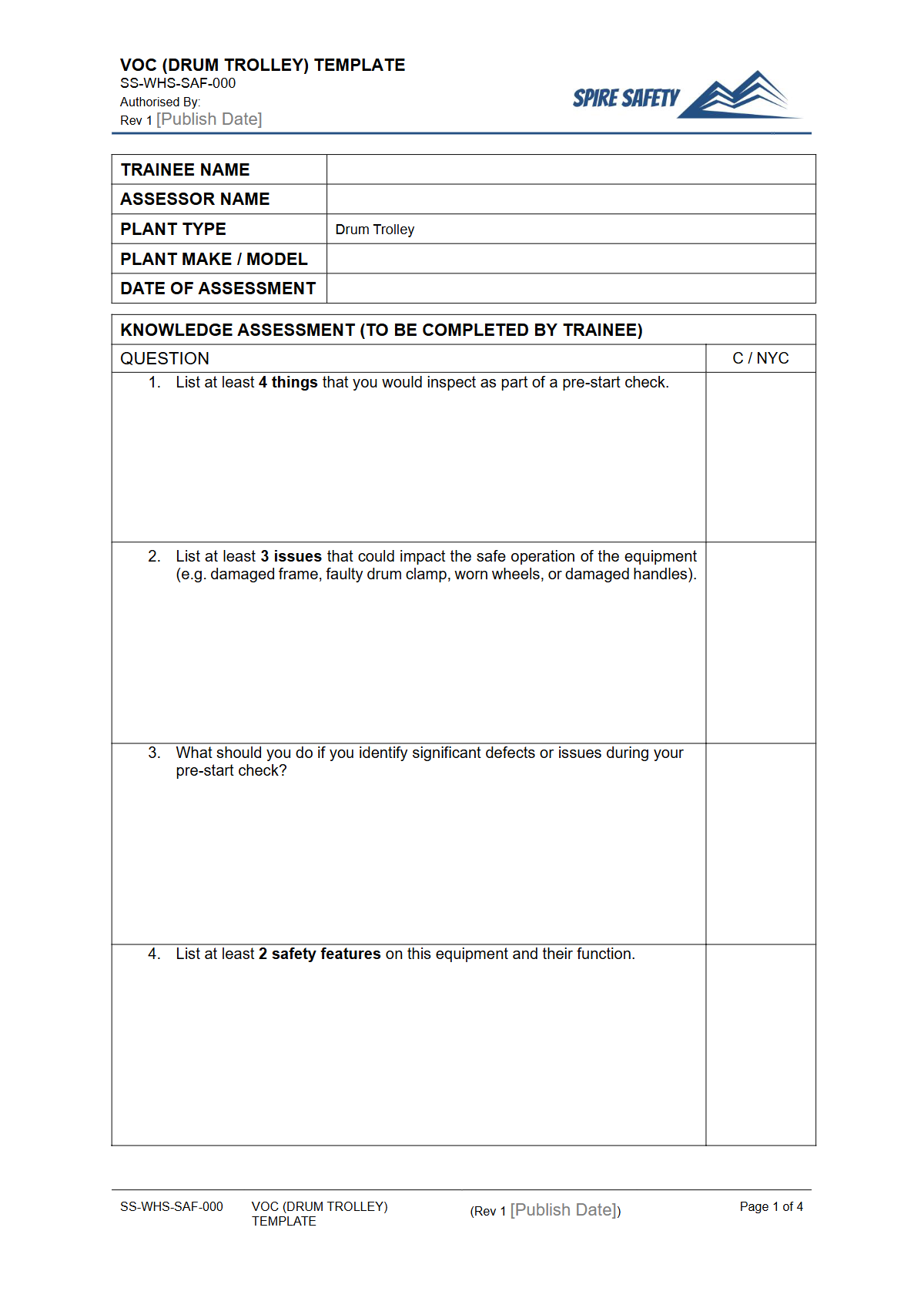
This free Verification of Competency (Drum Trolley) Template provides a structured framework for assessing and documenting an operator's ability to use a drum trolley safely and effectively.
Using this template helps formalise the assessment process, ensuring that key safety criteria are consistently evaluated. It serves as a practical tool to confirm that workers not only have the theoretical knowledge but also the practical skill to manage loads, navigate obstacles, and respond to potential issues.
Integrating such processes is a fundamental part of robust WHS management systems, providing clear evidence of your organisation's commitment to proactive risk management.
Video walkthrough
How to use the Free Verification of Competency (Drum Trolley) Template
This template is designed for straightforward implementation. It combines a knowledge assessment with a practical observation checklist to provide a holistic view of a worker's competency.
The process typically involves an experienced assessor observing the worker perform tasks with the drum trolley in their usual work environment.
Key steps for use:
- Download: Get the template in your preferred format (DOCX for easy editing or PDF).
- Customise: Adapt the checklist to suit the specific types of drum trolleys and drums used on your site (e.g., two-wheel, four-wheel, hydraulic clamp models), the materials being handled, and your site-specific procedures.
- Assess: A competent person observes the operator performing tasks listed in the checklist, from pre-start inspections to securing, moving, and placing the drum.
- Document: Record the outcomes directly on the form. The assessor should provide clear feedback, noting areas of strength and any areas requiring further training.
- Action Plan: If a worker is deemed 'Not Yet Competent' in any area, document the required corrective actions, such as further training or supervision, and schedule a re-assessment.
Important Note: This document is a starting-point template. You must customise it to reflect your specific equipment, workplace hazards, and operational procedures.
We provide a structured guide, but the responsibility for ensuring it is fit-for-purpose for your organisation rests with you.
When to Conduct a VOC
A Verification of Competency is not just a one-time event. It should be conducted at various points to ensure ongoing safety and skill retention. Consider using this template in the following situations:
- Pre-employment or role change: To verify the skills of new employees or existing workers moving into a role that requires using a drum trolley.
- Introduction of new equipment: When a new make or model of drum trolley is introduced to the workplace.
- Post-incident: Following an incident or near-miss involving a drum trolley, to identify any competency gaps that may have contributed.
- Periodic re-assessment: As part of a regular schedule (e.g., every 2-3 years) to confirm skills have been maintained, based on your own risk assessment.
- Identified performance issues: If a supervisor observes unsafe or incorrect use of the equipment.
Regularly scheduled assessments and the records they produce are often reviewed during a WHS compliance auditing process to demonstrate proactive management of worker competency.
Who Should Use This Template
This template is intended for use by individuals responsible for workplace safety and operational supervision. This includes:
- Work Health and Safety (WHS) Advisors and Managers
- Supervisors and Team Leaders
- Operations and Warehouse Managers
- Trainers and Assessors
Crucially, the person conducting the verification must be competent themselves. This means they should have extensive experience with the specific drum trolley, a thorough understanding of the associated risks, and the ability to assess performance objectively.
If you lack this internal expertise, engaging external support through WHS consulting can provide the necessary capability to conduct valid and reliable assessments.
Key Assessment Criteria
A thorough assessment goes beyond simply watching someone push a trolley. The template prompts the assessor to look for specific, safety-critical behaviours, including:
- Pre-operational checks: Inspecting the trolley's frame, wheels, axles, and clamping/securing mechanism for damage or defects before use.
- Load management: Correctly approaching the drum, engaging the securing mechanism, and using proper technique to 'break back' the load with minimal strain.
- Manoeuvring and travel: Maintaining control of the load, choosing safe travel paths, managing gradients, and demonstrating awareness of other personnel and vehicle traffic. This is as important for trolleys as it is for larger plant, such as that covered in our Verification of Competency (Rough Terrain Forklift) template.
- Unloading: Carefully lowering the drum to a stable, designated position without risk of it tipping.
Just as with other common workshop equipment, ensuring correct and safe use is paramount. Our Free Pressure Cleaner VOC (Verification of Competency) Template offers another example of how specific operational skills can be verified. You can find many more templates like this in our free WHS resources library.
Common mistakes
Common mistakes to avoid
- Using a generic checklist that doesn't match the specific drum trolley model or task.
- Having an assessor who lacks deep practical experience with the equipment.
- Treating the VOC as a paperwork exercise without genuine, thorough observation of the task.
- Failing to document and follow up on corrective actions for 'Not Yet Competent' findings.
Legal references
Legal considerations
The following legal requirements may be relevant to this type of work.
- Work Health and Safety Act (Harmonised) — Provides the primary duties for protecting workers and other people from work health and safety risks.
- Work Health and Safety Regulations (Harmonised) — Sets out requirements supporting the management of workplace hazards and risks.
The following codes may be relevant to this type of work.
- Managing WHS Risks Code of Practice — Provides practical guidance on identifying hazards, assessing risks and applying effective controls.
- Work Health and Safety Consultation, Cooperation and Coordination Code of Practice — Provides practical guidance on consulting workers and coordinating with other duty holders.
- Managing the Work Environment and Facilities Code of Practice — Provides practical guidance on safe work environments, workplace facilities and related controls.
Did you know
Manual Handling Risk
Musculoskeletal disorders (MSDs) from hazardous manual tasks are a leading cause of serious workers' compensation claims in Australia. Using mechanical aids like drum trolleys is a key engineering control to mitigate this risk.
Weight Matters
A standard 205-litre (44-gallon) steel drum can weigh over 250kg when full. This makes mechanical assistance not just a convenience, but an essential safety measure to prevent serious strain and crush injuries.
FAQ
Frequently asked questions
01What is a Verification of Competency (VOC)?
02Is a VOC for a drum trolley the same as a licence?
03How often should a drum trolley VOC be conducted?
04Who is considered a 'competent person' to conduct a drum trolley VOC?
Share this resource
Free Verification of Competency (Drum Trolley) Template
Browse Categories
How To Use It
- 1Download and open in Word or PDF.
- 2Replace the placeholders with your business details.
- 3Get it reviewed by a WHS specialist before rollout.
Need it customised?
Our WHS consultants can adapt this template to your site, run a gap analysis, or audit what you already have in place.
Book a Free Consultation WHS consulting servicesor call 1300 156 382
Related templates
- Free Verification of Competency (Dry Ice Blaster) Template
- Free Verification of Competency (Engine Hoist) Template
- Free Verification of Competency (Glass Lifter) Template
- Free Verification of Competency (Grapple Attachment) Template
- Free Verification of Competency (Hydraulic Breaker Attachment) Template
- Free Verification of Competency (Hydraulic Jack) Template