
Free Verification of Competency (Engine Hoist) Template
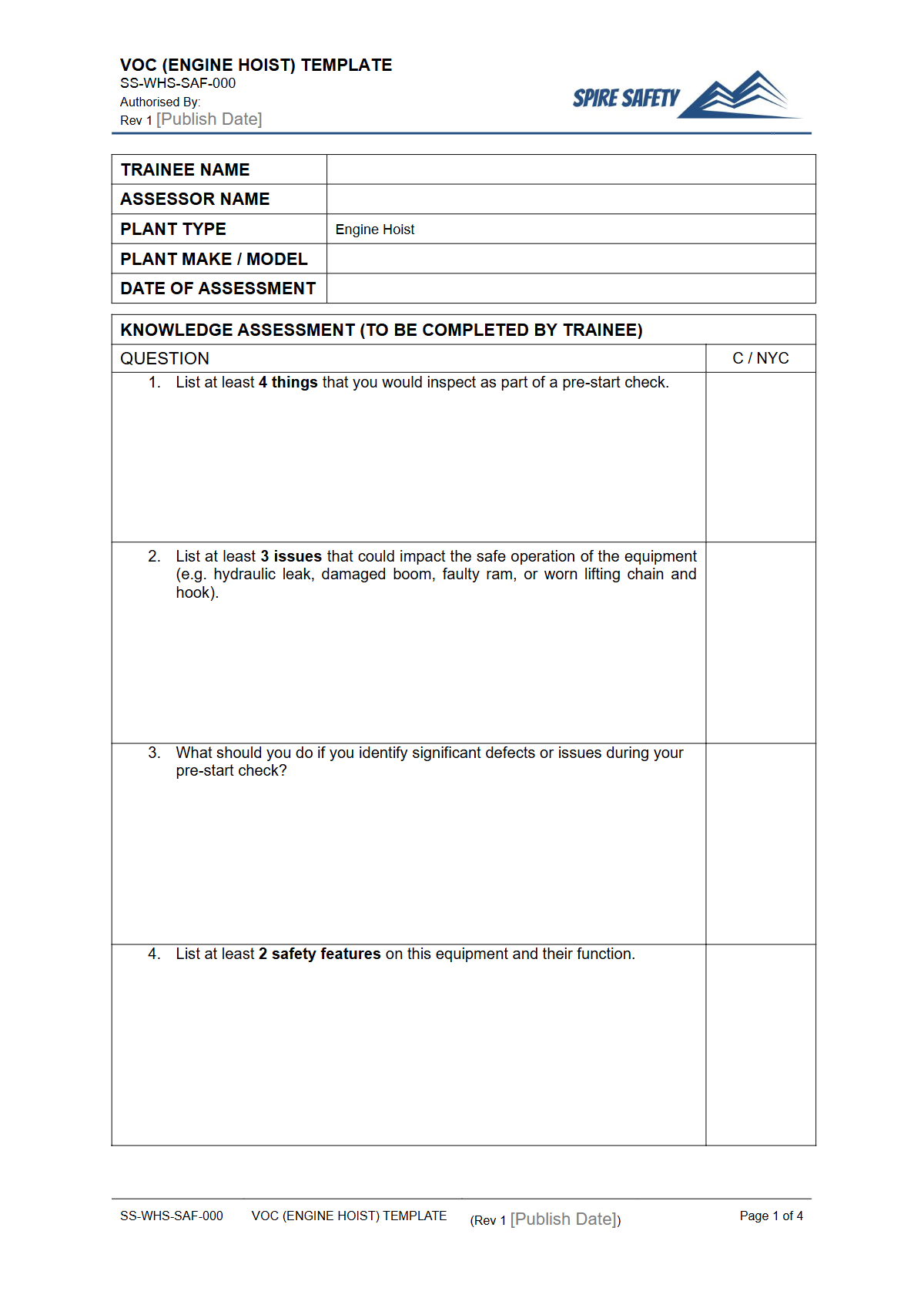
Download our free Verification of Competency (Engine Hoist) template. This DOCX & PDF resource helps assess operator skill and safety knowledge.
Free Verification of Competency (Engine Hoist) Template
DOCX • 140 KB + PDF
Updated Oct 2026
No signup required
Purpose of the Free Verification of Competency (Engine Hoist) Template
This Free Verification of Competency (Engine Hoist) Template provides a structured framework for Persons Conducting a Business or Undertaking (PCBUs) to confirm that a worker can operate an engine hoist safely and competently. A Verification of Competency (VOC) is not a training exercise; it is an assessment of skill and knowledge that takes place after training has been completed.
It is a critical tool for managing risks associated with plant and equipment in the workplace.
Using an engine hoist involves significant risks, including dropped loads, crushing injuries, hydraulic failure, and entanglement. This template helps an assessor systematically observe an operator’s performance against key safety and operational criteria, ensuring they understand pre-use checks, load limits, correct slinging techniques, and safe operating procedures.
The document is designed as a practical starting point, aligned with the principles of Australia's model WHS framework, to help you formalise your competency verification process. For other common workshop tools, our Free Drill Press VOC (Verification of Competency) Template provides a similar structure.
Video walkthrough
How to use the Free Verification of Competency (Engine Hoist) Template
Using this template involves a straightforward process designed to create a clear record of assessment. First, download the template in your preferred format (DOCX for easy editing or PDF).
Before use, it is essential to tailor the document to your specific needs. The assessor should then brief the operator on the process, explaining that their skills are being verified against established safe work procedures.
The core of the process involves the assessor observing the operator perform a range of tasks with the engine hoist, from pre-start inspections to lifting, moving, and lowering a load. The assessor uses the checklist to record observations, noting areas of competence and any areas requiring further training.
Upon completion, both the assessor and the operator should sign the form to acknowledge the outcome. These records are a valuable component of your safety documentation and demonstrate due diligence in managing worker competency.
Please note: This is a template resource. It is not a complete, out-of-the-box solution.
We have designed it as a starting point that you must customise to reflect your specific workplace, the exact model of engine hoist used, your internal procedures, and the unique risks present in your operational environment.
Integrating VOCs into Your Safety Framework
Isolated checklists are less effective than those integrated into a comprehensive safety system. A Verification of Competency program should be a key component of your broader WHS management systems. Integrating VOCs ensures that competency is managed systematically alongside hazard reporting, incident investigation, and safe work procedures, creating a more robust safety culture within the organisation.
When to conduct a VOC
A Verification of Competency for an engine hoist is not a one-time event. It should be conducted at several key points to ensure ongoing safety. These include:
- Pre-employment or role change: To verify the skills of new employees or workers moving into a role that requires use of an engine hoist.
- Introduction of new equipment: When a new make or model of engine hoist is introduced to the workplace, as controls and capacities may differ.
- Post-incident: Following an incident or near-miss involving the equipment to identify and address any competency gaps.
- Identified performance issues: If a supervisor or colleague observes an operator performing a task unsafely or incorrectly.
- As part of a regular schedule: Many organisations conduct VOCs at regular intervals (e.g., every 1-2 years) as part of their standard safety assurance activities. Findings from a WHS compliance auditing process may also trigger a need for widespread competency verification.
While engine hoists handle specific loads, workshops often require verification for other equipment. For example, assessing skills for using handheld powered tools is also crucial, for which our Verification of Competency for a Wrecker or Impact Wrench can be adapted.
Who should conduct the assessment
The credibility and effectiveness of a VOC depend entirely on the person conducting it. The assessor must be a competent person, meaning they have the necessary knowledge, skills, and experience to make a sound judgement about the operator's abilities. This individual could be:
- An experienced supervisor or leading hand with extensive knowledge of the specific engine hoist.
- An internal WHS advisor or training officer.
- An external consultant or third-party assessor with verifiable expertise.
Crucially, the assessor must not only be proficient in operating the equipment themselves but also understand the principles of assessment and be able to provide clear, constructive feedback. If your organisation lacks this internal expertise, engaging external WHS consulting services can provide the necessary competence and impartiality.
In settings where larger components are moved, it's also important to verify skills on associated machinery, such as that covered in our Verification of Competency (Rough Terrain Forklift) template.
For more templates and safety resources covering a wide range of plant, equipment, and high-risk work, browse our complete free WHS resources library.
Common mistakes
Common mistakes to avoid
- Using a generic VOC checklist that doesn't match the specific make and model of the engine hoist.
- The assessor not being competent or experienced enough with the equipment to make a valid judgement.
- Treating the VOC as a tick-box exercise without providing genuine observation and feedback.
- Failing to formally record the outcome and any required corrective actions, such as refresher training.
Legal references
Legal considerations
The following legal requirements may be relevant to this type of work.
- Work Health and Safety Act (Harmonised) — Provides the primary duties for protecting workers and other people from work health and safety risks.
- Work Health and Safety Regulations (Harmonised) — Sets out requirements supporting the management of workplace hazards and risks.
The following codes may be relevant to this type of work.
- Managing WHS Risks Code of Practice — Provides practical guidance on identifying hazards, assessing risks and applying effective controls.
- Work Health and Safety Consultation, Cooperation and Coordination Code of Practice — Provides practical guidance on consulting workers and coordinating with other duty holders.
- Managing the Work Environment and Facilities Code of Practice — Provides practical guidance on safe work environments, workplace facilities and related controls.
Did you know
The Weakest Link
The Working Load Limit (WLL) of any lifting setup is determined by its weakest component. This includes not just the hoist itself, but also the slings, shackles, and attachment points, all of which must be inspected before each use.
Creeping Failure
Hydraulic 'creep' or 'drift' is a common issue where a raised load slowly lowers on its own due to internal leaks in the hydraulic cylinder. A key part of any pre-use check is to test for this under a light load before lifting a heavy component.
FAQ
Frequently asked questions
01What is a Verification of Competency for an engine hoist?
02Is a VOC the same as a licence for an engine hoist?
03How often should engine hoist VOCs be conducted?
04Can this template be used for other types of lifting equipment?
Share this resource
Free Verification of Competency (Engine Hoist) Template
Browse Categories
How To Use It
- 1Download and open in Word or PDF.
- 2Replace the placeholders with your business details.
- 3Get it reviewed by a WHS specialist before rollout.
Need it customised?
Our WHS consultants can adapt this template to your site, run a gap analysis, or audit what you already have in place.
Book a Free Consultation WHS consulting servicesor call 1300 156 382
Related templates
- Free Verification of Competency (Glass Lifter) Template
- Free Verification of Competency (Grapple Attachment) Template
- Free Verification of Competency (Hydraulic Breaker Attachment) Template
- Free Verification of Competency (Hydraulic Jack) Template
- Free Verification of Competency (Hydraulic Press) Template
- Free Verification of Competency (Industrial Vacuum) Template