
Free Verification of Competency (Hydraulic Press) Template
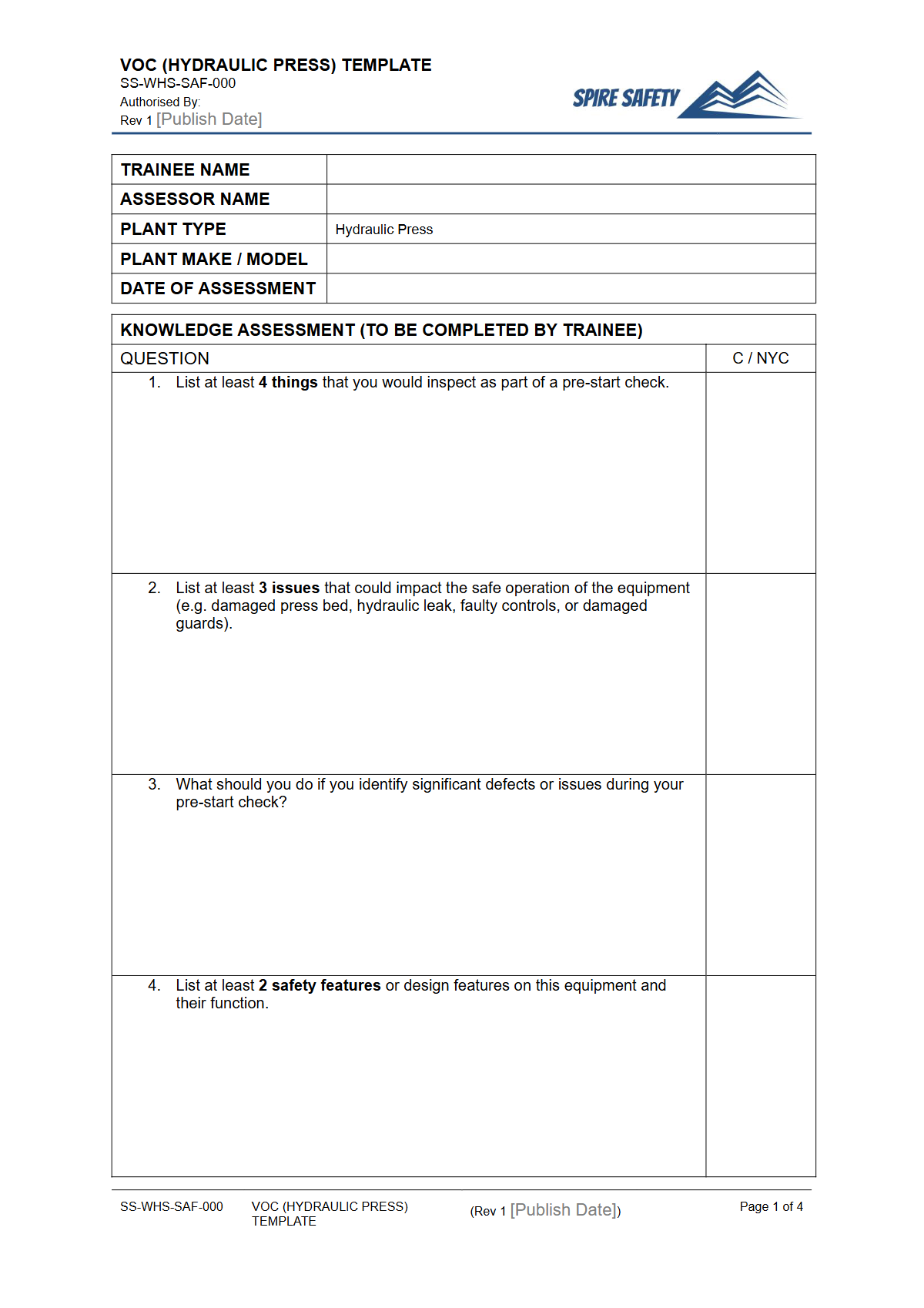
Download our free Verification of Competency (Hydraulic Press) template. This structured DOCX and PDF helps you assess operator skills and safety knowledge.
Free Verification of Competency (Hydraulic Press) Template
DOCX • 138 KB + PDF
Updated Oct 2026
No signup required
Purpose of the Free Verification of Competency (Hydraulic Press) Template
This free Verification of Competency (Hydraulic Press) template provides a structured method for employers to assess and confirm that an employee can operate a hydraulic press safely and competently. It serves as a practical tool for Persons Conducting a Business or Undertaking (PCBUs) to meet their duty of care under Australian WHS legislation.
Using a formal VOC process helps ensure that operators not only hold the relevant licence or ticket (if required) but also possess the current skills, knowledge, and safe work habits specific to the equipment used in your workplace. This process documents the assessment, providing a clear record of due diligence.
A thorough VOC goes beyond a simple check of a licence. It evaluates an operator's ability to conduct pre-start checks, identify hazards, apply control measures, operate the press according to manufacturer specifications, and perform correct shutdown procedures.
This is crucial for high-risk equipment like hydraulic presses, where incorrect use can lead to severe injuries. Just as with other common workshop equipment, a specific assessment is vital; for instance, our Drill Press VOC (Verification of Competency) template covers different risks and operational checks.
Video walkthrough
How to Use the Free Verification of Competency (Hydraulic Press) Template
Our template is provided in both DOCX and PDF formats for your convenience. The DOCX file is fully editable, allowing you to tailor the content to your specific operational needs.
The process involves an assessor observing the operator performing tasks on the hydraulic press and judging their performance against a set of established criteria covering theoretical knowledge and practical application.
Customisation is Essential
Important: This is a template, not a finished document. We have designed it to be a strong starting point, but you must customise it to reflect the specific hydraulic press models, tasks, risks, and control measures relevant to your workplace.
This includes adding or removing criteria based on your site-specific safe work procedures and risk assessments. Failure to adapt the template may result in an incomplete or ineffective verification process.
When to Use It
A Verification of Competency for a hydraulic press should be conducted in several key situations to maintain a safe working environment. It is essential for pre-employment screening to confirm the skills of new hires, or for existing employees transitioning into a new role that requires operating a press.
A VOC is also prudent after an incident or near-miss involving the equipment to identify and correct any gaps in competence.
Regular, scheduled VOCs are also a cornerstone of good safety practice, especially if an operator has not used a specific hydraulic press for an extended period. Integrating these checks into your broader safety framework demonstrates a proactive approach to risk management.
Many organisations incorporate VOCs as a key component of their comprehensive WHS management systems to ensure ongoing compliance and worker safety.
Who Should Use It
This template is designed for use by WHS managers, supervisors, team leaders, and internal trainers who are responsible for workplace safety and operator competence. The person conducting the assessment must be competent themselves—they should have the necessary knowledge, skills, and experience in operating the specific hydraulic press to make a valid judgement on the worker's abilities.
They must be able to confidently identify both safe and unsafe behaviours.
For complex operations or in high-risk environments, it may be beneficial to engage external safety professionals. Seeking specialist WHS consulting can provide an objective, expert assessment and help ensure your VOC processes are robust and effective.
Ultimately, the responsibility lies with the PCBU to ensure that all plant and equipment, including hydraulic systems, are operated safely by competent personnel. A consistent VOC program for all relevant hydraulic equipment, such as a Verification of Competency for a hydraulic impact wrench, helps fulfill this duty.
While this resource focuses on a specific piece of machinery, it is part of a wider collection of tools designed to support your safety programs. You can explore our complete free WHS resources library for more templates, checklists, and guides covering a range of topics and equipment.
Common mistakes
Common mistakes to avoid
- Using a generic checklist that doesn't match the specific press model.
- Assuming a licence or qualification is a substitute for practical verification.
- Failing to include both theoretical knowledge (like lockout/tagout) and practical skills in the assessment.
- Poor record-keeping, making it difficult to prove competence was verified.
Legal references
Legal considerations
The following legal requirements may be relevant to this type of work.
- Work Health and Safety Act (Harmonised) — Provides the primary duties for protecting workers and other people from work health and safety risks.
- Work Health and Safety Regulations (Harmonised) — Sets out requirements supporting the management of workplace hazards and risks.
The following codes may be relevant to this type of work.
- Managing WHS Risks Code of Practice — Provides practical guidance on identifying hazards, assessing risks and applying effective controls.
- Work Health and Safety Consultation, Cooperation and Coordination Code of Practice — Provides practical guidance on consulting workers and coordinating with other duty holders.
- Managing the Work Environment and Facilities Code of Practice — Provides practical guidance on safe work environments, workplace facilities and related controls.
Did you know
Pascal's Principle
Hydraulic presses operate on Pascal's principle, which states that pressure applied to a confined fluid is transmitted undiminished throughout the fluid. This allows a small force applied to a small piston to generate a massive force on a larger piston.
Force Multiplication
Even a small, benchtop hydraulic press can exert several tonnes of force. Industrial presses can generate thousands of tonnes, capable of shaping thick steel plates, making them powerful but extremely hazardous if not used correctly.
FAQ
Frequently asked questions
01What is a Verification of Competency (VOC)?
02Is a VOC a legal requirement in Australia?
03How often should a hydraulic press VOC be conducted?
04Who is considered a 'competent person' to conduct a VOC?
Share this resource
Free Verification of Competency (Hydraulic Press) Template
Browse Categories
How To Use It
- 1Download and open in Word or PDF.
- 2Replace the placeholders with your business details.
- 3Get it reviewed by a WHS specialist before rollout.
Need it customised?
Our WHS consultants can adapt this template to your site, run a gap analysis, or audit what you already have in place.
Book a Free Consultation WHS consulting servicesor call 1300 156 382
Related templates
- Free Verification of Competency (Industrial Vacuum) Template
- Free Verification of Competency (Jib Crane) Template
- Free Verification of Competency (Laser Level) Template
- Free Verification of Competency (Laser Screed) Template
- Free Verification of Competency (Lighting Tower) Template
- Free Verification of Competency (Log Splitter) Template