
Free Verification of Competency (Industrial Vacuum) Template
Assess operator skill with our free Verification of Competency (Industrial Vacuum) Template. Aligned with Australian WHS practice. Download the DOCX & PDF now.
Free Verification of Competency (Industrial Vacuum) Template
DOCX • 140 KB + PDF
Updated Oct 2026
No signup required
Purpose of the Free Verification of Competency (Industrial Vacuum) Template
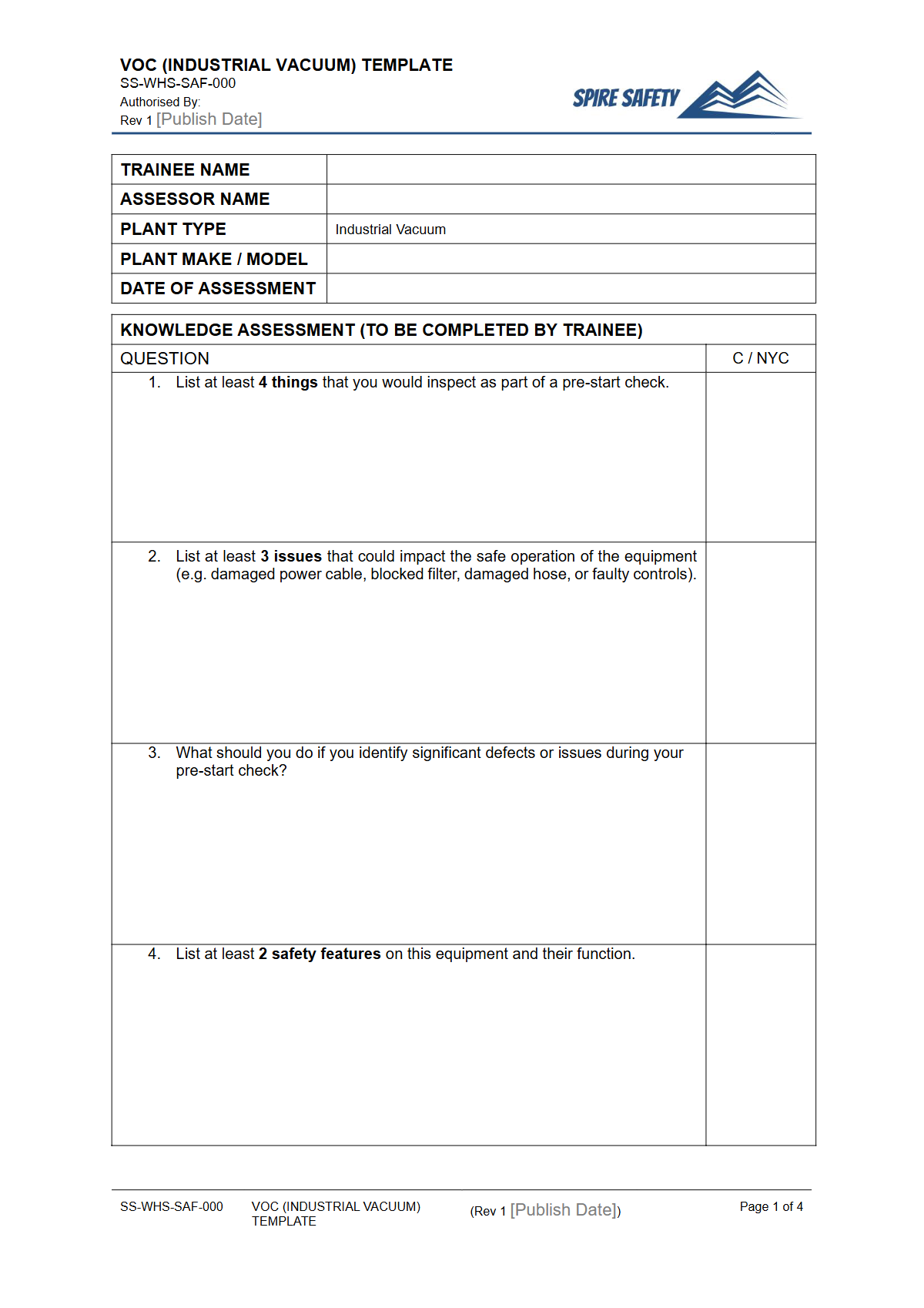
This free Verification of Competency (Industrial Vacuum) Template provides a structured framework for assessing an operator's ability to use industrial vacuum equipment safely and effectively. It is designed to help Persons Conducting a Business or Undertaking (PCBUs) meet their duties under WHS legislation by confirming that workers have the necessary skills and knowledge for the task.
This template serves as a practical tool for documenting competency, which is a critical component of a robust safety management system. While this document is specific to general industrial vacuums, those using more specialised machinery may find our Verification of Competency (Hydrovac or Vacuum Excavator) Template more suitable.
The primary purpose of this Verification of Competency template is to provide a consistent and documented method for evaluating an operator's competence. It helps employers verify that individuals can operate industrial vacuums according to manufacturer instructions, site-specific procedures, and legislative requirements. Using a formal VOC process supports the development of a strong safety culture and is a key element within comprehensive WHS management systems.
Video walkthrough
How to use the Free Verification of Competency (Industrial Vacuum) Template
To use this Verification of Competency template, first download the DOCX or PDF file. The document is divided into sections covering theoretical knowledge, pre-operational checks, practical operation, and shutdown procedures.
An experienced and competent person should act as the assessor, observing the operator and asking relevant questions to gauge their understanding. The assessor then records their findings and signs off on the final assessment.
Important: Customise to Your Workplace
This document is a template and must be customised to reflect your specific equipment, workplace environment, and established procedures. We've provided a solid foundation, but you must review and adapt the content to ensure it is relevant and comprehensive for your organisation's needs.
This includes adding details about the specific makes and models of industrial vacuums in use, unique site hazards, and internal safety protocols.
When to use it
A Verification of Competency for industrial vacuum operators should be conducted at several key stages. This includes prior to a new employee starting work, when an existing worker is assigned to use a new type of industrial vacuum, or as part of a scheduled refresher training program.
It is also a critical step following any incident or near-miss involving the equipment to identify and address any knowledge or skill gaps.
Regularly verifying competency ensures skills remain current and have not diminished over time. This proactive approach to safety management helps prevent complacency and reinforces safe work practices.
A periodic WHS compliance audit can help identify areas where competency verification processes, like this one, need to be strengthened across the organisation.
Who should use it
This template is intended for use by supervisors, WHS managers, trainers, and other personnel responsible for ensuring workplace safety. The person conducting the assessment must be competent themselves, possessing in-depth knowledge and experience in operating the specific industrial vacuum equipment being assessed.
Their expertise is crucial for making a valid judgment on the operator's skill level.
While this VOC focuses on industrial vacuums, the principles of competency verification apply to a wide range of plant and equipment. For tasks involving different machinery, such as high-pressure water systems, our Free Pressure Cleaner VOC (Verification of Competency) Template offers a similarly structured approach.
Competency assessments are vital for any high-risk equipment; for instance, when workers use powerful hand tools, a specific assessment is needed. You can find a relevant example in our Verification of Competency (Wrecker or Impact Wrench) Template.
By implementing consistent VOC processes across all relevant equipment, you build a more resilient safety framework. You can explore our entire free WHS resources library to find templates for other machinery and safety procedures that support your safety goals.
Common mistakes
Common mistakes to avoid
- Using a generic template without customising it for specific machine models and site hazards.
- Assigning an assessor who lacks sufficient experience with the exact industrial vacuum being assessed.
- Treating the VOC as a 'tick-and-flick' exercise rather than part of an ongoing competency management plan.
- Failing to review VOC criteria after an incident or when new equipment or procedures are introduced.
Legal references
Legal considerations
The following legal requirements may be relevant to this type of work.
- Work Health and Safety Act (Harmonised) — Provides the primary duties for protecting workers and other people from work health and safety risks.
- Work Health and Safety Regulations (Harmonised) — Sets out requirements supporting the management of workplace hazards and risks.
The following codes may be relevant to this type of work.
- Managing WHS Risks Code of Practice — Provides practical guidance on identifying hazards, assessing risks and applying effective controls.
- Work Health and Safety Consultation, Cooperation and Coordination Code of Practice — Provides practical guidance on consulting workers and coordinating with other duty holders.
- Managing the Work Environment and Facilities Code of Practice — Provides practical guidance on safe work environments, workplace facilities and related controls.
Did you know
Dust Hazards
Industrial vacuums are critical for controlling hazardous dusts like silica and asbestos. Inhaling these fine particles can lead to serious, irreversible lung diseases such as silicosis.
Static Electricity Risk
The movement of dust through vacuum hoses can generate static electricity, creating a serious ignition risk in flammable atmospheres if the equipment is not properly earthed or bonded.
FAQ
Frequently asked questions
01What is the difference between a VOC and a licence?
02How often should a Verification of Competency be done for an industrial vacuum?
03Can an industrial vacuum VOC be done in-house?
04Is this template enough to ensure WHS compliance?
Share this resource
Free Verification of Competency (Industrial Vacuum) Template
Browse Categories
How To Use It
- 1Download and open in Word or PDF.
- 2Replace the placeholders with your business details.
- 3Get it reviewed by a WHS specialist before rollout.
Need it customised?
Our WHS consultants can adapt this template to your site, run a gap analysis, or audit what you already have in place.
Book a Free Consultation WHS consulting servicesor call 1300 156 382
Related templates
- Free Verification of Competency (Jib Crane) Template
- Free Verification of Competency (Laser Level) Template
- Free Verification of Competency (Laser Screed) Template
- Free Verification of Competency (Lighting Tower) Template
- Free Verification of Competency (Log Splitter) Template
- Free Verification of Competency (Manual Pallet Jack) Template