
Free Verification of Competency (Hydraulic Jack) Template
Download our free Verification of Competency (Hydraulic Jack) Template to assess operator skills and safety knowledge.
Free Verification of Competency (Hydraulic Jack) Template
DOCX • 140 KB + PDF
Updated Oct 2026
No signup required
Purpose of the Free Verification of Competency (Hydraulic Jack) Template
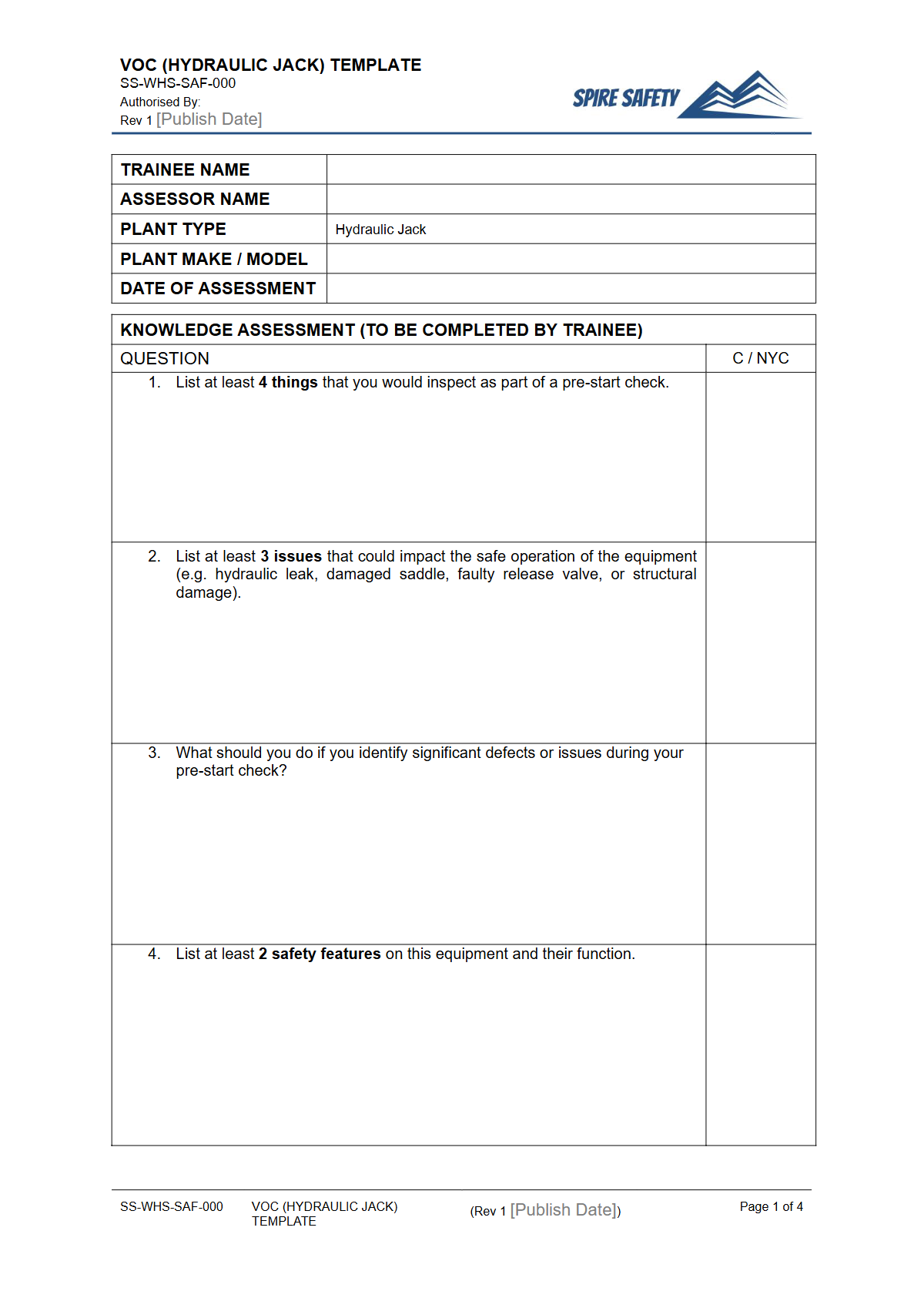
This free Verification of Competency (Hydraulic Jack) Template provides a structured framework for assessing an operator's ability to use hydraulic jacks safely and effectively. Using this template helps a Person Conducting a Business or Undertaking (PCBU) meet their primary duty of care by providing a clear record of worker competence.
It demonstrates due diligence in managing the risks associated with lifting heavy loads, such as vehicle maintenance or construction tasks. Formalising this process ensures that assessments are consistent, thorough, and focused on the practical skills and safety knowledge required for the specific equipment used in your workplace. These records are a critical component of robust WHS management systems.
Video walkthrough
How to use the Free Verification of Competency (Hydraulic Jack) Template
To effectively use this resource, download the document and adapt it to your operational context. The template includes sections for theoretical knowledge (like understanding load ratings and safety features) and practical observation (such as correct positioning, lifting, lowering, and use of support stands).
An assessor observes the worker performing the task, asks relevant questions, and documents their findings against the established criteria. The outcome helps identify any gaps in training that may require addressing.
Important: This is a template, not a finished document. It is a starting point aligned with Australian WHS practice.
We strongly advise that you customise this resource to reflect your specific hydraulic jack models, workplace procedures, safe work method statements (SWMS), and the unique hazards of your site. It should be used by a person competent in both the operation of the equipment and in conducting assessments.
Key Competencies to Assess with a Hydraulic Jack VOC
A comprehensive assessment for a hydraulic jack should cover several critical areas to ensure safe operation. The assessor should verify the operator's ability to perform pre-operational checks, including inspecting for hydraulic fluid leaks, damaged components, and verifying the jack's load capacity.
The assessment must also confirm their skill in identifying stable ground conditions and correct jacking points on a vehicle or structure. Practical skills to observe include the controlled lifting and lowering of a load and, most importantly, the correct placement of appropriately rated jack stands before commencing any work underneath. These competencies are foundational for many workshop tasks, much like those covered in our Free Drill Press VOC (Verification of Competency) Template.
Integrating VOCs into Your Safety Framework
Verification of Competency is not an isolated activity. It should be integrated into your broader safety framework.
The results of a VOC can inform a review of your existing training programs, SWMS, and risk assessments. If multiple workers are found to be non-competent in a specific area, it may indicate a systemic issue in your training or supervision processes.
Regular VOCs help maintain a high standard of safety and operational discipline. The process is similar for other hydraulic tools, as detailed in the Verification of Competency (Wrecker or Impact Wrench (Hydraulic)) template.
When to Conduct a Verification of Competency
A VOC for hydraulic jack operation should be conducted at several key moments. These include:
- Pre-employment: To verify the claimed skills and experience of a new hire.
- Post-training: To confirm a worker has absorbed and can apply newly learned skills.
- Introduction of new equipment: When a new model of hydraulic jack with different features or capacities is introduced.
- Post-incident: As part of an investigation after an incident or near-miss involving a hydraulic jack.
- Periodic reassessment: On a regular basis (e.g., every 2-3 years) as determined by your risk assessment, to ensure skills have been retained.
Documenting these assessments provides a clear and defensible record of your organisation's commitment to safety. For businesses needing to formalise these procedures across all equipment, independent WHS compliance auditing can provide valuable third-party review and recommendations.
Who Should Use This VOC Template?
This template is designed for use by safety managers, supervisors, team leaders, and internal trainers responsible for workplace safety and compliance. It is a practical tool for anyone tasked with ensuring that workers who operate hydraulic jacks are competent to do so without endangering themselves or others.
Whether in an automotive workshop, a construction site, or a manufacturing facility, this resource helps standardise the assessment process. It is just one of many templates available in our free WHS resources library to assist you in managing workplace risks.
Common mistakes
Common mistakes to avoid
- Failing to check the jack's load rating against the weight of the object being lifted.
- Positioning the jack on unstable, soft, or uneven ground, leading to potential slips or collapse.
- Neglecting to use supplementary supports like rated jack stands before working under a lifted load.
- Using a generic assessment that doesn't cover the specific model of hydraulic jack and its unique controls or risks.
Legal references
Legal considerations
The following legal requirements may be relevant to this type of work.
- Work Health and Safety Act (Harmonised) — Provides the primary duties for protecting workers and other people from work health and safety risks.
- Work Health and Safety Regulations (Harmonised) — Sets out requirements supporting the management of workplace hazards and risks.
The following codes may be relevant to this type of work.
- Managing WHS Risks Code of Practice — Provides practical guidance on identifying hazards, assessing risks and applying effective controls.
- Work Health and Safety Consultation, Cooperation and Coordination Code of Practice — Provides practical guidance on consulting workers and coordinating with other duty holders.
- Managing the Work Environment and Facilities Code of Practice — Provides practical guidance on safe work environments, workplace facilities and related controls.
Did you know
Pascal's Law
The principle behind hydraulic jacks, Pascal's Law, states that pressure applied to an enclosed fluid is transmitted undiminished to every portion of the fluid and the walls of the containing vessel, allowing a small force to lift a massive weight.
Stored Energy Hazard
Hydraulic systems operate under high pressure, meaning a failure can release stored energy with explosive force. This is a critical hazard that operators and assessors must be aware of during inspection and use.
FAQ
Frequently asked questions
01What is the difference between a VOC and a licence for a hydraulic jack?
02How often should a VOC for a hydraulic jack be conducted?
03Who is a 'competent person' to conduct this assessment?
04Can this template be used for all types of jacks?
Share this resource
Free Verification of Competency (Hydraulic Jack) Template
Browse Categories
How To Use It
- 1Download and open in Word or PDF.
- 2Replace the placeholders with your business details.
- 3Get it reviewed by a WHS specialist before rollout.
Need it customised?
Our WHS consultants can adapt this template to your site, run a gap analysis, or audit what you already have in place.
Book a Free Consultation WHS consulting servicesor call 1300 156 382
Related templates
- Free Verification of Competency (Hydraulic Press) Template
- Free Verification of Competency (Industrial Vacuum) Template
- Free Verification of Competency (Jib Crane) Template
- Free Verification of Competency (Laser Level) Template
- Free Verification of Competency (Laser Screed) Template
- Free Verification of Competency (Lighting Tower) Template