
Free Verification of Competency (Glass Lifter) Template
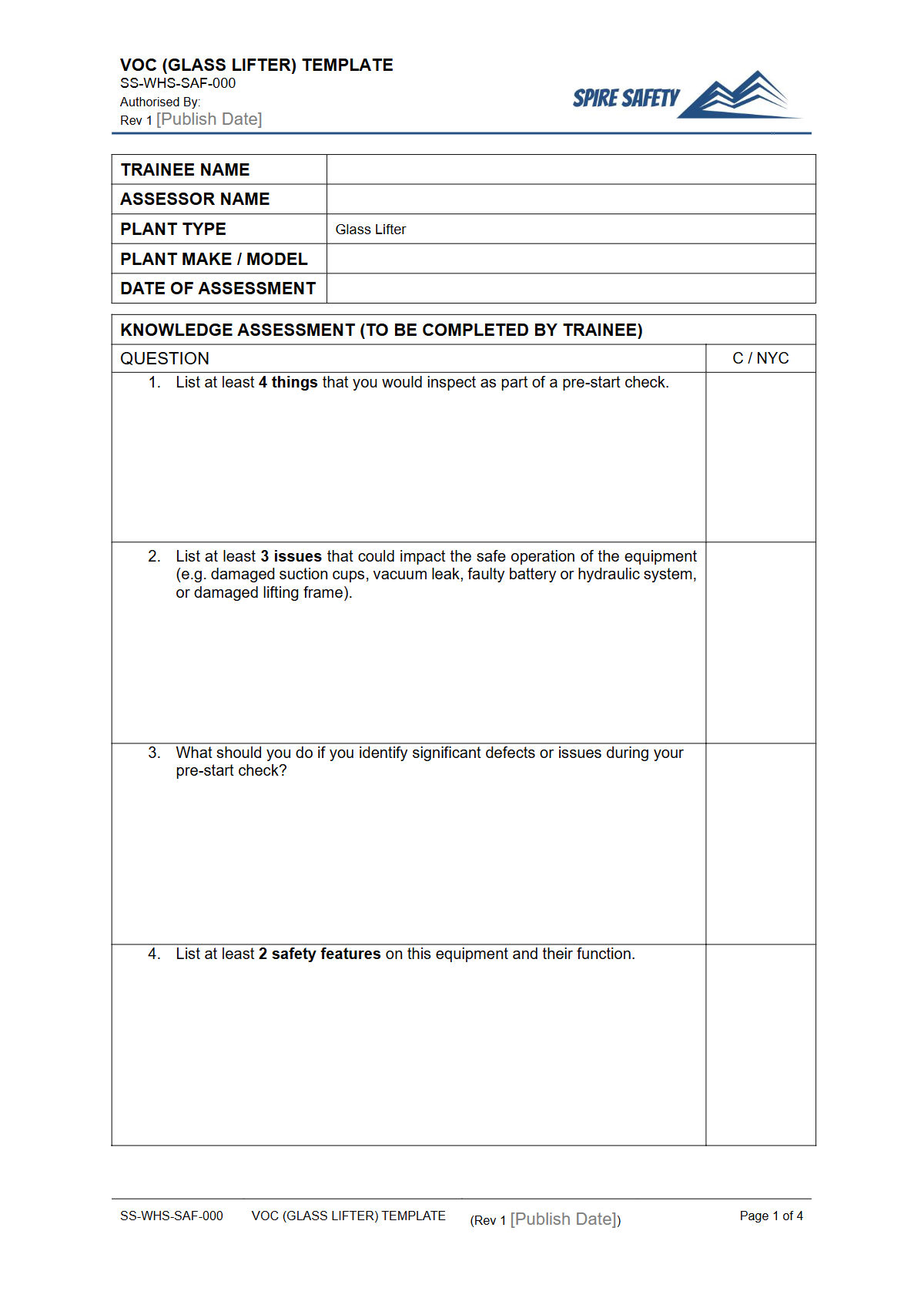
Download our free Verification of Competency (Glass Lifter) template. This structured DOCX & PDF helps assess operator skills and safety knowledge.
Free Verification of Competency (Glass Lifter) Template
DOCX • 140 KB + PDF
Updated Oct 2026
No signup required
Purpose of the Free Verification of Competency (Glass Lifter) Template
Operating a glass lifter, whether a vacuum lifter or a mechanical clamp system, requires specific skills to manage heavy, fragile, and potentially dangerous loads. Our Free Verification of Competency (Glass Lifter) Template provides a structured framework for employers to confirm that their workers have the necessary skills, knowledge, and safety awareness to operate this equipment correctly.
A Verification of Competency (VOC) is a formal process that goes beyond initial training, serving as documented proof that an individual’s competence has been assessed in a practical workplace context. This process is a critical component of your site’s safety measures and contributes to your overarching WHS management systems.
This template is designed to guide an assessor through a robust evaluation process. It covers key criteria including pre-operational checks, understanding of the equipment’s functions and limitations, safe lifting techniques, and emergency responses.
By using this VOC template, a Person Conducting a Business or Undertaking (PCBU) can systematically manage risks associated with glass handling and demonstrate due diligence in meeting their WHS obligations to ensure worker competence.
Video walkthrough
How to use the Free Verification of Competency (Glass Lifter) Template
This resource is a straightforward tool for supervisors, safety advisors, or other designated competent persons. It is formatted to be practical and easy to follow during an on-the-job assessment.
The process is similar to that used for other specialised plant, such as our Verification of Competency for rough terrain forklifts, focusing on both theoretical knowledge and practical demonstration.
The document includes sections for:
- Worker and Assessor Details: Record keeping for who was assessed, by whom, and when.
- Theory and Knowledge Assessment: A set of questions to probe the operator's understanding of the glass lifter’s specifications, load charts, safety features, and relevant procedures.
- Practical Skills Observation: A checklist for the assessor to verify the operator's ability to perform tasks safely, including pre-start inspections, correct attachment to the load, controlled movement, and shutdown procedures.
- Assessment Outcome: A summary section to formally record whether the worker is deemed competent or not yet competent, and to outline any action plans for further training.
Important: This is a template, not a finished document. We have designed it as a starting point, and you must customise it to reflect the specific glass lifter models, tasks, rated capacities, and unique hazards present in your workplace.
Generic assessments are not effective in managing specific risks.
When to use it
A VOC is not a one-time event. It should be integrated into your safety procedures and conducted at several key moments to ensure ongoing competence and safety.
Whether for glaziers on a construction site or workers in a manufacturing facility, a VOC is a vital check. Common triggers for conducting a glass lifter verification include:
- Pre-employment: To verify the skills and claims of a new hire before they begin work.
- Introduction of new equipment: When an operator transitions to a different make or model of glass lifter with new features or controls. The process for any new plant is critical, whether it's a glass lifter or a different machine covered by a mini excavator VOC template.
- Post-incident: After a near-miss or incident involving a glass lifter to identify and address any competency gaps.
- Extended absence: For an operator who has not used the equipment for a significant period.
- Periodic re-assessment: As part of a scheduled review cycle (e.g., annually or biennially) to ensure skills have been maintained.
Who should use it
This template is intended for use by individuals responsible for workplace safety and operational supervision. This typically includes:
- Supervisors and Team Leaders: Those with direct oversight of workers who operate glass lifters.
- WHS/HSE Advisors and Officers: Safety professionals responsible for implementing and monitoring safety procedures and compliance.
- Internal Trainers or Assessors: Designated personnel with the expertise to conduct assessments.
- Project Managers: To ensure that all operators on their site, including subcontractors, are competent.
Crucially, the person conducting the assessment must be competent themselves. They need to have extensive knowledge of the glass lifter, understand the operational risks, and be capable of judging another person's performance objectively. The documented outcomes from these VOCs can provide valuable evidence during WHS compliance auditing, showing that the organisation is proactively managing its safety obligations. To find more templates for other plant and equipment, you can explore our complete free WHS resources library.
Common mistakes
Common mistakes to avoid
- Using a generic VOC template without customising it for the specific make and model of glass lifter.
- Allowing an assessor who is not competent or experienced enough with the equipment to conduct the verification.
- Treating the VOC as a 'tick and flick' exercise instead of a genuine, practical skills assessment.
- Failing to document the assessment outcome, including any identified gaps and retraining plans.
Legal references
Legal considerations
The following legal requirements may be relevant to this type of work.
- Work Health and Safety Act (Harmonised) — Provides the primary duties for protecting workers and other people from work health and safety risks.
- Work Health and Safety Regulations (Harmonised) — Sets out requirements supporting the management of workplace hazards and risks.
The following codes may be relevant to this type of work.
- Managing WHS Risks Code of Practice — Provides practical guidance on identifying hazards, assessing risks and applying effective controls.
- Work Health and Safety Consultation, Cooperation and Coordination Code of Practice — Provides practical guidance on consulting workers and coordinating with other duty holders.
- Managing the Work Environment and Facilities Code of Practice — Provides practical guidance on safe work environments, workplace facilities and related controls.
Did you know
Vacuum Pad Safety
The holding capacity of a glass lifter's suction pads can be significantly reduced by dust, moisture, or even small scratches on the glass surface, making pre-use inspection critical.
Competency vs. Training
Training shows a worker has been taught how to do something, while a Verification of Competency confirms they can still do it safely and correctly in a real-world setting.
FAQ
Frequently asked questions
01Is a Verification of Competency the same as a licence?
02How often should a glass lifter VOC be conducted?
03Who is considered a competent person to conduct a VOC assessment?
04Do I need a VOC for every piece of plant in my workplace?
Share this resource
Free Verification of Competency (Glass Lifter) Template
Browse Categories
How To Use It
- 1Download and open in Word or PDF.
- 2Replace the placeholders with your business details.
- 3Get it reviewed by a WHS specialist before rollout.
Need it customised?
Our WHS consultants can adapt this template to your site, run a gap analysis, or audit what you already have in place.
Book a Free Consultation WHS consulting servicesor call 1300 156 382
Related templates
- Free Verification of Competency (Grapple Attachment) Template
- Free Verification of Competency (Hydraulic Breaker Attachment) Template
- Free Verification of Competency (Hydraulic Jack) Template
- Free Verification of Competency (Hydraulic Press) Template
- Free Verification of Competency (Industrial Vacuum) Template
- Free Verification of Competency (Jib Crane) Template