
Free Verification of Competency (Dry Ice Blaster) Template
Assess and confirm the skills of your workers with our free Verification of Competency (Dry Ice Blaster) Template. Download your free DOCX and PDF today.
Free Verification of Competency (Dry Ice Blaster) Template
DOCX • 141 KB + PDF
Updated Oct 2026
No signup required
Purpose of the Free Verification of Competency (Dry Ice Blaster) Template
Operating a dry ice blaster requires specialised skill and a deep understanding of unique hazards. This equipment uses solid carbon dioxide (CO2) pellets accelerated by compressed air, creating risks such as cryogenic burns, asphyxiation from CO2 displacement, and high-pressure injection injuries.
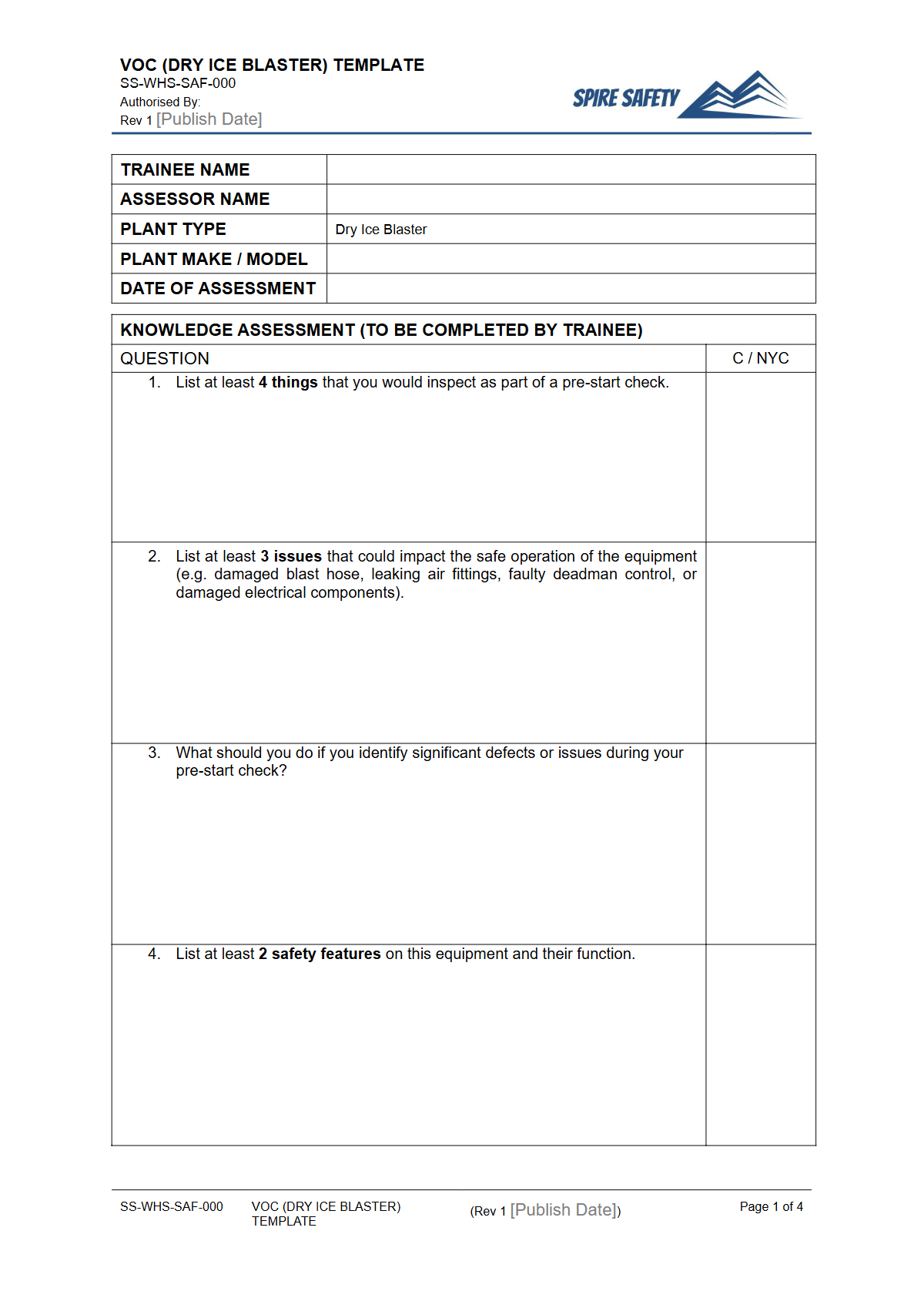
This free Verification of Competency (Dry Ice Blaster) Template provides a structured framework for employers and supervisors to confirm that an operator can use this equipment safely and effectively. It is designed as a starting point, aligned with Australian WHS principles, to help you document practical skills and theoretical knowledge.
A VOC is not a substitute for formal training but serves as a crucial verification step. It confirms that the skills learned during training can be applied competently in the specific context of your workplace.
Properly implemented, this process helps a Person Conducting a Business or Undertaking (PCBU) meet their primary duty of care to ensure workers are adequately trained and supervised. Similar verification is essential for other high-pressure cleaning equipment, and our Free Pressure Cleaner VOC template can be used for those assessments.
Video walkthrough
How to use the Free Verification of Competency (Dry Ice Blaster) Template
Using this template effectively involves more than just downloading and printing. It is a multi-step process designed to provide a robust assessment of an operator's abilities.
The process should include a combination of theoretical questions and practical observation to ensure a comprehensive evaluation.
Follow these steps:
- Download: Choose either the DOCX for easy editing or the PDF for straightforward printing.
- Customise: This is the most critical step. The template is a general guide. You must adapt it to reflect your specific brand and model of dry ice blaster, the unique hazards in your work environment (e.g., confined spaces, poor ventilation), and your organisation's safe work procedures.
- Observe: A competent person, such as a supervisor or experienced operator, should observe the individual performing a range of tasks. This includes pre-start checks, selecting the correct nozzles and blast pressures, demonstrating safe handling of dry ice, and executing a cleaning task efficiently and safely.
- Question: Assess the operator's theoretical knowledge. Ask about emergency procedures, the specific risks of CO2, required Personal Protective Equipment (PPE), and lockout/tagout procedures.
- Document: Record the assessment's outcome. Clearly state whether the operator was deemed competent or not yet competent. If further training or supervision is needed, document the specific actions required and set a date for reassessment. These records are a vital part of your WHS management systems.
Note: We have provided this document as a starting point. It is essential that you customise it to fit the unique requirements and risks of your workplace, plant, and equipment.
Spire Safety accepts no liability for the use of this template.
When to use it
A Verification of Competency is a versatile tool that should be integrated into your safety management processes at several key moments. It's not a one-time event but a recurring activity to ensure skills remain current and safety standards are upheld. Consider conducting a VOC in the following situations:
- Pre-employment or Mobilisation: Before allowing a new hire or contractor to operate equipment independently, verify that their qualifications and claimed experience translate to competence in your operational environment.
- Introduction of New Equipment: When a new model of dry ice blaster is introduced, all operators should have their competency verified on the new machine, even if they are experienced with older models.
- Post-Incident: If an incident or near-miss involving a dry ice blaster occurs, a VOC can help determine if a lack of skill or knowledge was a contributing factor.
- Identified Skill Gaps: If a supervisor observes unsafe or inefficient operating practices, a formal VOC can identify and address specific areas for improvement through targeted retraining.
- Periodic Re-verification: Skills can degrade over time. Scheduling regular VOCs (e.g., every 2-3 years) ensures that operators maintain their competence and are up-to-date with any changes in procedures or regulations. Such scheduled checks are often reviewed during a WHS compliance auditing process.
Who should use it
The responsibility for verifying competency is typically held by individuals with the appropriate authority, experience, and knowledge. This ensures the assessment is both fair and technically sound. The people who should use this template include:
- Supervisors and Line Managers: As the individuals directly responsible for overseeing daily operations, supervisors are ideally positioned to assess the practical skills of their team members in the actual work environment.
- WHS Advisors and Managers: Health and safety professionals can use this template to standardise the VOC process across the organisation, ensuring consistency and maintaining comprehensive records.
- Internal Trainers and Assessors: Designated trainers within your organisation can use this document as the final assessment tool following a training program.
- Experienced Operators: A senior, trusted operator with extensive experience can be designated as a workplace assessor to verify the skills of less experienced colleagues. This is particularly useful in organisations without a dedicated training department. The process should be robust for all types of plant, including for tools covered by our Verification of Competency (Pipe Cutter) Template.
Explore our extensive free WHS resources library for more templates and checklists to support your safety management programs.
Common mistakes
Common mistakes to avoid
- Using a generic VOC that doesn't account for the specific model of dry ice blaster and workplace hazards.
- Neglecting to assess understanding of critical hazards like asphyxiation in confined spaces or cryogenic burns.
- Treating the assessment as a paperwork exercise without meaningful observation of the operator performing tasks.
- Failing to document corrective actions and follow up when an operator is found 'not yet competent'.
Legal references
Legal considerations
The following legal requirements may be relevant to this type of work.
- Work Health and Safety Act (Harmonised) — Provides the primary duties for protecting workers and other people from work health and safety risks.
- Work Health and Safety Regulations (Harmonised) — Sets out requirements supporting the management of workplace hazards and risks.
The following codes may be relevant to this type of work.
- Managing WHS Risks Code of Practice — Provides practical guidance on identifying hazards, assessing risks and applying effective controls.
- Work Health and Safety Consultation, Cooperation and Coordination Code of Practice — Provides practical guidance on consulting workers and coordinating with other duty holders.
- Managing the Work Environment and Facilities Code of Practice — Provides practical guidance on safe work environments, workplace facilities and related controls.
Did you know
Sublimation Risk
Dry ice does not melt; it sublimates, turning directly from a solid into carbon dioxide gas. One kilogram of dry ice produces about 540 litres of CO2 gas, which can quickly displace oxygen in enclosed spaces, creating a serious asphyxiation hazard.
No Secondary Waste
Unlike sandblasting or bead blasting, dry ice blasting leaves no secondary waste. The dry ice pellets sublimate on impact, meaning the only material left to clean up is the contaminant that was removed from the surface.
FAQ
Frequently asked questions
01What is a Verification of Competency (VOC) for a dry ice blaster?
02Is a licence required to operate a dry ice blaster in Australia?
03What specific hazards should be covered in a dry ice blaster VOC?
04How often should a Verification of Competency for a dry ice blaster be conducted?
Share this resource
Free Verification of Competency (Dry Ice Blaster) Template
Browse Categories
How To Use It
- 1Download and open in Word or PDF.
- 2Replace the placeholders with your business details.
- 3Get it reviewed by a WHS specialist before rollout.
Need it customised?
Our WHS consultants can adapt this template to your site, run a gap analysis, or audit what you already have in place.
Book a Free Consultation WHS consulting servicesor call 1300 156 382
Related templates
- Free Verification of Competency (Engine Hoist) Template
- Free Verification of Competency (Glass Lifter) Template
- Free Verification of Competency (Grapple Attachment) Template
- Free Verification of Competency (Hydraulic Breaker Attachment) Template
- Free Verification of Competency (Hydraulic Jack) Template
- Free Verification of Competency (Hydraulic Press) Template