
Free Verification of Competency (Dewatering Pump) Template
Download our free Verification of Competency (Dewatering Pump) template. A structured starting point to assess operator skills. Get your DOCX & PDF now.
Free Verification of Competency (Dewatering Pump) Template
DOCX • 140 KB + PDF
Updated Oct 2026
No signup required
Purpose of the Free Verification of Competency (Dewatering Pump) Template
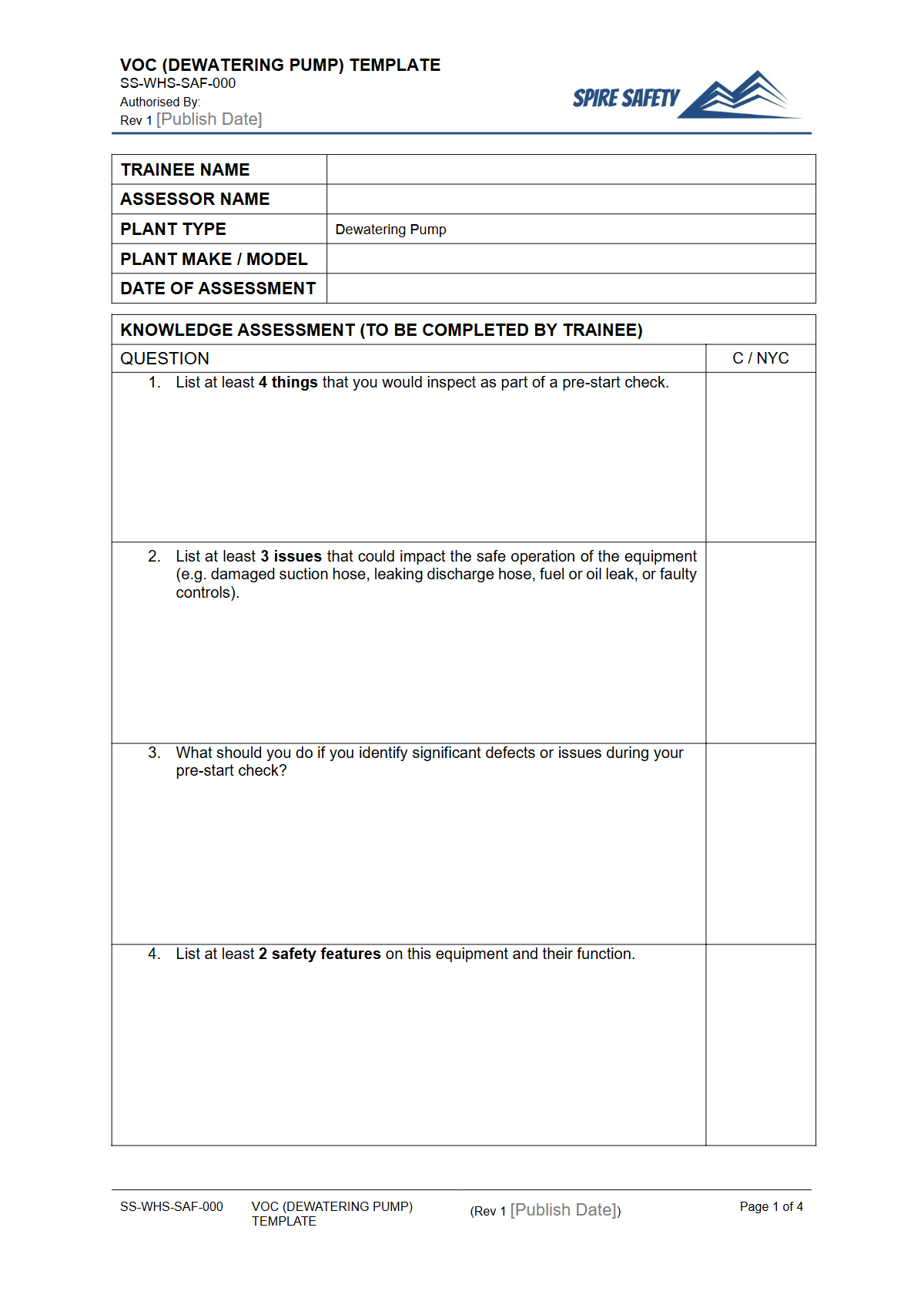
This Free Verification of Competency (Dewatering Pump) Template provides a structured framework for employers to confirm that workers have the necessary skills and knowledge to operate dewatering pumps safely and effectively. Its primary purpose is not for initial training but to verify existing competence.
Using a VOC process helps a Person Conducting a Business or Undertaking (PCBU) meet their primary duty of care by ensuring plant is operated by competent personnel, minimising risks such as flooding, electrical hazards, environmental contamination, and equipment damage. Properly assessing competence for water management equipment is a key part of site safety, similar to the process for our Verification of Competency for water carts.
A thorough assessment using this template covers critical competencies, including pre-start inspections, correct setup of suction and discharge hoses, priming procedures, operational monitoring, and safe shutdown. It formalises the process of observation and questioning, creating a documented record of an individual's capability at a specific point in time.
This record is invaluable for demonstrating due diligence, identifying training gaps, and maintaining high safety standards across your projects. It can also be adapted to assess competence on related equipment, much like our Pipe Cutter VOC Template is used for a specific ancillary task.
Video walkthrough
How to use the Free Verification of Competency (Dewatering Pump) Template
This template is designed for ease of use by a competent assessor, such as a supervisor or an experienced operator. The process involves both a theoretical and a practical component.
The assessor uses the included checklist to ask targeted questions about safety procedures and pump mechanics, then observes the operator performing the task in a real or simulated work environment. Observations should cover the entire operational cycle, from setup to pack-down.
The document is divided into clear sections: Candidate & Assessor Details, Theory Questions, a Practical Observation Checklist, and an Assessment Summary. The assessor marks each criterion and provides comments where necessary.
A final determination of 'Competent' or 'Not Yet Competent' is recorded, along with any recommendations for further training. Integrating this process into your safety framework strengthens your overall approach to robust WHS management systems.
Important Note on Customisation
Crucially, this document is a template, not a finished product. It MUST be customised to reflect the specific dewatering pumps (e.g., diesel, electric, submersible), site conditions, Safe Work Method Statements (SWMS), and operational procedures of your workplace. We have provided a solid foundation, but you are responsible for ensuring it is fit-for-purpose.
When to use it
A Verification of Competency for dewatering pump operators should be conducted at several key stages to ensure ongoing safety and skill retention. It is a vital tool for pre-employment screening to confirm a new hire's claimed experience.
It should also be used when introducing a new type or model of dewatering pump to the workplace, as controls and operating principles can vary significantly.
Other critical times for a VOC include following a safety incident or near-miss involving the equipment, or if a supervisor observes unsafe or inefficient operating practices. Many organisations also schedule regular VOCs (e.g., every 2-3 years) as part of a continuous skills maintenance program, ensuring that operator competence does not diminish over time. This approach aligns with best practice for a wide range of mobile plant, as reflected in resources like our mini excavator VOC template.
Who should use it
This template is intended for use by individuals responsible for workplace safety and personnel management. This typically includes Site Supervisors, Project Managers, and WHS Advisors or Officers.
These roles are best positioned to observe workers in their operational environment and have the authority to implement training recommendations if gaps in competence are identified.
The assessment itself must be carried out by a person who is not only competent in the operation of the specific dewatering pump but also has the skills to conduct an assessment fairly and objectively. This could be an internal expert (like a leading hand or experienced operator) or an external specialist.
If your team lacks the internal expertise to conduct assessments confidently, engaging specialist WHS consulting services can provide the necessary support and objectivity. This template is one of many practical tools available in our free WHS resources library to help manage workplace risks effectively.
This VOC complements other equipment assessments, such as those for a pressure cleaner VOC, by focusing on the specific hazards and skills related to moving water safely on a worksite.
Common mistakes
Common mistakes to avoid
- Using a generic checklist without customising it for the specific pump model and site risks.
- Treating the VOC as a 'tick-and-flick' exercise rather than a genuine observation of skill.
- Failing to document the assessment outcome, assessor details, and any required gap training.
- Overlooking theoretical knowledge, such as understanding pump capacity, head pressure, and suction lift limitations.
Legal references
Legal considerations
The following legal requirements may be relevant to this type of work.
- Work Health and Safety Act (Harmonised) — Provides the primary duties for protecting workers and other people from work health and safety risks.
- Work Health and Safety Regulations (Harmonised) — Sets out requirements supporting the management of workplace hazards and risks.
The following codes may be relevant to this type of work.
- Managing WHS Risks Code of Practice — Provides practical guidance on identifying hazards, assessing risks and applying effective controls.
- Work Health and Safety Consultation, Cooperation and Coordination Code of Practice — Provides practical guidance on consulting workers and coordinating with other duty holders.
- Managing the Work Environment and Facilities Code of Practice — Provides practical guidance on safe work environments, workplace facilities and related controls.
Did you know
Electrical Hazards
Water and electricity are a lethal combination. Many serious incidents involving dewatering pumps are related to improper electrical setup, damaged cords, or lack of residual current devices (RCDs).
Beyond the Pump
Effective dewatering involves more than just the pump; it includes assessing ground stability, managing discharge locations to prevent erosion or contamination, and controlling noise levels.
FAQ
Frequently asked questions
01What is a Verification of Competency (VOC)?
02Is a VOC a substitute for a high-risk work licence?
03How often should a dewatering pump VOC be conducted?
04Can this template be used for all types of dewatering pumps?
Share this resource
Free Verification of Competency (Dewatering Pump) Template
Browse Categories
How To Use It
- 1Download and open in Word or PDF.
- 2Replace the placeholders with your business details.
- 3Get it reviewed by a WHS specialist before rollout.
Need it customised?
Our WHS consultants can adapt this template to your site, run a gap analysis, or audit what you already have in place.
Book a Free Consultation WHS consulting servicesor call 1300 156 382
Related templates
- Free Verification of Competency (Drum Lifter) Template
- Free Verification of Competency (Drum Trolley) Template
- Free Verification of Competency (Dry Ice Blaster) Template
- Free Verification of Competency (Engine Hoist) Template
- Free Verification of Competency (Glass Lifter) Template
- Free Verification of Competency (Grapple Attachment) Template