
Free Verification of Competency (Drum Lifter) Template
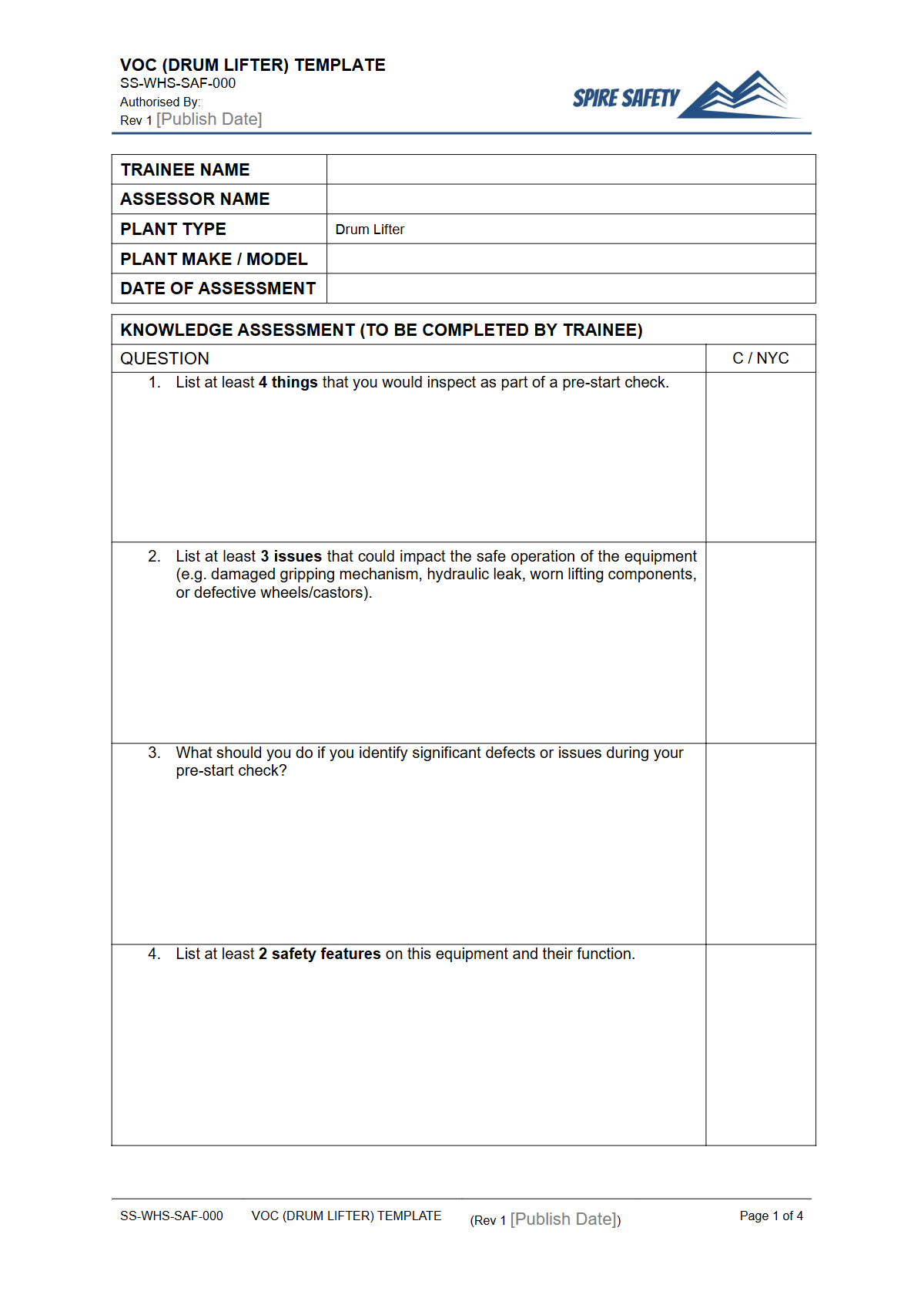
Download our free Verification of Competency (Drum Lifter) template. A structured starting point for assessing operator skills and safety knowledge.
Free Verification of Competency (Drum Lifter) Template
DOCX • 140 KB + PDF
Updated Oct 2026
No signup required
Purpose of the Free Verification of Competency (Drum Lifter) Template
Operating a drum lifter, whether it's a forklift attachment, a pedestrian stacker, or a specialised trolley, involves significant risks. These include musculoskeletal injuries from awkward postures, crush injuries from falling drums, and potential exposure to hazardous substances if a drum is breached.
This Free Verification of Competency (Drum Lifter) Template provides a structured framework for employers to confirm that their workers have the necessary skills and knowledge to operate this equipment safely. Using a formal assessment process helps demonstrate due diligence and ensures that training has been effectively understood and applied in a practical setting.
A systematic approach to competency is a cornerstone of effective safety management. This template helps formalise that process, providing documented evidence that operators have been assessed against specific criteria.
Integrating such verifications into your broader framework is crucial for maintaining a safe workplace. A well-documented process is a key part of robust WHS management systems, linking training directly to on-the-job safety and performance.
Video walkthrough
How to use the Free Verification of Competency (Drum Lifter) Template
This resource is designed as a starting point. First, download the template in your preferred format (DOCX for easy editing or PDF).
The document is divided into sections covering theoretical knowledge, pre-operational checks, and practical operational skills. An assessor, typically a supervisor or an experienced operator, uses the checklist to observe the worker and record their performance against each criterion.
The goal is to identify any gaps in competence that may require further training or instruction.
It is essential that you adapt this document to your specific needs. Different workplaces use various types of drum lifters, handle different materials, and face unique environmental hazards.
Customising the checklist ensures the assessment is relevant and comprehensive for your operations. For example, the assessment criteria for handling heavy equipment in a confined space will differ from those for open-yard work, a principle that also applies to our Verification of Competency (Rough Terrain Forklift) template.
Important: This document is a template. We have designed it to be customised to your specific workplace, equipment, and operational procedures.
You must review and amend it to ensure it aligns with your site-specific risk assessments and safe work procedures.
When to use it
A Verification of Competency (VOC) is not just a one-time event. It should be conducted at several key points during a worker's employment to ensure skills remain current and relevant. Key triggers for conducting a drum lifter VOC include:
- Pre-employment: To verify the skills and claims of a new hire.
- Post-training: To confirm that a worker has absorbed and can apply new training.
- Introduction of new equipment: When a new model of drum lifter is introduced to the workplace.
- Post-incident: After an accident or near-miss involving a drum lifter to identify and correct any unsafe behaviours.
- Periodic re-assessment: As part of a regular schedule (e.g., every 2-3 years) to ensure skills have not diminished over time.
This proactive approach helps manage risks associated with all types of site equipment. Having clear triggers for reassessment is a good practice, whether for lifting equipment or other tools, as seen in resources like the Free Pressure Cleaner VOC (Verification of Competency) Template.
Who should use it
This template is intended for use by individuals responsible for workplace safety and operational supervision. This typically includes:
- Supervisors and Team Leaders: Those who directly oversee operators and are responsible for their day-to-day safety.
- WHS/OHS Managers and Advisors: Professionals who manage the overall safety system and need to ensure competency requirements are being met and documented.
- Trainers and Assessors: Internal or external personnel tasked with delivering training and formally assessing worker capabilities.
The completed VOC records serve as critical evidence of your safety processes. During a formal audit, an auditor will look for proof that you are actively managing competency.
Having organised and completed VOCs demonstrates a commitment to safety and is a key focus during any WHS compliance auditing activity. If your organisation needs assistance in developing a comprehensive competency framework, specialist WHS consulting can provide valuable guidance and support. For more templates and safety guides, feel free to browse our complete free WHS resources library.
Common mistakes
Common mistakes to avoid
- Using a generic checklist without customising it for the specific drum lifter model and workplace environment.
- Only assessing theoretical knowledge without observing a practical demonstration of skills in a real-world context.
- Failing to document the assessment outcome, feedback provided, and any required re-training.
- Treating the VOC as a one-time event instead of part of an ongoing competency management cycle.
Legal references
Legal considerations
The following legal requirements may be relevant to this type of work.
- Work Health and Safety Act (Harmonised) — Provides the primary duties for protecting workers and other people from work health and safety risks.
- Work Health and Safety Regulations (Harmonised) — Sets out requirements supporting the management of workplace hazards and risks.
The following codes may be relevant to this type of work.
- Managing WHS Risks Code of Practice — Provides practical guidance on identifying hazards, assessing risks and applying effective controls.
- Work Health and Safety Consultation, Cooperation and Coordination Code of Practice — Provides practical guidance on consulting workers and coordinating with other duty holders.
- Managing the Work Environment and Facilities Code of Practice — Provides practical guidance on safe work environments, workplace facilities and related controls.
Did you know
Manual Handling Risk
A standard 205-litre (44-gallon) steel drum of oil can weigh over 200kg, making mechanical aids like drum lifters essential to prevent serious musculoskeletal injuries.
Competency Records
WHS regulators can request evidence of worker competency during site inspections or incident investigations. Maintaining clear, detailed VOC records is a key part of demonstrating due diligence.
FAQ
Frequently asked questions
01What should a drum lifter VOC assessment include?
02How often should drum lifter competency be verified?
03Is a licence required to operate a drum lifter in Australia?
04Can this template be used for all types of drum lifters?
Share this resource
Free Verification of Competency (Drum Lifter) Template
Browse Categories
How To Use It
- 1Download and open in Word or PDF.
- 2Replace the placeholders with your business details.
- 3Get it reviewed by a WHS specialist before rollout.
Need it customised?
Our WHS consultants can adapt this template to your site, run a gap analysis, or audit what you already have in place.
Book a Free Consultation WHS consulting servicesor call 1300 156 382
Related templates
- Free Verification of Competency (Drum Trolley) Template
- Free Verification of Competency (Dry Ice Blaster) Template
- Free Verification of Competency (Engine Hoist) Template
- Free Verification of Competency (Glass Lifter) Template
- Free Verification of Competency (Grapple Attachment) Template
- Free Verification of Competency (Hydraulic Breaker Attachment) Template