
Free Verification of Competency (Crawler Crane) Template
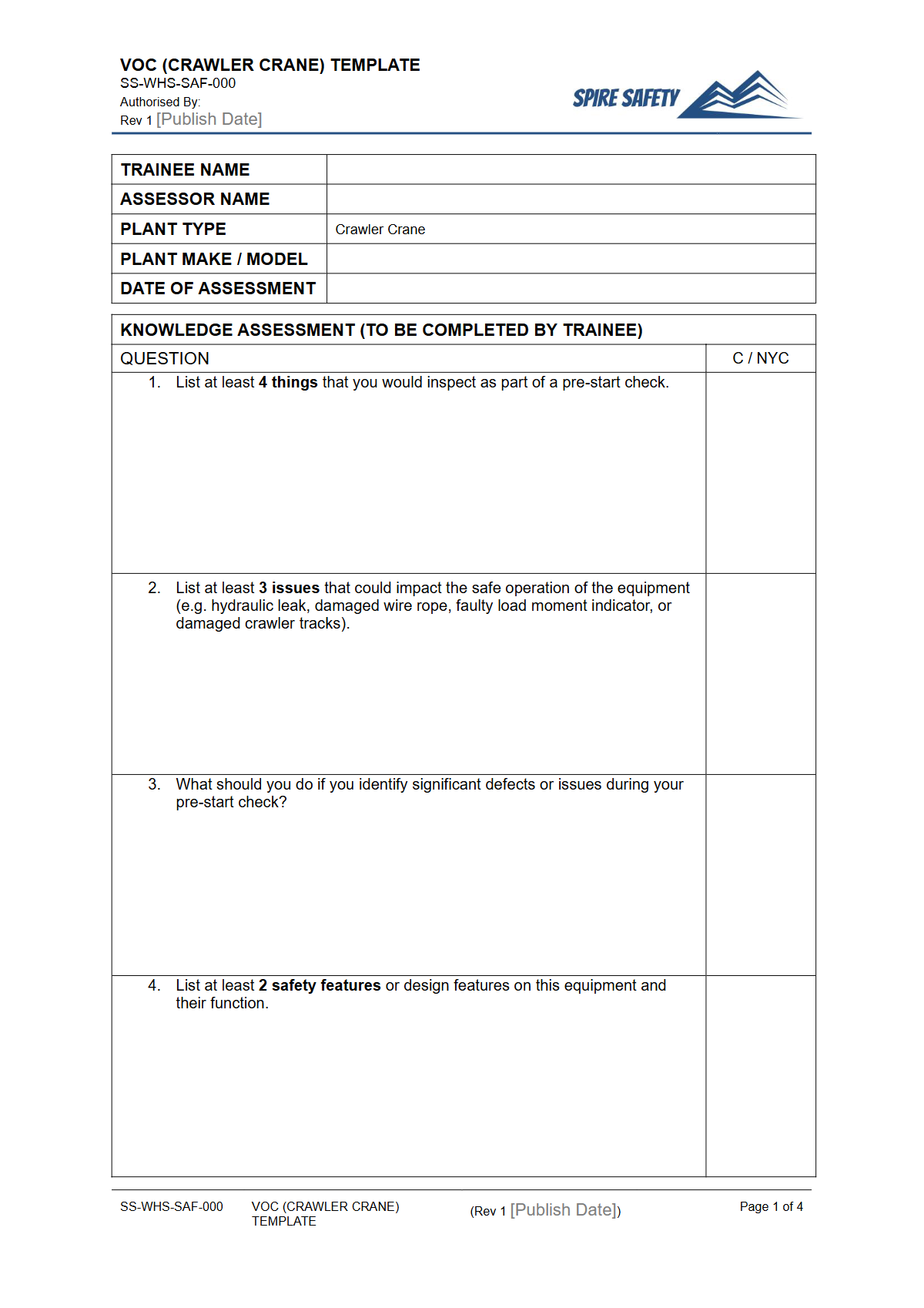
Download our free Verification of Competency (Crawler Crane) template. A structured starting point for assessing operator skills and ensuring safe operation.
Free Verification of Competency (Crawler Crane) Template
DOCX • 140 KB + PDF
Updated Oct 2026
No signup required
Purpose of the Free Verification of Competency (Crawler Crane) Template
Operating a crawler crane is a high-risk activity that requires significant skill and safety awareness. While a High Risk Work Licence (HRWL) is mandatory, it doesn't guarantee a worker's ongoing competence on a specific machine or in a particular work environment.
This is where our Free Verification of Competency (Crawler Crane) Template becomes essential. It provides a structured framework for employers to confirm that an operator can still perform their duties safely and effectively, long after they've obtained their initial licence.
Using this template helps a Person Conducting a Business or Undertaking (PCBU) meet their primary duty of care under WHS legislation. It's a practical tool to ensure workers are provided with the necessary information and instruction to work safely.
Documenting VOCs is a critical component of robust WHS management systems, demonstrating proactive risk management and a commitment to workplace safety.
What is a Verifications of Competency?
A Verification of Competency (VOC) is an assessment process used to verify that an individual has the current skills, knowledge, and experience to operate equipment or perform a task safely. It is not a substitute for formal training or licensing but rather a confirmation of existing competence.
The process typically involves both a theoretical component (questioning) and a practical observation of the worker operating the crawler crane in a controlled, realistic environment.
Video walkthrough
How to use the Free Verification of Competency (Crawler Crane) Template
This document provides a comprehensive starting point for your Verifications of Competency process. It includes sections for pre-operational checks, operational tasks, shutdown procedures, and underpinning knowledge questions specific to crawler cranes.
It is available for download as a DOCX file for easy customisation or as a PDF for straightforward printing.
To effectively use this template:
- Download: Select the DOCX or PDF version.
- Customise: This is the most critical step. The provided template is generic. You must adapt it to reflect your specific workplace, the models of crawler cranes used, the types of lifts performed, and the unique hazards present on your site. Add your company branding and details.
- Review: Have a competent person, such as a senior crane operator or a safety professional, review the customised document to ensure it is thorough and relevant.
- Implement: Use the document to conduct the assessment, recording observations and outcomes clearly and objectively.
- Retain: Keep the completed VOC form as a record of your safety and training activities.
Important Note: This document is a template, not a finished legal or safety document. We are not lawyers or your WHS advisors.
You must customise this template for your specific circumstances and have it reviewed by a qualified person to ensure it meets your site's operational and WHS requirements.
When to use it
A VOC for a crawler crane operator should be conducted at various points to manage risk effectively. It is not a one-time event. Consider conducting a VOC in the following situations:
- Pre-employment: To verify the skills claimed by a new hire before they begin work.
- New Equipment: When an operator is required to use a different make or model of crawler crane.
- Post-incident: Following any incident or near-miss involving a crawler crane to identify and address any competency gaps.
- Extended Absence: If an operator has been away from their role for a significant period.
- Periodic Verification: As part of a regular schedule (e.g., every 2-3 years) to ensure skills remain current, similar to how you might assess operators of other plant like those covered in our Verification of Competency (Rough Terrain Forklift) template.
Who should use it
This Verifications of Competency template is designed for use by:
- Safety Managers and WHS Advisors: To implement a standardised process for verifying operator competence across the organisation.
- Site Supervisors and Forepersons: To conduct on-the-ground assessments of their team members.
- Training and Development Coordinators: As part of a broader competency framework and training needs analysis.
- Recruitment Managers: As a practical assessment tool during the hiring process for plant operators.
The assessment itself must be carried out by a 'competent person'. This is someone who has the requisite technical knowledge, skills, and experience with crawler cranes to make an informed judgement about the operator's abilities.
This may be an experienced internal supervisor or an external specialist. If you lack in-house expertise, engaging external WHS consulting services can provide the necessary third-party assurance.
For a broader collection of safety documents, you can explore our complete free WHS resources library, which includes tools for various high-risk tasks and equipment. If your site uses a variety of earthmoving equipment, you may also find value in our Free Grader VOC template to maintain consistency in your verification processes.
Common mistakes
Common mistakes to avoid
- Treating the VOC as a simple 'tick and flick' administrative task without proper observation.
- Using an assessor who is not themselves competent and experienced with crawler cranes.
- Failing to customise the template to reflect site-specific hazards, ground conditions, and crane models.
- Confusing a VOC with initial training; a VOC assesses existing skills, it does not teach new ones.
Legal references
Legal considerations
The following legal requirements may be relevant to this type of work.
- Work Health and Safety Act (Harmonised) — Provides the primary duties for protecting workers and other people from work health and safety risks.
- Work Health and Safety Regulations (Harmonised) — Sets out requirements supporting the management of workplace hazards and risks.
The following codes may be relevant to this type of work.
- Managing WHS Risks Code of Practice — Provides practical guidance on identifying hazards, assessing risks and applying effective controls.
- Work Health and Safety Consultation, Cooperation and Coordination Code of Practice — Provides practical guidance on consulting workers and coordinating with other duty holders.
- Managing the Work Environment and Facilities Code of Practice — Provides practical guidance on safe work environments, workplace facilities and related controls.
Did you know
Licence for Life?
While a High Risk Work Licence for crane operation does not expire, a PCBU's duty of care to ensure current competency never does. VOCs bridge the gap between holding a licence and proving current, site-specific safety skills.
Lifting Calculations
A critical part of a crawler crane VOC isn't just operating the machine, but assessing the operator's ability to understand and interpret lift charts, calculate load weights, and plan the lift safely.
FAQ
Frequently asked questions
01What is the difference between a High Risk Work Licence (HRWL) and a Verification of Competency?
02How often do I need to conduct a VOC for a crawler crane operator?
03Can I use this template for a mobile crane or tower crane?
04Who can be an assessor for a crawler crane VOC?
Share this resource
Free Verification of Competency (Crawler Crane) Template
Browse Categories
How To Use It
- 1Download and open in Word or PDF.
- 2Replace the placeholders with your business details.
- 3Get it reviewed by a WHS specialist before rollout.
Need it customised?
Our WHS consultants can adapt this template to your site, run a gap analysis, or audit what you already have in place.
Book a Free Consultation WHS consulting servicesor call 1300 156 382
Related templates
- Free Verification of Competency (Dewatering Pump) Template
- Free Verification of Competency (Drum Lifter) Template
- Free Verification of Competency (Drum Trolley) Template
- Free Verification of Competency (Dry Ice Blaster) Template
- Free Verification of Competency (Engine Hoist) Template
- Free Verification of Competency (Glass Lifter) Template