
Free WHS Inspection (Dental Clinic) Template
Manage health and safety in your dental practice with our structured WHS Inspection Template. Aligned with Australian WHS standards.
Free WHS Inspection (Dental Clinic) Template
DOCX • 128 KB + PDF
Updated Oct 2026
No signup required
Purpose of the Free WHS Inspection (Dental Clinic) Template
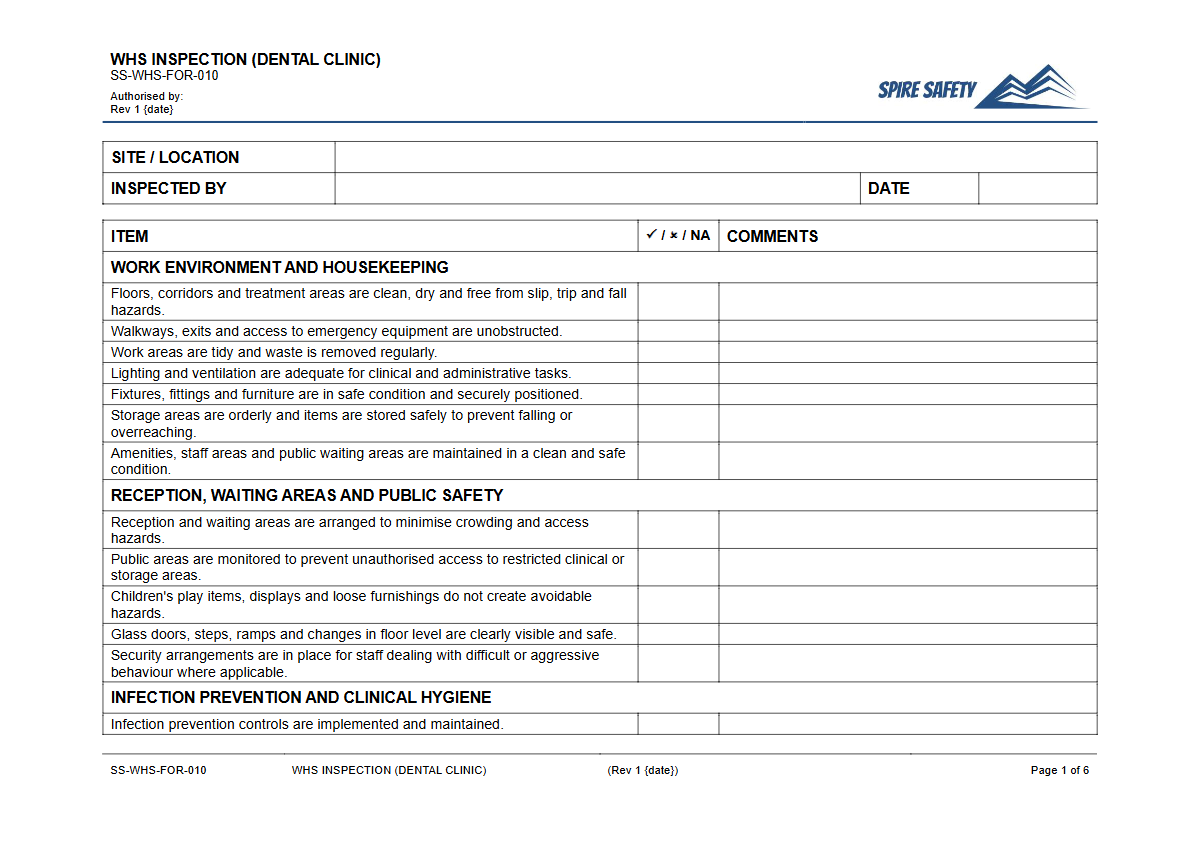
Systematically identifying and controlling hazards is a fundamental part of managing work health and safety in a dental clinic. This Free WHS Inspection (Dental Clinic) Template provides a structured starting point for your practice's physical workplace inspections.
Regular inspections help your organisation meet its duty of care by proactively finding unsafe conditions or work practices before they cause an incident. A dental practice contains a unique combination of hazards, including sharps, radiation-emitting equipment, hazardous substances, infectious agents, and significant ergonomic risks for clinical staff.
Using a formal checklist helps ensure all key areas are assessed consistently, from clinical treatment rooms and sterilisation areas to administrative offices and staff facilities. It also creates a documented record of your safety efforts, which is crucial for demonstrating due diligence.
Properly conducted inspections are a key activity within any effective safety framework. For equipment-specific checks, such as those for lifting aids, you might use a more detailed tool like our free patient hoist pre-start checklist.
What this Inspection Template covers
This template is designed to be comprehensive, prompting a review of common risk areas in a dental clinic environment. Key sections include:
- General Environment: Assessing housekeeping, slip and trip hazards, lighting, ventilation, and emergency exits.
- Clinical Areas: Checking operatories for ergonomic setups, equipment safety, and clear walkways.
- Sterilisation and Decontamination: Reviewing processes, personal protective equipment (PPE) availability, and autoclave safety.
- Hazardous Substances: Verifying storage, labelling, and availability of Safety Data Sheets (SDS).
- Radiation Safety: Confirming compliance with usage protocols and signage for X-ray equipment.
- Emergency Preparedness: Checking first aid kits, fire extinguishers, and emergency contact information.
These prompts are designed to integrate into a broader safety program. The findings from your inspections are valuable inputs when looking to improve your overall WHS management system.
Video walkthrough
How to use the Free WHS Inspection (Dental Clinic) Template
This resource is provided in both DOCX and PDF formats for your convenience. The DOCX file is fully editable, allowing you to tailor the checklist to the specific layout, equipment, and procedures of your clinic.
To get started, download the template and add your company branding. Then, walk through the document and add, remove, or modify checklist items to ensure they accurately reflect your workplace.
Important: This is a template only. We have designed it as a starting point, and you must customise it to reflect the specific hazards, equipment, and procedures in your dental clinic.
Its effectiveness depends on its correct customisation and implementation.
When to use it
The frequency of workplace inspections should be based on a risk assessment. For a dynamic environment like a dental clinic, conducting a full inspection quarterly is a common and effective schedule.
However, inspections should also be triggered by specific events, such as after an incident or near miss, when new equipment or substances are introduced, or when procedures change. The results of these checks can form an important part of a scheduled WHS compliance audit, providing evidence of your ongoing hazard identification processes.
Who should use it
Workplace inspections should be a consultative process. While the Practice Manager or a designated WHS Officer may lead the inspection, involving a mix of staff is highly beneficial.
Include a dentist, a dental assistant, and an administrative team member to gain different perspectives on the workplace's hazards. This collaborative approach not only improves the quality of the inspection but also enhances the overall safety culture within the practice.
The completed inspection report should be discussed by management and the health and safety committee (if one exists) to ensure corrective actions are assigned and tracked to completion. For more templates to support your safety program, you can browse our complete free WHS resources library.
Common mistakes
Common mistakes to avoid
- Failing to customise the template for the specific clinic layout and equipment.
- Treating the inspection as a paperwork exercise without implementing and tracking corrective actions.
- Not involving a mix of clinical and administrative staff in the inspection process.
- Neglecting to review and update the inspection checklist after an incident or when changes occur.
Legal references
Legal considerations
The following legal requirements may be relevant to this type of work.
- Work Health and Safety Act (Harmonised) — Provides the primary duties for protecting workers and other people from work health and safety risks.
- Work Health and Safety Regulations (Harmonised) — Sets out requirements supporting the management of workplace hazards and risks.
The following codes may be relevant to this type of work.
- Managing WHS Risks Code of Practice — Provides practical guidance on identifying hazards, assessing risks and applying effective controls.
- Work Health and Safety Consultation, Cooperation and Coordination Code of Practice — Provides practical guidance on consulting workers and coordinating with other duty holders.
- Managing the Work Environment and Facilities Code of Practice — Provides practical guidance on safe work environments, workplace facilities and related controls.
Did you know
Ergonomic Risk
Musculoskeletal disorders are one of the most common work-related injuries for dental professionals, often resulting from awkward postures, repetitive movements, and prolonged standing or sitting.
Industry Claim Rates
According to Safe Work Australia, the 'Health care and social assistance' industry consistently has one of the highest rates of serious workers' compensation claims in the country.
FAQ
Frequently asked questions
01What is the difference between a WHS inspection and a WHS audit?
02How often should a dental clinic conduct a WHS inspection?
03Who is legally responsible for WHS in a dental clinic?
04Does this template cover all infection control requirements?
Share this resource
Free WHS Inspection (Dental Clinic) Template
Browse Categories
How To Use It
- 1Download and open in Word or PDF.
- 2Replace the placeholders with your business details.
- 3Get it reviewed by a WHS specialist before rollout.
Need it customised?
Our WHS consultants can adapt this template to your site, run a gap analysis, or audit what you already have in place.
Book a Free Consultation WHS consulting servicesor call 1300 156 382