
Free WHS Inspection (Diesel Workshop) Template
Download our Free WHS Inspection (Diesel Workshop) Template to systematically identify and control hazards in your vehicle maintenance areas.
Free WHS Inspection (Diesel Workshop) Template
DOCX • 129 KB + PDF
Updated Oct 2026
No signup required
Purpose of the Free WHS Inspection (Diesel Workshop) Template
Diesel workshops are dynamic environments filled with significant WHS risks, including hazardous chemicals, heavy machinery, noise, and manual tasks. This Free WHS Inspection (Diesel Workshop) Template provides a structured starting point for systematically reviewing your workshop's safety measures.
By conducting regular inspections, you can proactively identify potential hazards, assess risk controls, and ensure a safer working environment for your mechanics and technicians. This template is designed to align with Australian WHS principles and helps formalise the process of monitoring workplace conditions and safety procedures.
Using a standardised checklist helps ensure that no critical areas are overlooked, from the storage of flammable liquids to the condition of lifting equipment. It serves as documented evidence of your organisation's commitment to safety and due diligence.
Regular inspections are a cornerstone of any effective safety management system, helping to prevent incidents before they occur. This process also supports ongoing consultation with workers, encouraging them to participate in identifying and resolving safety issues.
A comprehensive inspection can feed valuable data into your broader risk management processes, such as the need for new safe work method statements (SWMS) or training updates.
Video walkthrough
How to use the Free WHS Inspection (Diesel Workshop) Template
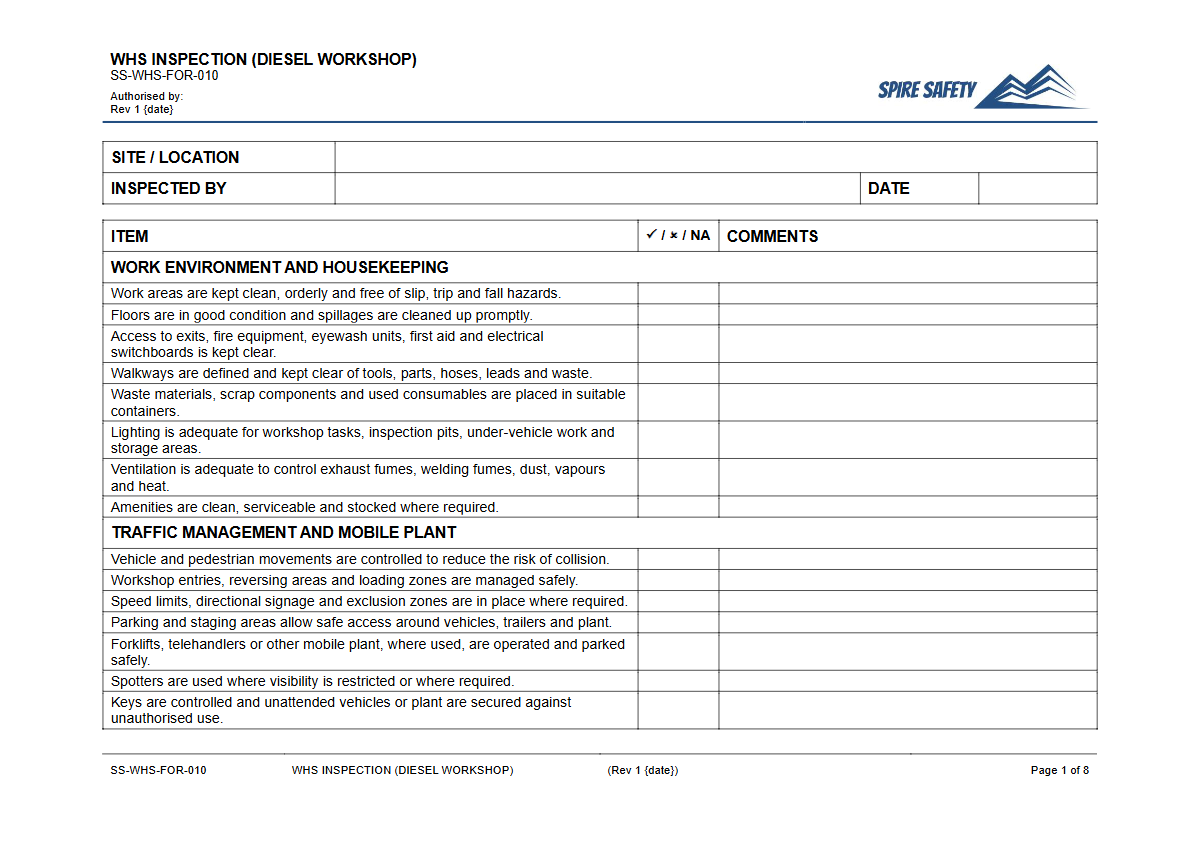
This template is provided as a fully editable DOCX file, allowing for complete customisation, along with a print-ready PDF version. It covers common hazards found in a diesel workshop environment, including general housekeeping, chemical safety, electrical equipment, emergency procedures, and vehicle hoists.
To use the template effectively, a competent person should walk through the workshop and assess each item on the list. The checklist uses a simple system to mark items as 'Compliant', 'Non-Compliant', or 'N/A', with space to add detailed comments and recommend corrective actions for any identified deficiencies.
Proper documentation is key to the inspection process. For each non-compliant item, you should assign a responsible person and a due date for the corrective action.
This creates a clear action plan and ensures accountability. Once completed, the inspection form should be signed, dated, and filed as part of your WHS records. These records are essential for demonstrating compliance during internal or external WHS compliance audits.
Important: This document is a template only. We are not WHS consultants, and this template does not constitute legal advice.
You must customise it to suit the specific hazards, equipment, substances, and processes present in your workplace. Always ensure your procedures align with the model WHS laws and relevant Codes of Practice.
When to use it
The frequency of workshop inspections depends on the level of risk and the nature of the work being performed. It is recommended to establish a regular schedule, such as monthly or quarterly, for comprehensive workplace inspections.
This routine helps maintain safety standards and identify gradual degradation of equipment or work practices. In addition to scheduled inspections, this template should be used following any significant change in the workplace, such as the introduction of new heavy machinery, a change in workshop layout, or after a safety incident or near-miss.
These ad-hoc inspections ensure that new risks are identified and controlled promptly.
You might also use a focused version of this checklist for daily or weekly checks on specific high-risk areas. For example, you could supplement this general workshop inspection with a daily pre-start checklist for an electric hoist to ensure critical lifting equipment is safe for use each day.
Integrating various checks into a cohesive schedule creates a multi-layered safety net. The goal is to build a proactive safety culture rather than a reactive one.
Who should use it
This inspection should be conducted by a person with the knowledge and experience to identify hazards specific to a diesel workshop. This could be a Workshop Manager, a Health and Safety Representative (HSR), a supervisor, or a member of the safety committee.
Involving workers who perform the day-to-day tasks can provide valuable insights, as they have direct experience with the equipment and processes. For organisations without internal expertise, engaging external WHS consulting professionals can provide an objective and thorough assessment.
The findings from the inspection report are crucial for management. The Person Conducting a Business or Undertaking (PCBU) has the primary duty of care and must ensure that identified risks are managed effectively.
This template provides the information needed for managers to make informed decisions about resource allocation for safety improvements. Ultimately, a well-executed inspection process is a key component of a WHS management system, demonstrating leadership and commitment to worker safety from the top down.
For other related templates and checklists, such as a boom gate pre-start checklist for site entry points, explore our extensive library of free WHS resources, all available for instant download.
Common mistakes
Common mistakes to avoid
- Failing to customise the template for site-specific equipment, chemicals, and tasks.
- Conducting a 'pencil-whip' inspection without physically verifying each item.
- Neglecting to document, assign, and track corrective actions for identified hazards.
- Not reviewing and updating the inspection checklist regularly or after an incident.
Legal references
Legal considerations
The following legal requirements may be relevant to this type of work.
- Work Health and Safety Act (Harmonised) — Provides the primary duties for protecting workers and other people from work health and safety risks.
- Work Health and Safety Regulations (Harmonised) — Sets out requirements supporting the management of workplace hazards and risks.
The following codes may be relevant to this type of work.
- Managing WHS Risks Code of Practice — Provides practical guidance on identifying hazards, assessing risks and applying effective controls.
- Work Health and Safety Consultation, Cooperation and Coordination Code of Practice — Provides practical guidance on consulting workers and coordinating with other duty holders.
- Managing the Work Environment and Facilities Code of Practice — Provides practical guidance on safe work environments, workplace facilities and related controls.
Did you know
Diesel Fume Dangers
Diesel engine exhaust, especially fine particulate matter (DPM), is classified as a Group 1 carcinogen. Effective ventilation and extraction systems are critical controls in a workshop environment to minimise worker exposure.
Workshop Injuries
According to Safe Work Australia, the transport, postal, and warehousing industry has one of the highest rates of serious workers' compensation claims, with technicians and trades workers being a significant subgroup.
FAQ
Frequently asked questions
01What's the difference between a workshop inspection and a pre-start check?
02How often should diesel workshop inspections be conducted?
03Who is qualified to conduct a diesel workshop safety inspection?
04Can this inspection template be used for other vehicle workshops?
Share this resource
Free WHS Inspection (Diesel Workshop) Template
Browse Categories
How To Use It
- 1Download and open in Word or PDF.
- 2Replace the placeholders with your business details.
- 3Get it reviewed by a WHS specialist before rollout.
Need it customised?
Our WHS consultants can adapt this template to your site, run a gap analysis, or audit what you already have in place.
Book a Free Consultation WHS consulting servicesor call 1300 156 382