
Free Inspection & Test Plan (Compaction Testing) Template
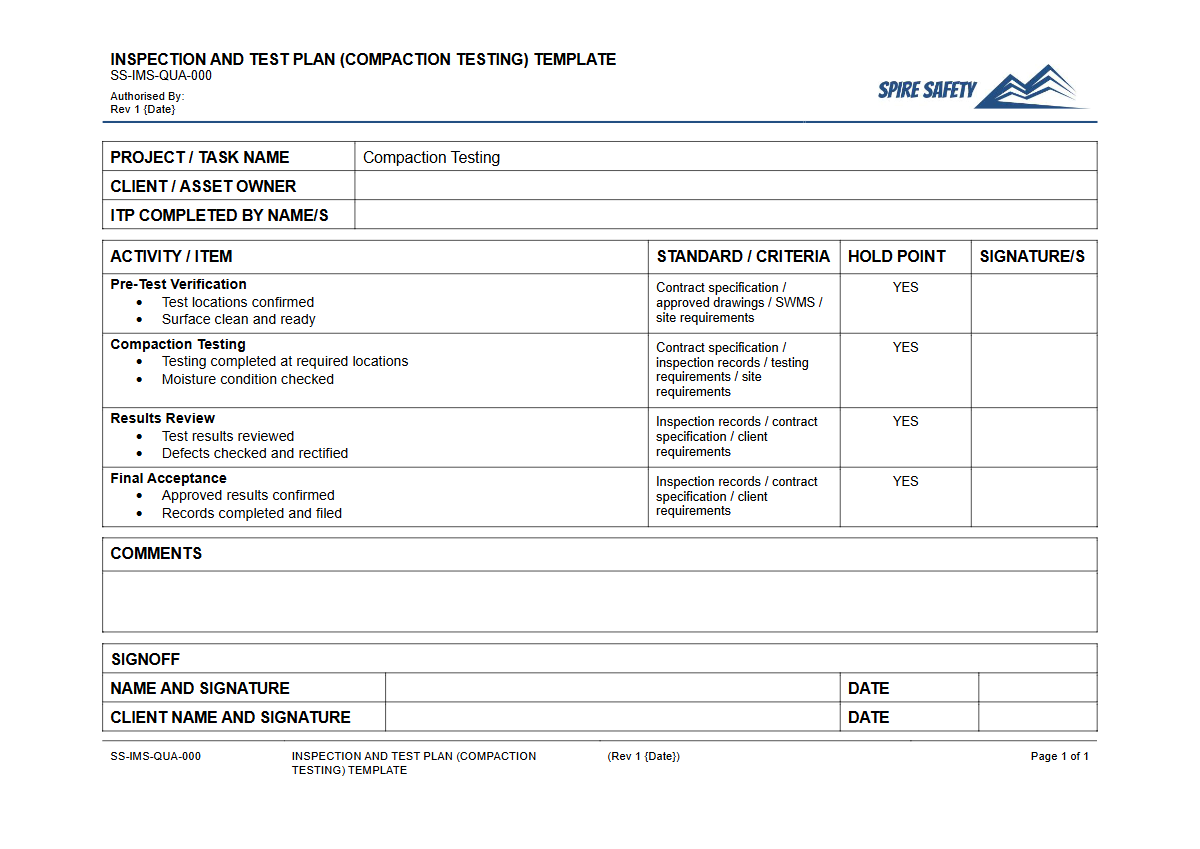
Get our Free Inspection & Test Plan for Compaction Testing. This DOCX & PDF template helps formalise quality control for civil and earthworks projects.
Free Inspection & Test Plan (Compaction Testing) Template
DOCX • 136 KB + PDF
Updated Oct 2026
No signup required
Purpose of the Free Inspection & Test Plan (Compaction Testing) Template
This Free Inspection & Test Plan (Compaction Testing) Template provides a structured framework for managing and documenting quality control activities for earthworks and pavement construction. Its primary purpose is to ensure that all compacted materials—such as soil, gravel, or asphalt—meet the specified engineering standards for density and stability.
Using a formal ITP helps verify that construction is performed correctly, reducing the risk of structural failures, settlement, or costly rework. It creates a clear, auditable trail of evidence that demonstrates due diligence and adherence to project specifications.
An effective ITP is a cornerstone of a project's quality assurance framework. It defines the 'who, what, when, and how' of testing, outlining inspection points, test methods, acceptance criteria, and the records to be maintained.
By systematically planning these activities, project teams can proactively manage quality rather than reactively fixing defects. This ITP serves as a critical communication tool between contractors, clients, and regulatory bodies, ensuring all parties are aligned on quality expectations.
Integrating this plan into broader WHS management systems also helps ensure that safety and quality processes are managed cohesively.
Video walkthrough
How to use the Free Inspection & Test Plan (Compaction Testing) Template
Our Free Inspection & Test Plan (Compaction Testing) Template is designed as a comprehensive starting point. To use it effectively, begin by reviewing the document and populating the project-specific details, such as the project name, location, and relevant personnel.
The template prompts you to define each key activity in the compaction process, from material delivery and preparation to the final testing of the compacted layer. For each step, you will need to specify the test to be performed (e.g., nuclear densometer test, sand replacement test), the frequency of testing, and the acceptance criteria based on project specifications or relevant Australian Standards (like AS 1289).
You must also assign responsibilities for performing tests, witnessing inspections (hold and witness points), and signing off on results. The 'Records' column is crucial for listing the documentation that needs to be generated, such as test certificates or daily reports.
Remember, this document is a template and must be customised to your specific workplace and project requirements. We make no claim that it supports your compliance efforts; its effectiveness depends on its correct adaptation and implementation by a competent person. The final, completed ITP becomes an official project document that may be reviewed during internal or external WHS compliance auditing.
When to use it
An Inspection & Test Plan for compaction testing should be developed during the project planning phase and implemented before any earthworks or pavement construction begins. It is a live document that is used throughout the construction lifecycle.
It is essential for a wide range of civil engineering and construction projects, including the construction of roads, highways, and airport runways where subgrade and base course stability is critical. It is also vital for building foundations, where improperly compacted soil can lead to differential settlement and structural damage.
Other key applications include the construction of earth-fill dams, embankments, and retaining walls, which all rely on achieving specific soil density for stability. It is also used when backfilling trenches for utilities like water pipes and conduits to prevent future ground subsidence.
For large-scale quarrying or mining operations, ITPs are often integrated with overarching principal hazard management plans to ensure ground stability and operational safety.
Who should use it
This template is designed for use by a range of professionals involved in the management and execution of civil construction and geotechnical projects. Project Managers and Site Managers will use the ITP to plan, schedule, and oversee quality control activities.
Quality Assurance/Quality Control (QA/QC) Managers and Engineers are typically responsible for developing, implementing, and maintaining the ITP, ensuring it aligns with the project's overall Quality Management Plan. Site Engineers and Supervisors will use it daily to direct field testing, review results, and ensure work crews are adhering to the specified procedures.
Geotechnical Engineers and technicians are the primary users for conducting the actual tests and providing the data that populates the ITP records. Contractors and subcontractors will also reference the ITP to understand their quality obligations and the verification processes they will be subject to.
Even roles adjacent to the core construction, such as those responsible for vehicle workshop safety inspections, benefit from understanding the project's quality demands, as equipment readiness is key to achieving compaction specifications. You can find more templates like this in our complete free WHS resources library to support your project's safety and quality needs.
Common mistakes
Common mistakes to avoid
- Failing to calibrate testing equipment like nuclear densometers or sand cone apparatus, leading to inaccurate results.
- Using a generic ITP without customising it to specific project soil types, layer thicknesses, and engineering requirements.
- Inadequate record-keeping of test locations, elevations, and results, making it impossible to prove compliance.
- Testing at incorrect or insufficient frequencies, creating gaps in quality verification and missing potentially non-compliant areas.
Legal references
Legal considerations
The following legal requirements may be relevant to this type of work.
- Work Health and Safety Act (Harmonised) — Provides the primary duties for protecting workers and other people from work health and safety risks.
- Work Health and Safety Regulations (Harmonised) — Sets out requirements supporting the management of workplace hazards and risks.
The following codes may be relevant to this type of work.
- Managing WHS Risks Code of Practice — Provides practical guidance on identifying hazards, assessing risks and applying effective controls.
- Work Health and Safety Consultation, Cooperation and Coordination Code of Practice — Provides practical guidance on consulting workers and coordinating with other duty holders.
- Managing the Work Environment and Facilities Code of Practice — Provides practical guidance on safe work environments, workplace facilities and related controls.
Did you know
The Proctor Test
The standard laboratory test for determining the optimal moisture content for soil compaction, the Proctor test, was developed by Ralph R. Proctor in the 1930s to control the construction of earth-fill dams.
Nuclear Densometers
Nuclear density gauges are a common field tool for compaction testing. They use a contained radioactive source to measure the density and moisture content of soil in-situ without requiring physical sampling for every test.
FAQ
Frequently asked questions
01What is the difference between an ITP and a SWMS/JSA?
02What standards should be referenced in a compaction testing ITP?
03Does this template cover all types of compaction testing?
04How often should compaction tests be performed?
Share this resource
Free Inspection & Test Plan (Compaction Testing) Template
Browse Categories
How To Use It
- 1Download and open in Word or PDF.
- 2Replace the placeholders with your business details.
- 3Get it reviewed by a WHS specialist before rollout.
Need it customised?
Our WHS consultants can adapt this template to your site, run a gap analysis, or audit what you already have in place.
Book a Free Consultation WHS consulting servicesor call 1300 156 382
Related templates
- Free Inspection & Test Plan (Concrete Columns and Walls) Template
- Free Inspection & Test Plan (Concrete Finishes) Template
- Free Inspection & Test Plan (Concrete Footings Slab) Template
- Free Inspection & Test Plan (Concrete Kerb and Channel) Template
- Free Inspection & Test Plan (Concrete Rectification Repair) Template
- Free Inspection & Test Plan (Concrete Staircase) Template