
Free Inspection & Test Plan (Concrete Kerb and Channel) Template
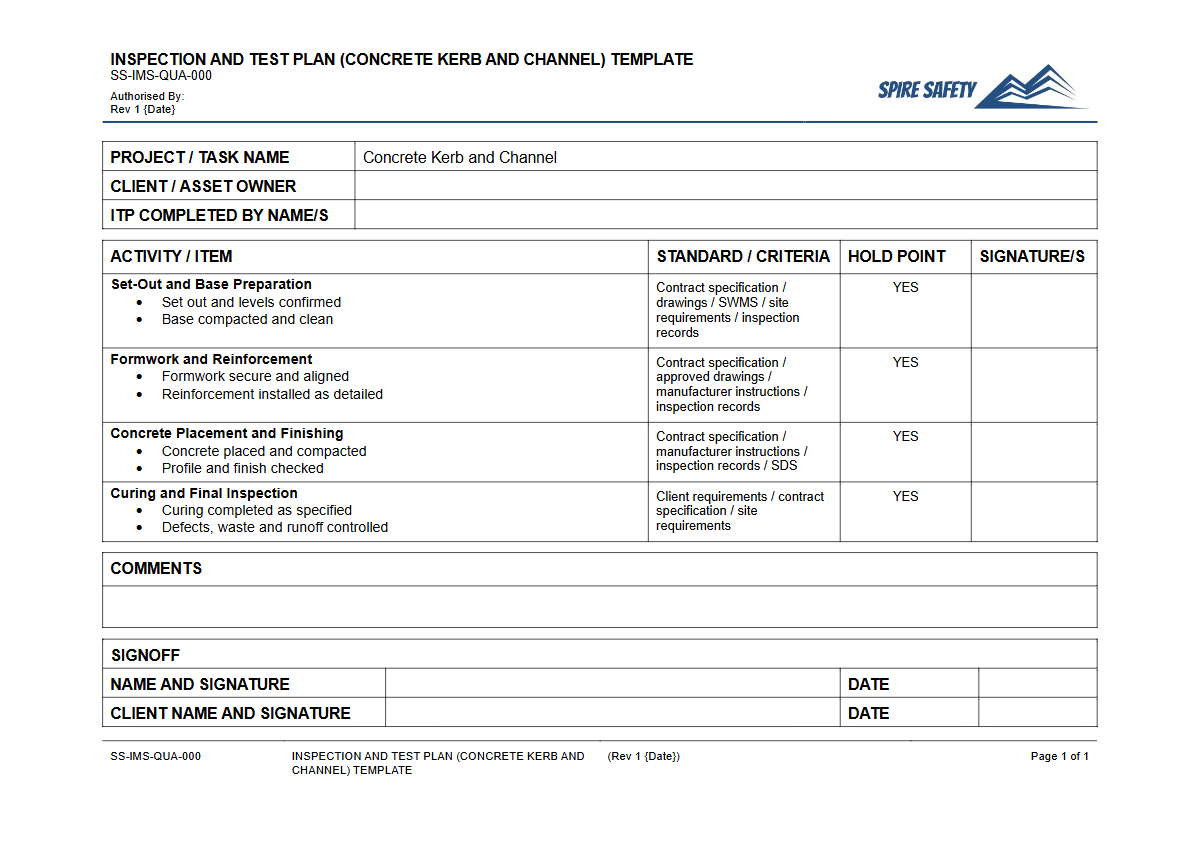
Download our free Inspection & Test Plan for Concrete Kerb and Channel projects. A structured template for Australian civil construction. Get your DOCX & PDF.
Free Inspection & Test Plan (Concrete Kerb and Channel) Template
DOCX • 137 KB + PDF
Updated Oct 2026
No signup required
Purpose of the Free Inspection & Test Plan (Concrete Kerb and Channel) Template
An Inspection and Test Plan (ITP) is a critical quality assurance document used in civil construction to ensure that concrete kerb and channel installations meet project specifications and Australian Standards. This Free Inspection & Test Plan (Concrete Kerb and Channel) Template provides a structured framework for outlining the sequence of inspections, tests, and verifications required at each stage of the process, from pre-pour checks to final handover.
Using an ITP helps formalise quality control, provides evidence of compliance, and ensures all stakeholders understand their responsibilities. It creates a clear record of verification activities, confirming that materials, equipment, and workmanship conform to the required standards. It also ensures that personnel are appropriately skilled for their tasks, which can be documented using tools like a Verification of Competency (Concrete Pump (Stationary)) Template.
Video walkthrough
How to use the Free Inspection & Test Plan (Concrete Kerb and Channel) Template
This template is designed to be a comprehensive starting point for your quality management processes. To use it effectively, follow these steps:
- Download: Choose between the DOCX file for easy editing or the PDF for straightforward printing and reference.
- Review and Customise: Go through each inspection point and hold point. Adjust the activities, responsibilities, acceptance criteria, and referenced documents to align with your specific project requirements, client specifications (e.g., council or road authority standards), and the relevant Australian Standards (such as AS 1379 and AS 3600).
- Integrate: Incorporate the customised ITP into your project documentation. Ensure it is communicated to all relevant personnel, including supervisors, workers, and subcontractors.
Important: This document is a template only. We have designed it as a structured starting point, but it must be customised to suit the specific requirements of your project, site, and organisational procedures.
This includes referencing client specifications and the outcomes of your risk assessments. A well-tailored ITP forms a key component of broader WHS management systems by embedding quality and safety checks directly into the workflow.
When to use it
The Concrete Kerb and Channel ITP should be developed and approved before any physical work commences on site. It serves as a live document throughout the project lifecycle.
Its primary use is during the construction phase to guide supervisors and engineers in carrying out and signing off on mandatory checks. These checks include verifying set-out and excavation, checking formwork and reinforcement, confirming concrete mix design compliance, monitoring the pour, and inspecting the finished product for alignment, level, and defects.
For large-scale civil or quarrying projects, these plans often integrate with overarching site safety frameworks, such as Principal Mining Hazard Management Plans. The completed and signed-off ITP also forms part of the final project handover documentation, providing an auditable record of quality assurance for the client.
Who should use it
This template is intended for use by several key roles within a construction or civil engineering project to ensure a coordinated approach to quality:
- Project Managers: To oversee the quality assurance process and ensure resources are available for inspections and testing.
- Site Engineers/Project Engineers: Responsible for developing the site-specific ITP, conducting inspections, reviewing test results, and signing off on hold and witness points.
- Quality Managers/Advisors: To ensure the ITP aligns with the company's Quality Management System and meets all contractual and regulatory requirements. They may also conduct periodic reviews or audits.
- Supervisors and Foremen: To execute the work in accordance with the ITP, ensuring their crews are aware of the inspection points and quality requirements before starting each task.
The document is also valuable for external parties, such as client representatives or superintendents, who use it to verify that work is progressing as specified. The records generated from an ITP are essential during formal WHS compliance auditing to demonstrate procedural adherence.
If your team lacks experience in developing these documents, engaging external support through WHS consulting can help establish robust and effective plans for your projects.
Common mistakes
Common mistakes to avoid
- Failing to customise the template with project-specific specifications and drawings.
- Not clearly defining objective acceptance criteria, leading to subjective or inconsistent assessments.
- Incomplete record-keeping, with missed signatures or unrecorded test results.
- Neglecting to reference the correct versions of Australian Standards or client specifications.
Legal references
Legal considerations
The following legal requirements may be relevant to this type of work.
- Work Health and Safety Act (Harmonised) — Provides the primary duties for protecting workers and other people from work health and safety risks.
- Work Health and Safety Regulations (Harmonised) — Sets out requirements supporting the management of workplace hazards and risks.
The following codes may be relevant to this type of work.
- Managing WHS Risks Code of Practice — Provides practical guidance on identifying hazards, assessing risks and applying effective controls.
- Work Health and Safety Consultation, Cooperation and Coordination Code of Practice — Provides practical guidance on consulting workers and coordinating with other duty holders.
- Managing the Work Environment and Facilities Code of Practice — Provides practical guidance on safe work environments, workplace facilities and related controls.
Did you know
Slump Test
The 'slump test' (AS 1012.3.1) is a simple, on-site method to measure the consistency and workability of fresh concrete before it's poured, ensuring it matches the mix design specifications.
Kerb vs. Channel
In civil terms, the 'kerb' is the raised vertical or semi-mountable edge, while the 'channel' (or gutter) is the flat or angled section at the base that directs water flow.
FAQ
Frequently asked questions
01What is an Inspection and Test Plan (ITP) in civil construction?
02What are the key stages in a Concrete Kerb and Channel ITP?
03Is this ITP template suitable for RMS/TMR projects?
04How does an ITP relate to a Safe Work Method Statement (SWMS)?
Share this resource
Free Inspection & Test Plan (Concrete Kerb and Channel) Template
Browse Categories
How To Use It
- 1Download and open in Word or PDF.
- 2Replace the placeholders with your business details.
- 3Get it reviewed by a WHS specialist before rollout.
Need it customised?
Our WHS consultants can adapt this template to your site, run a gap analysis, or audit what you already have in place.
Book a Free Consultation WHS consulting servicesor call 1300 156 382
Related templates
- Free Inspection & Test Plan (Concrete Rectification Repair) Template
- Free Inspection & Test Plan (Concrete Staircase) Template
- Free Inspection & Test Plan (Concrete Subfloor Ground Slab) Template
- Free Inspection & Test Plan (Concrete Terracotta Roof Tile) Template
- Free Inspection & Test Plan (Cornice and Set) Template
- Free Inspection & Test Plan (Curtain Wall Unitised Facade) Template