
Free Inspection & Test Plan (Structural Steel Erection) Template
Formalise quality control on your construction project with our free Inspection & Test Plan for structural steel erection. A structured starting point.
Free Inspection & Test Plan (Structural Steel Erection) Template
DOCX • 139 KB + PDF
Updated Oct 2026
No signup required
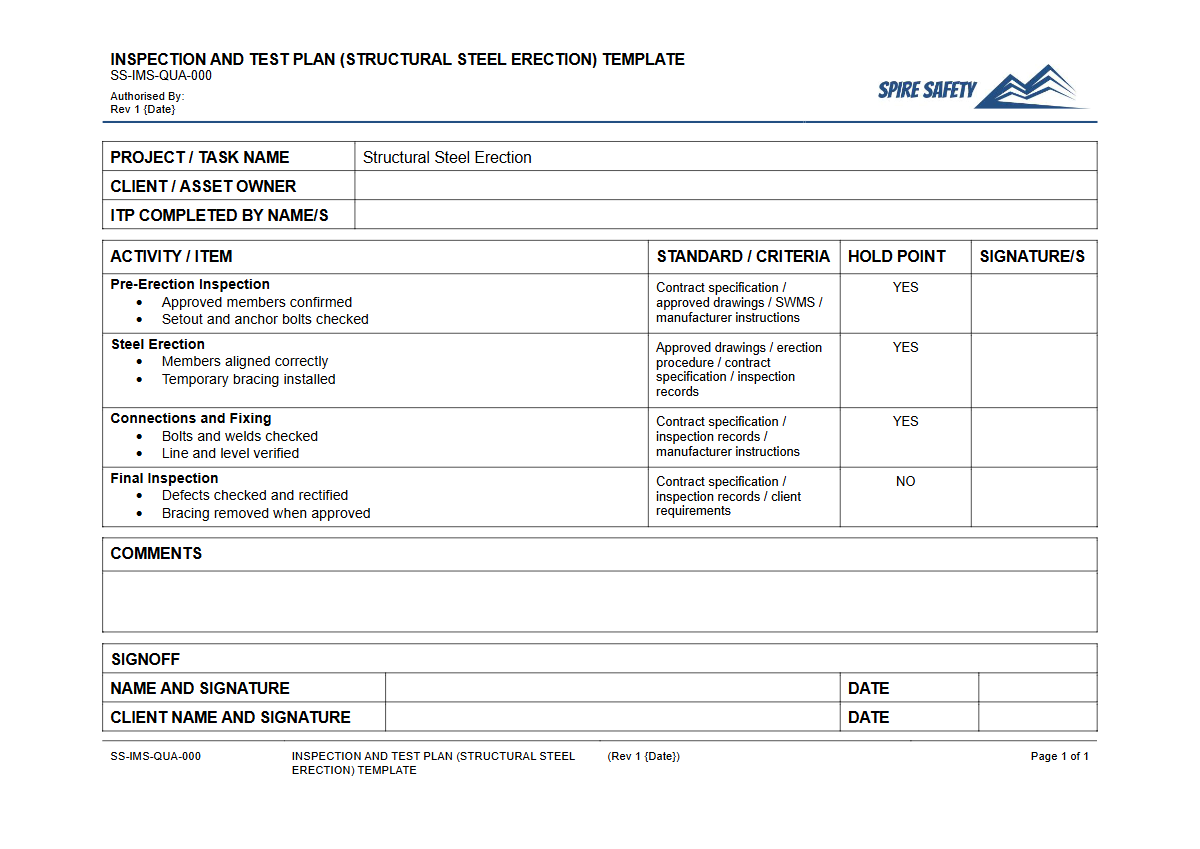
Purpose of the Free Inspection & Test Plan (Structural Steel Erection) Template
This Free Inspection & Test Plan (Structural Steel Erection) Template provides a structured framework for managing quality and safety during high-risk construction activities. Structural steel erection involves significant risks, and an ITP is a critical tool for ensuring that every stage of the process—from material receival to final bolt tensioning—is performed, inspected, and verified against project specifications and Australian standards.
An effective Inspection & Test Plan helps you systematically define key checkpoints (witness and hold points), specify acceptance criteria, assign responsibilities, and create a verifiable record of compliance. This not only promotes safety but also ensures structural integrity, prevents costly rework, and provides clear evidence of due diligence for all stakeholders.
Implementing this plan is a core component of a robust quality assurance program and demonstrates a proactive approach to managing project risks.
Key objectives of this Inspection & Test Plan include:
- Ensuring all work complies with the project design, engineering specifications, and relevant Australian Standards (e.g., AS/NZS 5131).
- Verifying that materials, fabrication, and erection methods meet required quality benchmarks.
- Providing a clear, documented trail for quality assurance and handover.
- Integrating safety checks and verification steps directly into the construction workflow.
- Defining clear hold points where work cannot proceed without formal approval, preventing non-conformances from being built upon.
For organisations undertaking high-risk activities, the ITP is a fundamental document that supports the broader safety framework. It works alongside other critical documents, such as Safe Work Method Statements (SWMS), and can be integrated into comprehensive WHS management systems to ensure a holistic approach to site safety and quality.
Video walkthrough
How to Use the Free Inspection & Test Plan (Structural Steel Erection) Template
This template is provided in both DOCX and PDF formats to give you a flexible starting point. It outlines typical stages, inspection types, and acceptance criteria common to structural steel erection projects in Australia.
To use it effectively, you must adapt it to the unique requirements of your specific project.
Please note: This template provides a foundational structure. We strongly recommend you customise it to address the specific risks, materials, equipment, personnel, and site conditions of your project.
It is not a substitute for professional engineering or safety advice.
Steps for implementation:
- Review Project Specifications: Thoroughly examine all engineering drawings, technical specifications, and contractual requirements.
- Customise the ITP: Populate the template with project-specific details. Add, remove, or modify inspection stages to match your construction sequence. Define precise, measurable acceptance criteria for each check.
- Assign Responsibilities: Clearly nominate the person or role responsible for carrying out each inspection (e.g., Site Engineer, Supervisor), witnessing the check (e.g., Client Representative, Third-Party Inspector), and signing off on its completion.
- Define Points: Distinguish between Witness Points (where an inspector may choose to observe) and Hold Points (mandatory stops where work cannot proceed without formal verification and sign-off).
- Integrate and Communicate: Ensure the ITP is communicated to all relevant personnel, including site crews, supervisors, and subcontractors. Integrate it into daily pre-start meetings and toolbox talks to maintain awareness.
- Execute and Record: Use the ITP as an active document on site. Complete all checks, collect the required evidence (e.g., photos, test certificates), and ensure all sign-offs are obtained in a timely manner. The completed records are crucial for project handover.
Regularly reviewing the ITP's effectiveness and seeking feedback from the team can help refine processes. For complex projects, engaging in independent WHS compliance auditing can provide external validation that your systems are being implemented as intended.
When to Use an Inspection & Test Plan
An Inspection & Test Plan should be developed during the project planning phase, well before any structural steel arrives on site or erection work begins. It is a live document that is used continuously throughout the construction lifecycle, from pre-commencement activities to final completion and handover.
Use this ITP at critical stages such as:
- Material receival and verification of compliance certificates.
- Pre-erection survey and set-out checks.
- During the erection sequence for each major structural element.
- Verification of bolt connections and tensioning.
- Checks for plumb, level, and alignment.
- Application of protective coatings and fire protection.
- Final inspection before handover to the principal contractor or client.
Who Should Use This Template
This Inspection & Test Plan is designed for use by various professionals involved in the construction and management of structural steel projects. Key personnel who will benefit from this resource include:
- Project Managers: For overall quality and project schedule management.
- Site Engineers & Project Engineers: For technical oversight and ensuring compliance with engineering specifications.
- Quality Assurance / Quality Control (QA/QC) Managers: For implementing and managing the project's quality system.
- Construction Supervisors & Forepersons: For directing work crews and ensuring on-the-ground compliance.
- WHS Advisors and Safety Officers: For integrating safety verifications and ensuring high-risk work is controlled.
- Principal Contractors and Subcontractors: To ensure alignment on quality standards and responsibilities.
For organisations that require further guidance on customising technical documents or enhancing their overall safety framework, seeking specialist WHS consulting can provide tailored support and expertise. If you're looking for other document templates, you can browse our complete free WHS resources library for more useful downloads.
Common mistakes
Common mistakes to avoid
- Failing to customise the template for the specific project's scope, materials, and risks.
- Using generic 'pass/fail' criteria instead of specific, measurable standards from project specifications.
- Not clearly defining and communicating responsibilities for inspection, verification, and sign-off.
- Treating the ITP as a paperwork exercise instead of an active quality and safety tool used on site.
Legal references
Legal considerations
The following legal requirements may be relevant to this type of work.
- Work Health and Safety Act (Harmonised) — Provides the primary duties for protecting workers and other people from work health and safety risks.
- Work Health and Safety Regulations (Harmonised) — Sets out requirements supporting the management of workplace hazards and risks.
The following codes may be relevant to this type of work.
- Managing WHS Risks Code of Practice — Provides practical guidance on identifying hazards, assessing risks and applying effective controls.
- Work Health and Safety Consultation, Cooperation and Coordination Code of Practice — Provides practical guidance on consulting workers and coordinating with other duty holders.
- Managing the Work Environment and Facilities Code of Practice — Provides practical guidance on safe work environments, workplace facilities and related controls.
Did you know
High-Risk Work
Structural steel erection is classified as 'high-risk construction work' under Australian WHS Regulations, requiring a Safe Work Method Statement (SWMS) to be in place before work commences.
Material Traceability
ITPs play a vital role in ensuring material traceability, creating a documented chain of evidence that confirms the steel used meets the specified grade and standards from the mill to final installation.
FAQ
Frequently asked questions
01What is the difference between a Witness Point and a Hold Point in an ITP?
02Is an ITP for structural steel a legal requirement in Australia?
03Can this template be used for small residential steel projects?
04What other documents should accompany this Inspection & Test Plan?
Share this resource
Free Inspection & Test Plan (Structural Steel Erection) Template
Browse Categories
How To Use It
- 1Download and open in Word or PDF.
- 2Replace the placeholders with your business details.
- 3Get it reviewed by a WHS specialist before rollout.
Need it customised?
Our WHS consultants can adapt this template to your site, run a gap analysis, or audit what you already have in place.
Book a Free Consultation WHS consulting servicesor call 1300 156 382
Related templates
- Free Inspection & Test Plan (Structural Steel Welding) Template
- Free Inspection & Test Plan (Subgrade Preparation) Template
- Free Inspection & Test Plan (Suspended Ceiling System) Template
- Free Inspection & Test Plan (Suspended Concrete Slab) Template
- Free Inspection & Test Plan (Switchboard Installation) Template
- Free Inspection & Test Plan (Tiling) Template