
Free Inspection & Test Plan (Switchboard Installation) Template
Download our free Inspection & Test Plan (Switchboard Installation) template. This structured DOCX & PDF helps manage quality and safety for electrical work.
Free Inspection & Test Plan (Switchboard Installation) Template
DOCX • 138 KB + PDF
Updated Oct 2026
No signup required
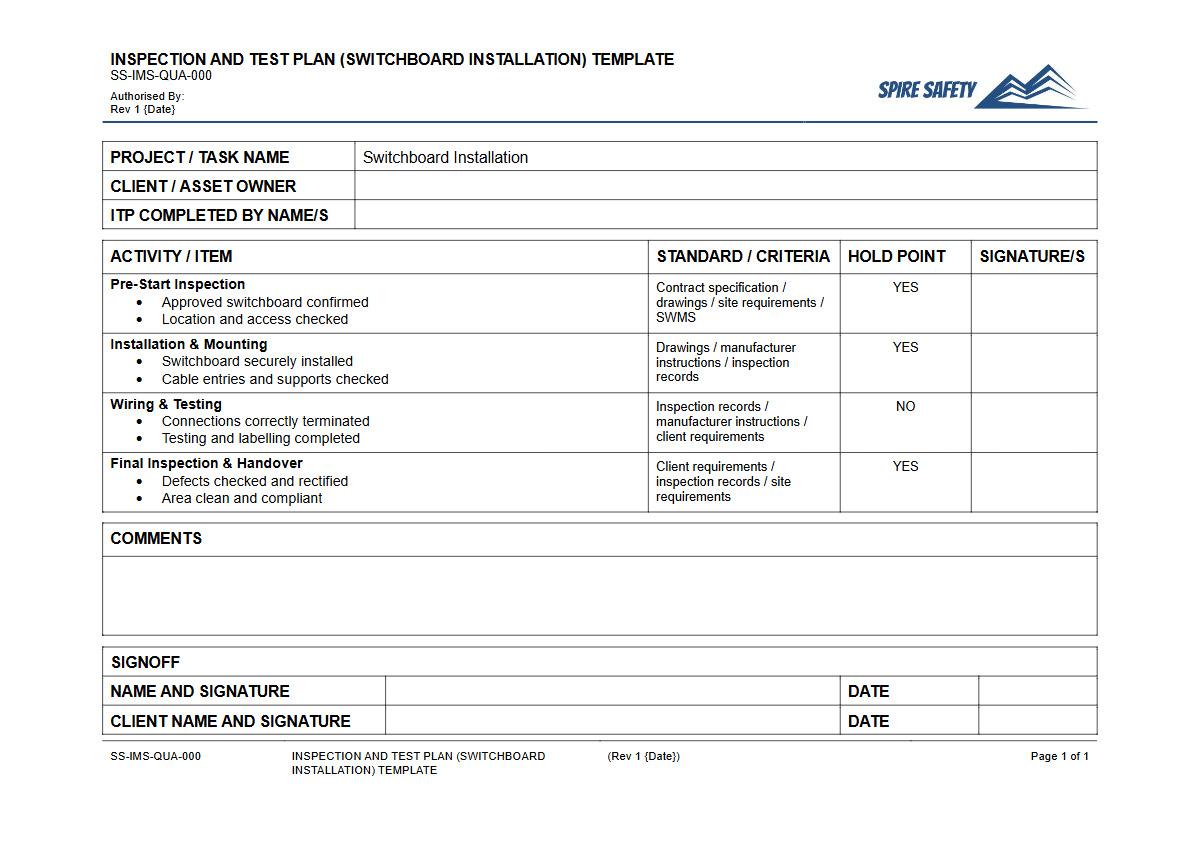
Purpose of the Free Inspection & Test Plan (Switchboard Installation) Template
An Inspection and Test Plan (ITP) is a critical quality assurance document that outlines the sequence of inspections and tests for a specific process. Our Free Inspection & Test Plan (Switchboard Installation) Template provides a structured framework to ensure every stage of a switchboard installation meets Australian standards, client specifications, and safety requirements.
It methodically maps out key checkpoints—known as witness points, hold points, and surveillance points—to verify that work is completed correctly before proceeding to the next phase. This proactive approach helps prevent defects, manage risks, and ensures a compliant and safe final installation.
Using an ITP demonstrates a commitment to quality and safety, providing clear evidence of due diligence. It serves as a vital record for project handover and is an essential component of robust WHS management systems, helping to formalise processes and ensure consistency across all electrical installation projects.
Video walkthrough
How to use the Free Inspection & Test Plan (Switchboard Installation) Template
This Inspection & Test Plan template is provided as a fully editable DOCX file, with a PDF version for easy printing and distribution. To use it, simply download the file and adapt it to your specific project needs.
The template includes sections for detailing inspection types, acceptance criteria, verification procedures, and responsible personnel. You will need to populate these fields with project-specific information, referencing relevant drawings, standards (like AS/NZS 3000), and specifications.
Important: This is a template only. We have developed it as a structured starting point, and you must customise it to the specific switchboard, site conditions, project requirements, and relevant Australian Standards. Thorough customisation ensures the ITP is a practical and effective tool for managing your unique risks, similar to the detailed risk management processes found in Principal Mining Hazard Management Plans.
When to use an Inspection & Test Plan
An Inspection & Test Plan for switchboard installation should be developed during the initial project planning phase, before any work commences on site. It should be reviewed and approved by all relevant stakeholders, including the client, project manager, and lead electrician.
The ITP is a live document used throughout the project lifecycle, from verifying off-site fabrication to final on-site commissioning. It guides supervisors and electricians on what to check and when, ensuring that no critical verification step is missed.
Upon project completion, the signed-off ITP forms part of the official handover documentation, providing a permanent record of the quality and compliance checks performed. This complements the ongoing safety inspections required for any facility, such as those detailed in our Free WHS Inspection (Vehicle Workshop) Template, which focuses on maintaining safety post-installation.
Who should use this ITP
This template is designed for a range of professionals involved in electrical construction and maintenance projects. The primary users include:
- Electrical Contractors: To standardise quality control and supports your compliance efforts across their installation teams.
- Project Managers & Site Supervisors: To monitor progress, manage quality, and ensure project milestones are met according to specification.
- Licensed Electricians: As a guide for self-checking work and preparing for formal inspection points.
- WHS & Quality Advisors: To integrate quality assurance procedures into the broader safety and quality management framework.
The responsibility for completing and signing off the ITP lies with competent and authorised personnel. For businesses needing support in developing or implementing these systems, professional WHS consulting can provide expert guidance.
The finalised ITP also serves as a key piece of evidence during internal or external audits, which can be verified through a formal WHS compliance auditing process. When you have finished customising your template, feel free to browse our complete free WHS resources library for more helpful tools.
Common mistakes
Common mistakes to avoid
- Failing to adequately customise the template for the specific project, switchboard type, and site conditions.
- Not involving competent personnel (e.g., licensed electricians, engineers) in the development and review of the ITP.
- Poor record-keeping, including missing signatures, dates, or objective evidence at verification points.
- Treating 'hold points' as 'witness points' and proceeding with work without formal sign-off from the required authority.
Legal references
Legal considerations
The following legal requirements may be relevant to this type of work.
- Work Health and Safety Act (Harmonised) — Provides the primary duties for protecting workers and other people from work health and safety risks.
- Work Health and Safety Regulations (Harmonised) — Sets out requirements supporting the management of workplace hazards and risks.
The following codes may be relevant to this type of work.
- Managing WHS Risks Code of Practice — Provides practical guidance on identifying hazards, assessing risks and applying effective controls.
- Work Health and Safety Consultation, Cooperation and Coordination Code of Practice — Provides practical guidance on consulting workers and coordinating with other duty holders.
- Managing the Work Environment and Facilities Code of Practice — Provides practical guidance on safe work environments, workplace facilities and related controls.
Did you know
Outdated Switchboards
Many older Australian homes still have switchboards with replaceable ceramic fuses. These offer less protection than modern circuit breakers and are a significant electrical hazard, lacking the safety switch technology that protects against electric shock.
A Leading Fire Hazard
Electrical faults are a leading cause of house fires in Australia. Regular inspection and testing of electrical systems, including switchboards, is a critical fire prevention measure.
FAQ
Frequently asked questions
01What is the primary purpose of an Inspection & Test Plan for switchboard installation?
02Who is responsible for signing off on an ITP?
03Does this template cover both low voltage and high voltage switchboards?
04How does an ITP relate to a Safe Work Method Statement (SWMS)?
Share this resource
Free Inspection & Test Plan (Switchboard Installation) Template
Browse Categories
How To Use It
- 1Download and open in Word or PDF.
- 2Replace the placeholders with your business details.
- 3Get it reviewed by a WHS specialist before rollout.
Need it customised?
Our WHS consultants can adapt this template to your site, run a gap analysis, or audit what you already have in place.
Book a Free Consultation WHS consulting servicesor call 1300 156 382
Related templates
- Free Inspection & Test Plan (Tiling) Template
- Free Inspection & Test Plan (Tilt-Up Panel) Template
- Free Inspection & Test Plan (Timber Floor Framing) Template
- Free Inspection & Test Plan (Timber Flooring) Template
- Free Inspection & Test Plan (Timber Hardiplank Cladding) Template
- Free Inspection & Test Plan (Timber Wall Framing) Template