
Free Inspection & Test Plan (Structural Steel Welding) Template
Streamline quality control for structural steel fabrication with our free Inspection & Test Plan (Structural Steel Welding) Template.
Free Inspection & Test Plan (Structural Steel Welding) Template
DOCX • 137 KB + PDF
Updated Oct 2026
No signup required
Purpose of this Free Inspection & Test Plan (Structural Steel Welding) Template
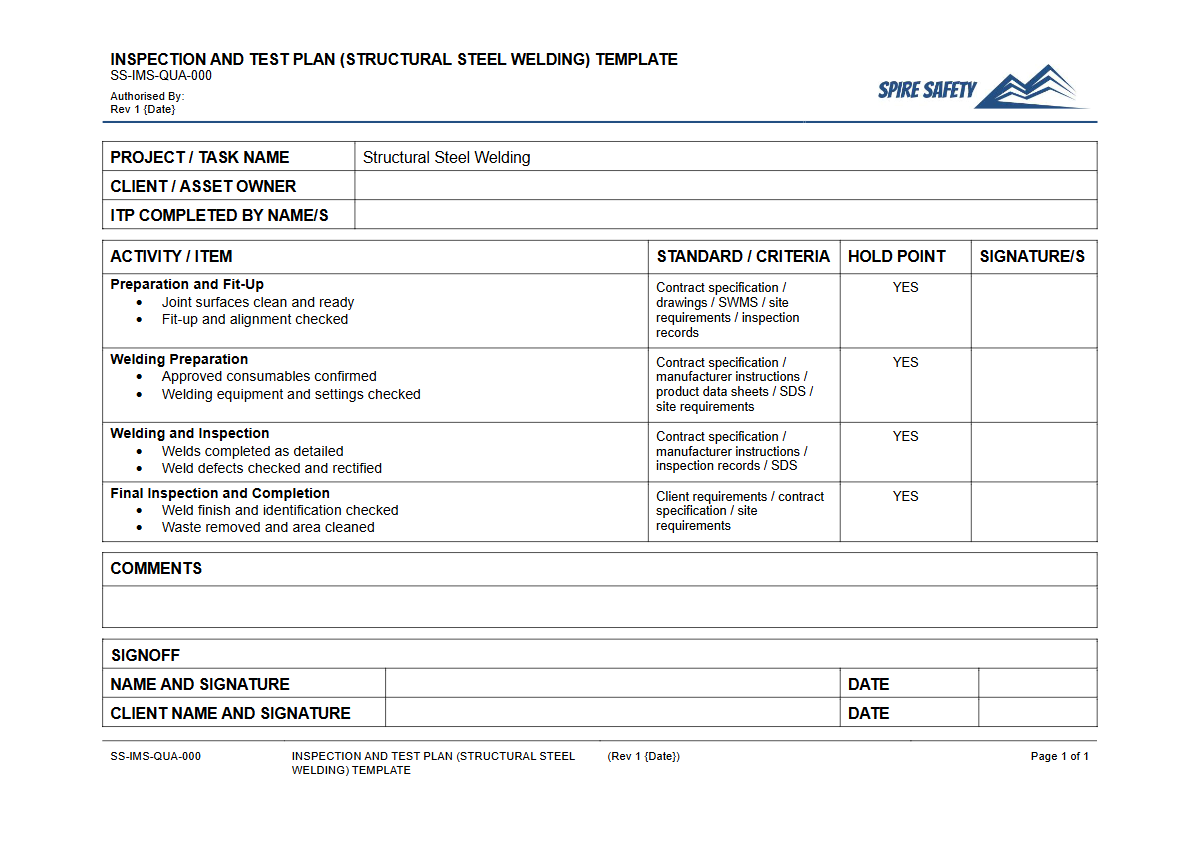
Ensuring the integrity of structural steel welds is critical for the safety and longevity of any building, bridge, or industrial structure. This free Inspection & Test Plan (ITP) for Structural Steel Welding provides a structured starting point for fabricators, builders, and project managers to systematically manage quality control.
An ITP outlines the sequence of inspections, tests, verification points, and acceptance criteria required to confirm that all welding activities meet project specifications and Australian Standards. It serves as a key quality assurance document, providing evidence that processes are controlled and work is completed correctly.
By implementing a detailed Inspection & Test Plan, your organisation can proactively identify non-conformances, reduce costly rework, and maintain a documented audit trail of quality checks. This plan is an essential component of robust WHS management systems, helping to formalise procedures and demonstrate due diligence.
It establishes clear responsibilities for each inspection point, from material verification before welding begins to final visual and non-destructive testing (NDT) of the completed welds.
Video walkthrough
How to use the Free Inspection & Test Plan (Structural Steel Welding) Template
This template is designed to be a comprehensive but adaptable framework. To use it effectively, you should begin by reviewing the entire document and identifying the sections relevant to your specific project.
The plan is structured with columns for the activity or inspection point, references to applicable standards (e.g., AS/NZS 1554), acceptance criteria, verification methods, and sign-off responsibilities. Populate each row with the specific details of your fabrication and erection sequence, including material checks, welder qualifications, pre-weld setup, in-process checks, and post-weld inspections.
It is crucial to customise this document to your project's unique requirements. We strongly advise that you modify the template to align with your specific engineering drawings, project specifications, client requirements, and internal quality procedures.
The hold points, witness points, and review points should be agreed upon with all relevant stakeholders, including clients and third-party inspectors, before work commences. Regular reviews and follow-up actions, sometimes verified through WHS compliance auditing, ensure the plan remains effective throughout the project lifecycle.
When to use an Inspection & Test Plan
An ITP for structural steel welding should be developed during the project planning phase and implemented before any fabrication work begins. It is a live document used throughout the entire welding process.
Key stages for its application include pre-commencement reviews to approve procedures and qualify personnel, checks on incoming materials to ensure they meet specifications, and inspections during fabrication at designated hold points. Welding is considered a high-risk activity, and managing it requires documented processes similar to those outlined in guides for principal hazard management plans.
The plan is also essential during the post-weld phase, governing activities like post-weld heat treatment (PWHT), non-destructive testing (NDT), and final dimensional and visual checks. It provides the framework for final acceptance and collation of all quality records, which are then typically handed over to the client as part of the project completion documentation.
Using the ITP consistently ensures that no critical quality or safety check is missed.
Who should use this Inspection & Test Plan
This template is intended for a range of personnel involved in the quality management of structural steel projects. Quality Assurance (QA) and Quality Control (QC) managers will use it to establish and monitor the project's quality framework.
Project Managers and Construction Managers rely on it to supports your compliance efforts with standards and contractual obligations. Welding Supervisors and Forepersons use the ITP as a daily guide to manage workshop or on-site activities and ensure their teams adhere to the specified checkpoints.
Third-party inspectors and client representatives will also use the ITP to verify that work is being performed to the agreed-upon standards at witness and hold points. While this document details the welding process, overall site safety must also be maintained.
For example, fabrication often occurs within large structures where multiple activities happen concurrently, making broad safety checks like those in a WHS inspection for an aircraft hangar equally important. You can find more templates for various workplaces in our free WHS resources library to support your broader safety program.
Common mistakes
Common mistakes to avoid
- Failing to reference the specific clauses of applicable standards (e.g., AS/NZS 1554.1).
- Using generic or undefined acceptance criteria instead of project-specific requirements.
- Inadequate record-keeping, leading to a failed audit trail and missing compliance evidence.
- Skipping or inadequately documenting 'hold points', which require formal sign-off before work can proceed.
Legal references
Legal considerations
The following legal requirements may be relevant to this type of work.
- Work Health and Safety Act (Harmonised) — Provides the primary duties for protecting workers and other people from work health and safety risks.
- Work Health and Safety Regulations (Harmonised) — Sets out requirements supporting the management of workplace hazards and risks.
The following codes may be relevant to this type of work.
- Managing WHS Risks Code of Practice — Provides practical guidance on identifying hazards, assessing risks and applying effective controls.
- Work Health and Safety Consultation, Cooperation and Coordination Code of Practice — Provides practical guidance on consulting workers and coordinating with other duty holders.
- Managing the Work Environment and Facilities Code of Practice — Provides practical guidance on safe work environments, workplace facilities and related controls.
Did you know
Weld Strength
A correctly performed structural weld is designed to be as strong as or stronger than the base metals being joined, effectively making the fabricated structure monolithic.
Sydney Harbour Bridge
While the Sydney Harbour Bridge is famous for its riveted construction, modern structural steel fabrication relies almost exclusively on welding for its efficiency, strength, and design flexibility.
FAQ
Frequently asked questions
01What is the difference between an Inspection & Test Plan (ITP) and a Safe Work Method Statement (SWMS)?
02Does this ITP template cover all requirements of AS/NZS 1554?
03Who is responsible for signing off on an ITP?
04How do I determine the correct acceptance criteria for my project?
Share this resource
Free Inspection & Test Plan (Structural Steel Welding) Template
Browse Categories
How To Use It
- 1Download and open in Word or PDF.
- 2Replace the placeholders with your business details.
- 3Get it reviewed by a WHS specialist before rollout.
Need it customised?
Our WHS consultants can adapt this template to your site, run a gap analysis, or audit what you already have in place.
Book a Free Consultation WHS consulting servicesor call 1300 156 382
Related templates
- Free Inspection & Test Plan (Subgrade Preparation) Template
- Free Inspection & Test Plan (Suspended Ceiling System) Template
- Free Inspection & Test Plan (Suspended Concrete Slab) Template
- Free Inspection & Test Plan (Switchboard Installation) Template
- Free Inspection & Test Plan (Tiling) Template
- Free Inspection & Test Plan (Tilt-Up Panel) Template