
Free Pre-Start Checklist (Chipper) Template
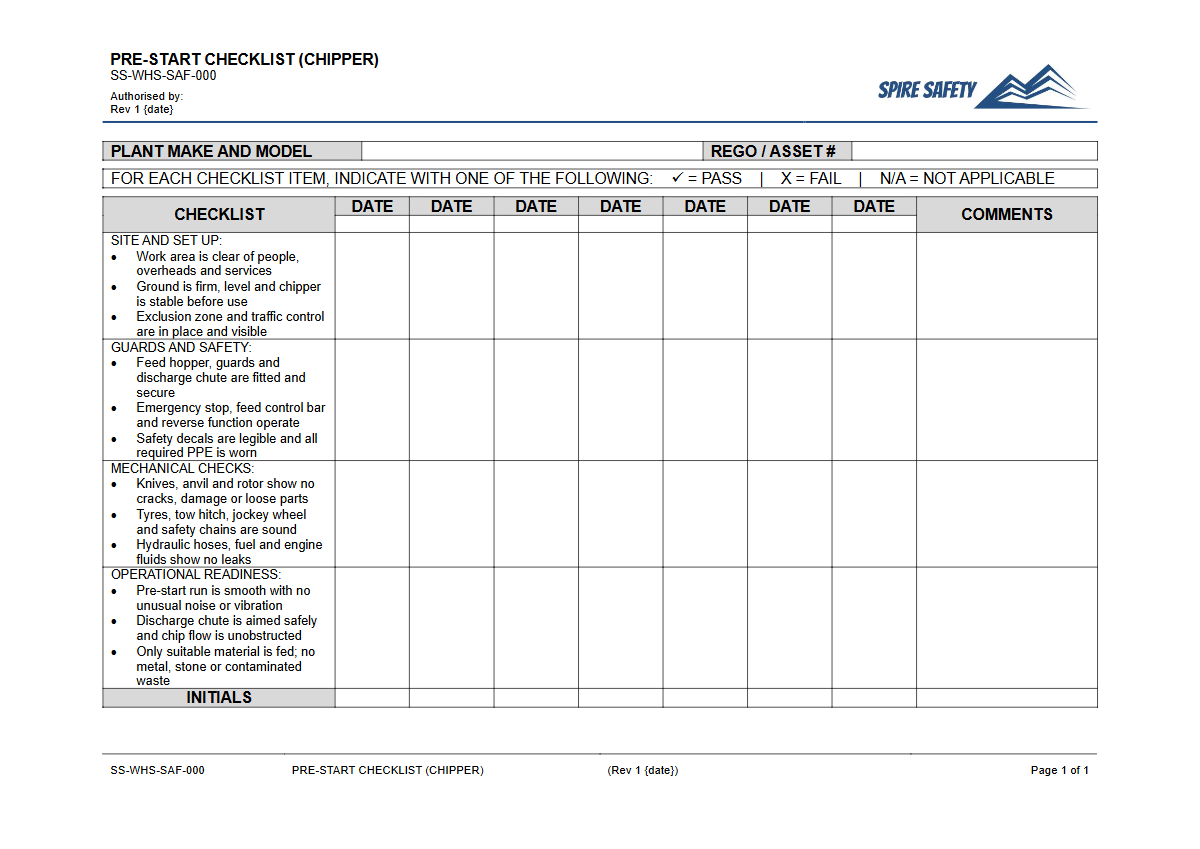
Download our Free Pre-Start Checklist (Chipper) Template to formalise your equipment safety inspections. This DOCX and PDF is a structured starting point.
Free Pre-Start Checklist (Chipper) Template
DOCX • 125 KB + PDF
Updated Oct 2026
No signup required
Purpose of the Free Pre-Start Checklist (Chipper) Template
Using a wood chipper introduces significant workplace hazards, including entanglement, cuts, and being struck by flying debris. This Free Pre-Start Checklist (Chipper) Template provides a structured framework for operators to inspect the equipment before use, ensuring it is in safe working order.
Systematically conducting these checks helps identify mechanical faults, fluid leaks, or damage to safety features like guards and emergency stops before they can lead to an incident. Integrating this process into your daily operations is a critical component of risk management and demonstrates a commitment to proactive safety, forming a key part of effective WHS management systems.
Video walkthrough
How to Use the Free Pre-Start Checklist (Chipper) Template
This resource is available as a fully editable DOCX file and a print-ready PDF. After downloading, you can implement it immediately.
The checklist guides the operator through a logical inspection sequence, covering critical components like the infeed chute, blades, discharge chute, engine, and safety controls. A key part of using any template is ensuring it is fit for your specific operational context and equipment.
While this checklist covers common inspection points, it is vital to also assess operator skill with a process like our Verification of Competency for a Wood Chipper to ensure they have the necessary knowledge to operate the machinery safely.
Note: This document is a template and must be customised to your specific workplace. We recommend you review and amend it to include the make and model of your chipper, site-specific hazards, and any additional inspection points required by the manufacturer or your Safe Work Method Statement (SWMS).
When to Conduct a Chipper Pre-Start Check
A pre-start inspection must be completed before the chipper is used for the first time each day or at the beginning of each shift. This routine ensures that the equipment's condition hasn't changed overnight and is safe for the day's work.
It is also essential to conduct a check after the equipment has been transported to a new location, or following any maintenance or repair work. Regular safety discussions reinforce this habit, which can be facilitated with resources like a Pre-Start Checks and Plant Maintenance Toolbox Talk.
Who Should Complete the Checklist
Only workers who have been trained, deemed competent, and are authorised to operate the wood chipper should perform the pre-start inspection. The operator has the most hands-on interaction with the machine and is best placed to notice subtle changes in its condition or performance.
Supervisors or managers also have a responsibility to ensure these checks are being completed correctly and to review submitted checklists for any reported faults. If your organisation requires assistance in developing competency frameworks for plant operators, consider engaging specialist WHS consulting to ensure your processes are robust.
By consistently using this checklist, you create a documented record of equipment serviceability. This history can be invaluable for maintenance planning, incident investigations, and WHS audits.
For businesses in landscaping, arboriculture, or council works, this checklist is just one of many useful tools. You may also find value in our Free Pre-Start Checklist (Aerator) Template for other common equipment.
These resources help formalise safety processes across your entire plant inventory. Explore our complete free WHS resources library for more templates to support your safety management system.
Common mistakes
Common mistakes to avoid
- Operator completes the checklist from memory without physically inspecting the item (a 'tick and flick' exercise).
- Failing to immediately remove faulty equipment from service and clearly tag it as 'Out of Service'.
- Using a generic checklist that does not match the specific make and model of the chipper being used.
- Neglecting to train operators on *how* to properly conduct each check, not just that they need to do it.
Legal references
Legal considerations
The following legal requirements may be relevant to this type of work.
- Work Health and Safety Act (Harmonised) — Provides the primary duties for protecting workers and other people from work health and safety risks.
- Work Health and Safety Regulations (Harmonised) — Sets out requirements supporting the management of workplace hazards and risks.
The following codes may be relevant to this type of work.
- Managing WHS Risks Code of Practice — Provides practical guidance on identifying hazards, assessing risks and applying effective controls.
- Work Health and Safety Consultation, Cooperation and Coordination Code of Practice — Provides practical guidance on consulting workers and coordinating with other duty holders.
- Managing the Work Environment and Facilities Code of Practice — Provides practical guidance on safe work environments, workplace facilities and related controls.
Did you know
Danger Zone
The area around a chipper's infeed chute is extremely dangerous. Workers should never reach into the chute and must maintain a safe distance, as the machine is designed to aggressively pull material in.
Blade Speed
The cutting disc or drum in a commercial wood chipper can rotate at speeds exceeding 1,000 RPM, generating immense force and kinetic energy capable of processing large logs in seconds.
FAQ
Frequently asked questions
01Is this chipper pre-start checklist a legal requirement in Australia?
02What should an operator do if a fault is found during the inspection?
03How often should I review and update my pre-start checklists?
04Can I integrate this checklist into our digital safety system?
Share this resource
Free Pre-Start Checklist (Chipper) Template
Browse Categories
How To Use It
- 1Download and open in Word or PDF.
- 2Replace the placeholders with your business details.
- 3Get it reviewed by a WHS specialist before rollout.
Need it customised?
Our WHS consultants can adapt this template to your site, run a gap analysis, or audit what you already have in place.
Book a Free Consultation WHS consulting servicesor call 1300 156 382