
Free Pre-Start Checklist (CNC Lathe) Template
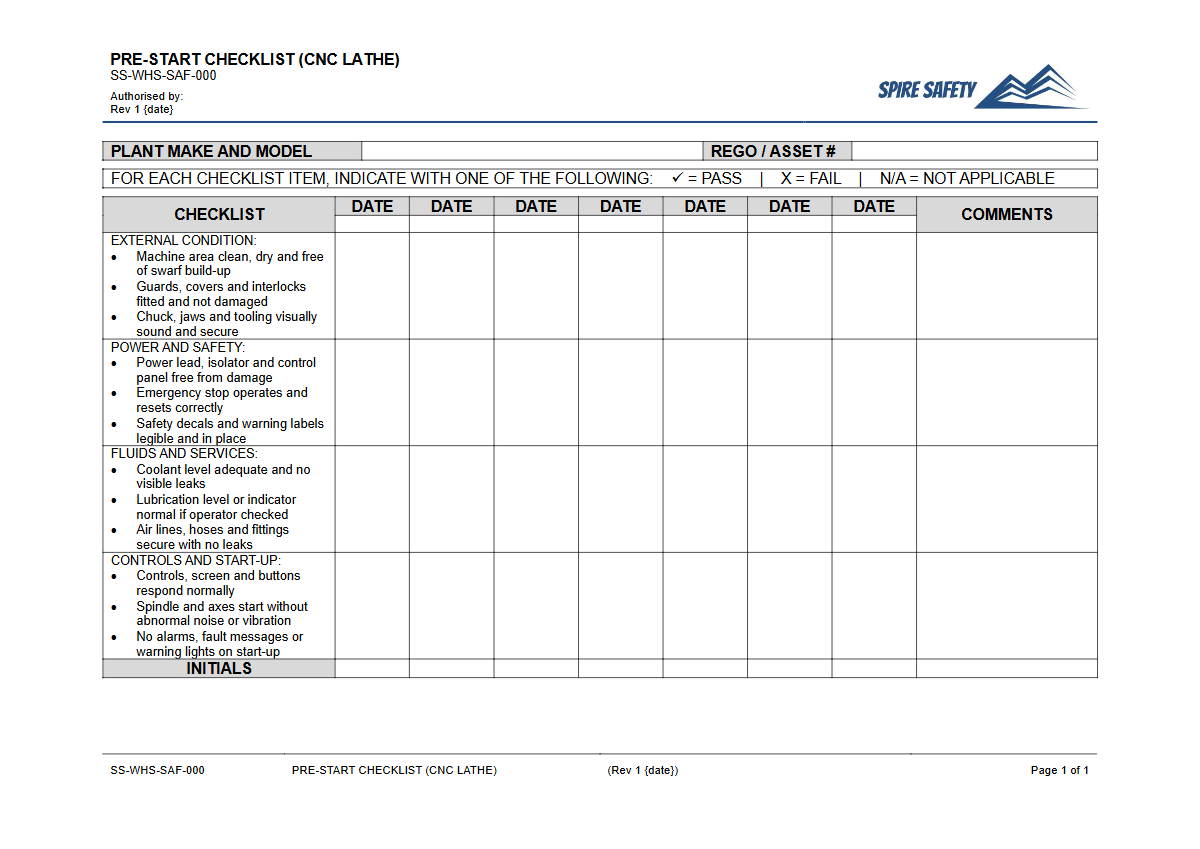
Download our free Pre-Start Checklist (CNC Lathe) Template. This structured DOCX & PDF resource helps formalise daily safety checks for your workshop.
Free Pre-Start Checklist (CNC Lathe) Template
DOCX • 125 KB + PDF
Updated Oct 2026
No signup required
Purpose of the Free Pre-Start Checklist (CNC Lathe) Template
Operating a Computer Numerical Control (CNC) lathe involves significant risks, including entanglement, high-speed projectiles, and exposure to cutting fluids. A systematic pre-start inspection is a fundamental safety measure to identify and control these hazards before they cause an incident.
Our Free Pre-Start Checklist (CNC Lathe) Template provides a structured framework to guide operators through these essential checks, ensuring equipment is in safe working order before any job commences.
Using this checklist helps formalise your safety procedures, creating a documented record of due diligence and fostering a proactive safety culture within your organisation. Integrating regular, documented inspections is a cornerstone of effective WHS management systems, demonstrating a commitment to worker safety. The principles of verifying guards, controls, and fluid levels are transferable across various types of workshop machinery, though the specifics will differ, as seen in a pre-start checklist for a bench grinder.
Video walkthrough
How to use the Free Pre-Start Checklist (CNC Lathe) Template
This resource is designed to be a practical starting point for your workplace. After downloading the DOCX or PDF file, you should review and adapt the checklist items to suit your specific operational needs.
This ensures the document is relevant and effective for the machinery and tasks your workers perform.
It is crucial to customise this template to reflect the specific make, model, and configuration of your CNC lathe, as well as your unique site conditions, safe work procedures, and the types of materials being machined. If you are uncertain about identifying all relevant hazards or control measures, seeking specialist WHS consulting can provide clarity and ensure your safety documentation is robust.
The inspection points for a lathe are very different from those on other industrial equipment, such as a pre-start checklist for a floor saw, highlighting the need for customisation.
When to use it
A pre-start check should be completed by the operator at the beginning of every shift or before the first use of the machine each day. It should also be performed after any maintenance or repair work, or if the machine has been idle for an extended period.
The goal is to catch potential faults before the machine is put under load.
Completed checklists should be signed, dated, and stored as part of your organisation's safety records. These documents provide a valuable history of the machine's condition and can be a critical piece of evidence during incident investigations or WHS compliance audits. They help track recurring issues and demonstrate that safety checks are being consistently performed.
Who should use it
The pre-start checklist must be completed by a worker who is trained, competent, and authorised to operate the specific CNC lathe. This person must not only be skilled in its operation but also understand the hazards associated with it and be able to recognise the signs of a fault, such as unusual noises, vibrations, or leaks.
Supervisors should periodically review completed checklists to ensure they are being filled out correctly and to follow up on any reported defects or maintenance requirements.
While the operator performs the check, the responsibility for providing a safe machine and safe systems of work ultimately lies with the Person Conducting a Business or Undertaking (PCBU). This structured checklist assists both parties in fulfilling their safety duties.
You can explore our free WHS resources library for other templates and guides to support your safety management activities.
Common mistakes
Common mistakes to avoid
- Using a generic checklist without customising it for the specific CNC lathe model and its unique risks.
- Operators 'pencil-whipping' the form (ticking boxes) without physically inspecting the items.
- Failing to immediately tag out and report faulty equipment identified during the check.
- Poor record-keeping practices, which prevent the tracking of recurring faults or demonstration of due diligence.
Legal references
Legal considerations
The following legal requirements may be relevant to this type of work.
- Work Health and Safety Act (Harmonised) — Provides the primary duties for protecting workers and other people from work health and safety risks.
- Work Health and Safety Regulations (Harmonised) — Sets out requirements supporting the management of workplace hazards and risks.
The following codes may be relevant to this type of work.
- Managing WHS Risks Code of Practice — Provides practical guidance on identifying hazards, assessing risks and applying effective controls.
- Work Health and Safety Consultation, Cooperation and Coordination Code of Practice — Provides practical guidance on consulting workers and coordinating with other duty holders.
- Managing the Work Environment and Facilities Code of Practice — Provides practical guidance on safe work environments, workplace facilities and related controls.
Did you know
Entanglement Risk
The spindle on a CNC lathe can rotate at thousands of RPM. Even a moment's contact with loose clothing, hair, or jewellery can result in a catastrophic entanglement injury in a fraction of a second.
Projectile Hazard
The cutting and clamping forces in a CNC lathe are immense. An improperly secured workpiece or a failing tool can be ejected at extremely high velocity, creating a lethal projectile hazard.
FAQ
Frequently asked questions
01What are the most critical checks on a CNC lathe pre-start?
02How often should a CNC lathe pre-start check be done?
03Who is responsible for actioning faults found on the checklist?
04Does using this pre-start checklist template guarantee WHS compliance?
Share this resource
Free Pre-Start Checklist (CNC Lathe) Template
Browse Categories
How To Use It
- 1Download and open in Word or PDF.
- 2Replace the placeholders with your business details.
- 3Get it reviewed by a WHS specialist before rollout.
Need it customised?
Our WHS consultants can adapt this template to your site, run a gap analysis, or audit what you already have in place.
Book a Free Consultation WHS consulting servicesor call 1300 156 382