
Free Pre-Start Checklist (Coffee Machine) Template
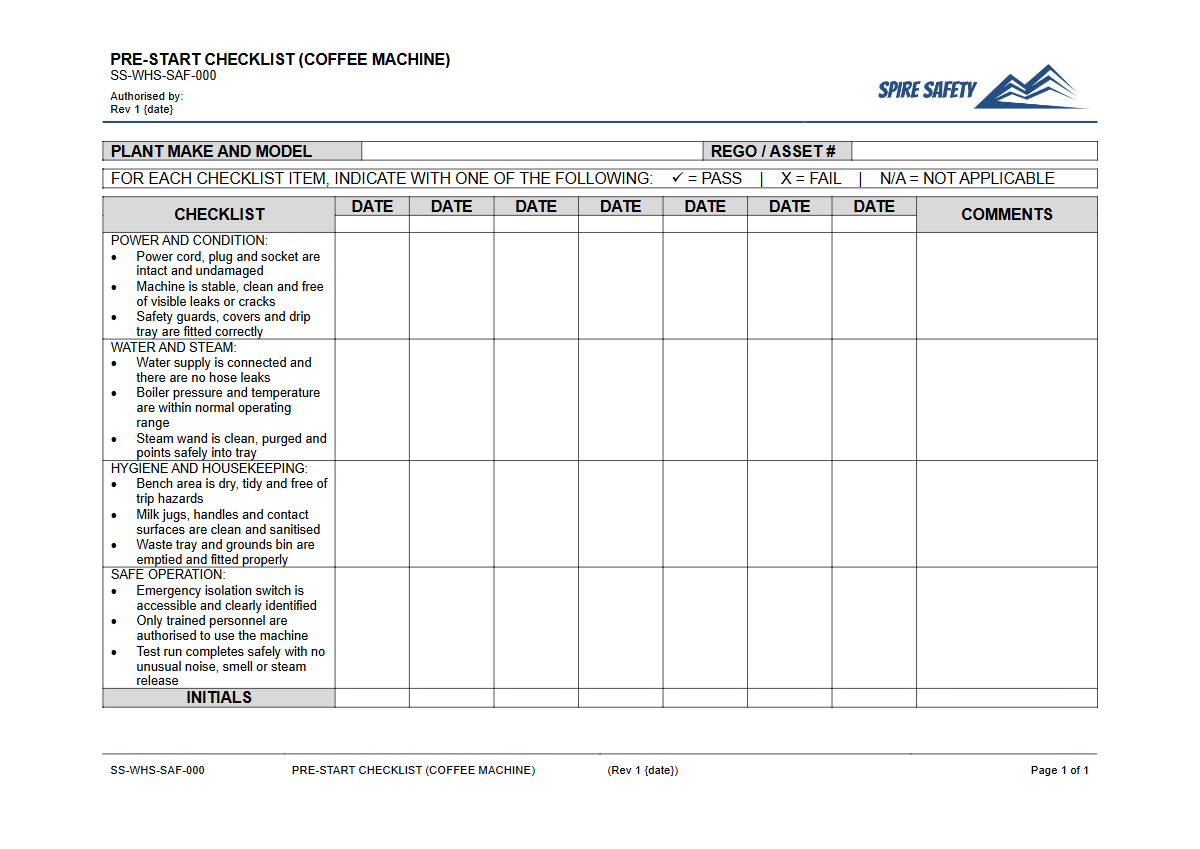
Download our free Pre-Start Checklist for Coffee Machines (DOCX & PDF). Formalise daily equipment inspections and improve safety in your cafe or office.
Free Pre-Start Checklist (Coffee Machine) Template
DOCX • 125 KB + PDF
Updated Oct 2026
No signup required
Purpose of the Free Pre-Start Checklist (Coffee Machine) Template
While often seen as a standard kitchen appliance, commercial coffee machines are pieces of plant that combine high-pressure steam, hot water, and electricity. A failure in any of these systems can pose a significant risk of burns, electric shock, or other injuries.
Using a Free Pre-Start Checklist (Coffee Machine) Template helps a Person Conducting a Business or Undertaking (PCBU) meet their primary duty of care by formalising daily safety and operational checks. This ensures the equipment is safe for use before staff members begin their shift, preventing incidents and promoting a consistent safety culture.
Regularly documenting these checks provides a clear record of due diligence and equipment condition over time.
Implementing daily checks helps identify minor issues like worn seals, frayed cords, or blocked steam wands before they escalate into serious hazards or cause costly equipment downtime. These routine inspections are a fundamental component of preventative maintenance.
You can reinforce these concepts with staff by using a dedicated Pre-Start Checks and Plant Maintenance Toolbox Talk to discuss the importance of the procedure.
Video walkthrough
How to use the Free Pre-Start Checklist (Coffee Machine) Template
This template provides a structured starting point for developing your workplace-specific checklist. To use it effectively, download the DOCX file and adapt it to the unique characteristics of your coffee machine and operational environment.
It's crucial to add or remove checks based on the specific make, model, and features of your equipment. For example, a machine with a direct water line has different checks than one with a manual-fill reservoir.
Walk through the checklist with a competent person, such as an experienced barista or maintenance technician, to ensure all relevant inspection points are covered. You should also add your company branding and specific instructions for reporting faults.
Many workplaces also require checks on related equipment, so you may find our Free Pre-Start Checklist (Coffee Grinder) Template useful for building a complete morning procedure. This customisation process ensures the checklist is practical, relevant, and effective for your business.
Important: This is a template only. We cannot guarantee it will be suitable for your specific needs. You must review and customise this document to align with your equipment, operational risks, and the specific WHS legislative requirements of your state or territory.
What to Include in Your Pre-Start Checklist
A comprehensive coffee machine pre-start should be logical and easy to follow. Grouping checks into categories can help operators work through it efficiently. Consider including the following sections:
General & Visual Checks
- Machine is clean and in its designated position.
- Power cords and plugs are free from damage, cuts, or abrasion.
- No visible leaks from hoses, fittings, or under the machine.
- Drip tray and waste container are empty and correctly positioned.
- All panels and casings are secure.
Functional & Operational Checks
- Water supply is on and pressure is within the normal range (if a gauge is present).
- Machine powers on correctly without error codes.
- Steam wands function correctly, producing dry steam with no blockages.
- Hot water outlet dispenses correctly.
- Group heads are clear and dispense water evenly.
This checklist forms part of a safe system of work, but it is not a substitute for a full Safe Operating Procedure (SOP). While a pre-start confirms readiness, a procedure like a Milling Machine SOP provides detailed step-by-step instructions for the entire task.
Your coffee machine operation should also be supported by a full SOP.
Who should use this Pre-Start Checklist
The checklist should be completed by any worker who is authorised and trained to operate the coffee machine. This typically includes baristas in a cafe setting or designated staff members in an office kitchen.
It is the PCBU's responsibility to ensure that operators are not only provided with the checklist but are also competent to perform the checks and understand what to do if they identify a fault. Competence includes knowing the specific hazards of the machine and the control measures in place.
Integrating these procedures into your overall WHS management systems ensures that training, documentation, and safety protocols are all aligned.
Reviewing and Improving Your Checks
Like any safety document, your pre-start checklist should be a living document. It should be reviewed regularly, at least annually, or whenever there is a change in equipment, processes, or after an incident.
Regular reviews ensure the checklist remains effective and relevant. This process of verification is a key part of ensuring your safety systems are working as intended.
For organisations looking to formalise this verification at a higher level, a WHS compliance audit can provide a thorough, independent assessment of all safety processes. For more templates and safety documents, browse our complete free WHS resources library.
Common mistakes
Common mistakes to avoid
- Using a generic checklist without customising it for the specific machine model and workplace.
- Operators 'pencil-whipping' the form without physically performing the checks.
- Failing to train staff on what each check involves and why it's important.
- Not having a clear 'tag out' and reporting procedure for when a fault is found.
Legal references
Legal considerations
The following legal requirements may be relevant to this type of work.
- Work Health and Safety Act (Harmonised) — Provides the primary duties for protecting workers and other people from work health and safety risks.
- Work Health and Safety Regulations (Harmonised) — Sets out requirements supporting the management of workplace hazards and risks.
The following codes may be relevant to this type of work.
- Managing WHS Risks Code of Practice — Provides practical guidance on identifying hazards, assessing risks and applying effective controls.
- Work Health and Safety Consultation, Cooperation and Coordination Code of Practice — Provides practical guidance on consulting workers and coordinating with other duty holders.
- Managing the Work Environment and Facilities Code of Practice — Provides practical guidance on safe work environments, workplace facilities and related controls.
Did you know
Under Pressure
The ideal pressure for brewing espresso is around 9 bars (130 PSI). A fault in the pressure system could potentially create a significant hazard if not identified during a pre-start check.
Water and Electricity
In commercial kitchens, faulty electrical appliances are a leading cause of incidents. Daily visual checks of power cords are a simple but critical control measure to prevent electric shock.
FAQ
Frequently asked questions
01Why is a pre-start checklist needed for a coffee machine?
02Can this template be used for any brand of commercial coffee machine?
03What should happen if a fault is found during the pre-start check?
04How often should we review our coffee machine pre-start checklist?
Share this resource
Free Pre-Start Checklist (Coffee Machine) Template
Browse Categories
How To Use It
- 1Download and open in Word or PDF.
- 2Replace the placeholders with your business details.
- 3Get it reviewed by a WHS specialist before rollout.
Need it customised?
Our WHS consultants can adapt this template to your site, run a gap analysis, or audit what you already have in place.
Book a Free Consultation WHS consulting servicesor call 1300 156 382