
Free Pre-Start Checklist (Commercial Oven) Template
Download our free Pre-Start Checklist for Commercial Ovens template.
Free Pre-Start Checklist (Commercial Oven) Template
DOCX • 125 KB + PDF
Updated Oct 2026
No signup required
Purpose of the Free Pre-Start Checklist (Commercial Oven) Template
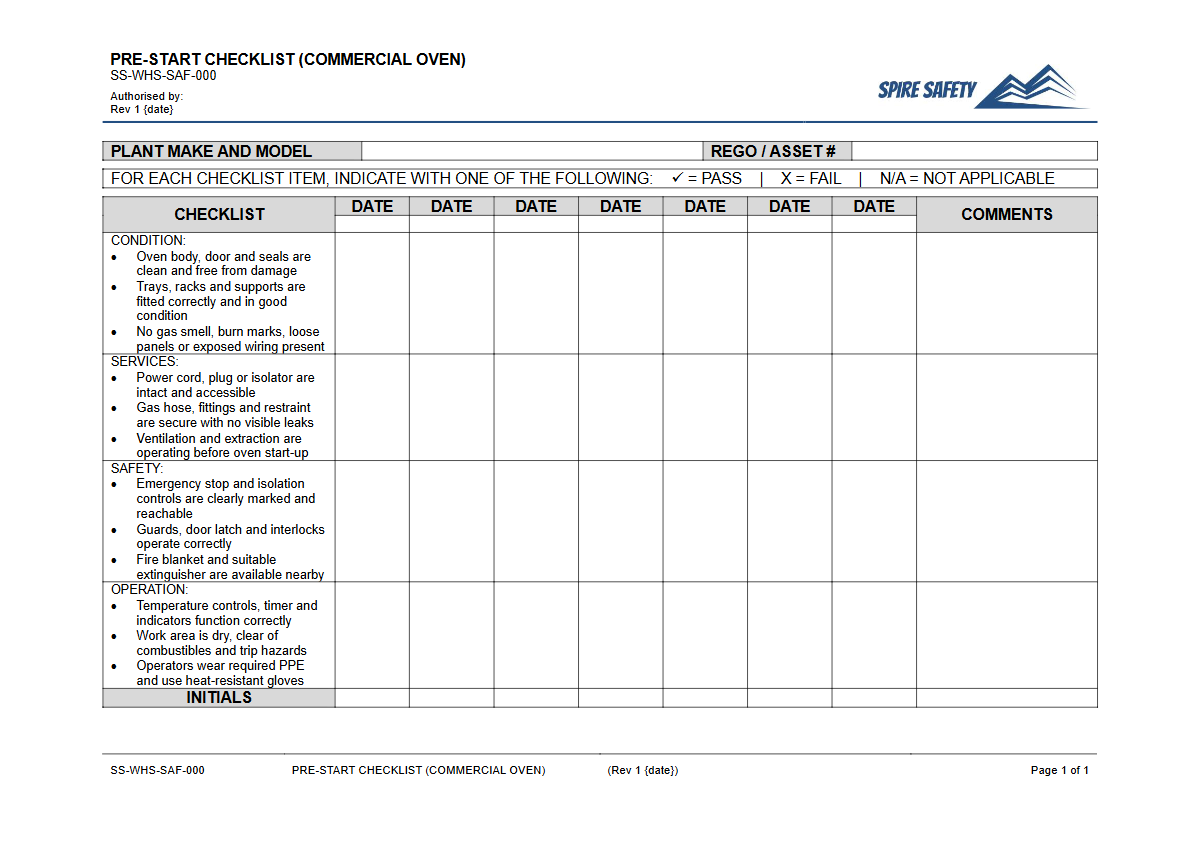
Operating a commercial oven comes with significant risks, including fires, burns, gas leaks, and electrical hazards. This Free Pre-Start Checklist (Commercial Oven) Template provides a structured framework for operators to conduct consistent, documented safety inspections before each use.
Implementing these checks helps a Person Conducting a Business or Undertaking (PCBU) meet their primary duty of care to provide and maintain safe plant and equipment.
By formalising the inspection process, you create a clear record of due diligence and empower workers to identify and report potential faults before they escalate into serious incidents. A systematic check helps ensure that critical safety components—such as gas lines, door seals, thermostats, and ventilation systems—are in good working order. The process of equipment inspection is a valuable safety topic and can be reinforced through regular team meetings, such as a Pre-Start Checks and Plant Maintenance Toolbox Talk.
What is a Pre-Start Checklist?
A Pre-Start Checklist is a simple tool used to verify the safety and operational readiness of equipment or machinery before it is turned on. It guides the user through a series of visual and physical checks to spot damage, wear, or other unsafe conditions.
For a commercial oven, this includes inspecting for signs of gas leaks, frayed electrical cords, blocked vents, and faulty controls. The goal is to catch problems early, prevent accidents, and ensure the equipment is safe for operation throughout the shift.
Video walkthrough
How to use the Free Pre-Start Checklist (Commercial Oven) Template
This template is provided in both DOCX and PDF formats for your convenience. The DOCX file is fully editable, allowing you to tailor it to your specific workplace and equipment. A successful implementation involves several key steps:
- Download: Select the DOCX or PDF version and save it to your system.
- Customise: Adapt the checklist to the make, model, and type (e.g., convection, combi, deck) of your commercial oven. Add your company branding, site-specific details, and any unique hazards identified in your risk assessment.
- Train: Ensure all relevant workers (chefs, kitchen hands, supervisors) are trained on how to use the checklist correctly. This training should cover what each item means, what to look for, and the procedure for reporting faults.
- Implement: Integrate the checklist into your daily opening procedures. Store completed records securely as part of your WHS documentation.
It is crucial that this document is customised to fit your organisation's specific context. A generic checklist cannot account for all variables. We recommend you add, remove, and amend checklist items based on your own risk assessments and the manufacturer's operating manual. This checklist should form just one part of your broader safety framework, which is managed through comprehensive WHS management systems.
When to use it
The Pre-Start Checklist for a commercial oven should be completed before the first use of the day or at the beginning of each new shift. This frequency ensures that any issues that may have developed overnight or between shifts are identified before the oven is operated under heat and pressure.
Consistent daily checks create a valuable historical record of the equipment's condition, which can be reviewed during maintenance planning or safety investigations. This documentation is also a key piece of evidence reviewed during formal WHS compliance auditing to demonstrate systematic safety management.
Many commercial kitchens use a range of powered equipment, each requiring its own safety checks. The principles in this checklist can be adapted for other appliances, similar to our Free Pre-Start Checklist (Coffee Grinder) Template, ensuring a consistent approach to equipment safety across your operations.
Who should use it
This checklist is designed to be used by the workers directly operating the commercial oven, such as chefs, cooks, and kitchen staff. These individuals are best placed to notice subtle changes in the equipment's condition from one day to the next.
Supervisors and managers also have a critical role. They are responsible for ensuring the checks are completed correctly, reviewing the completed checklists, and taking prompt action to address any reported faults or deficiencies.
This includes arranging for repairs and tagging out unsafe equipment to prevent its use until it is certified as safe. For organisations needing assistance in establishing these roles and responsibilities, our WHS consulting services can provide expert guidance.
By involving operators in the safety process, you foster a positive safety culture where everyone takes ownership of maintaining a hazard-free work environment. This template is one of many tools available in our free WHS resources library designed to support your safety management efforts.
Common mistakes
Common mistakes to avoid
- Pencil-whipping the checklist without physically inspecting each item.
- Failing to immediately report and tag out faulty equipment found during the check.
- Using a generic checklist that doesn't account for the specific model or installation of the oven.
- Neglecting to train workers on what to look for and how to perform each check correctly.
Legal references
Legal considerations
The following legal requirements may be relevant to this type of work.
- Work Health and Safety Act (Harmonised) — Provides the primary duties for protecting workers and other people from work health and safety risks.
- Work Health and Safety Regulations (Harmonised) — Sets out requirements supporting the management of workplace hazards and risks.
The following codes may be relevant to this type of work.
- Managing WHS Risks Code of Practice — Provides practical guidance on identifying hazards, assessing risks and applying effective controls.
- Work Health and Safety Consultation, Cooperation and Coordination Code of Practice — Provides practical guidance on consulting workers and coordinating with other duty holders.
- Managing the Work Environment and Facilities Code of Practice — Provides practical guidance on safe work environments, workplace facilities and related controls.
Did you know
Leading Cause of Fires
According to Fire and Rescue NSW, cooking equipment is the leading cause of fires in restaurants and cafes, accounting for nearly half of all incidents. Regular inspections are a key preventative measure.
Gas Safety
Natural gas and LPG are odourless, but a chemical called mercaptan is added to give them a distinct 'rotten egg' smell. If staff smell this, it's a critical sign of a potential leak that must be addressed immediately.
FAQ
Frequently asked questions
01Why are pre-start checks for commercial ovens so important?
02What key items should be on a commercial oven pre-start checklist?
03How often do commercial oven pre-starts need to be done?
04Can this template be used for any type of commercial oven?
Share this resource
Free Pre-Start Checklist (Commercial Oven) Template
Browse Categories
How To Use It
- 1Download and open in Word or PDF.
- 2Replace the placeholders with your business details.
- 3Get it reviewed by a WHS specialist before rollout.
Need it customised?
Our WHS consultants can adapt this template to your site, run a gap analysis, or audit what you already have in place.
Book a Free Consultation WHS consulting servicesor call 1300 156 382