
Free Pre-Start Checklist (Compactor Attachment) Template
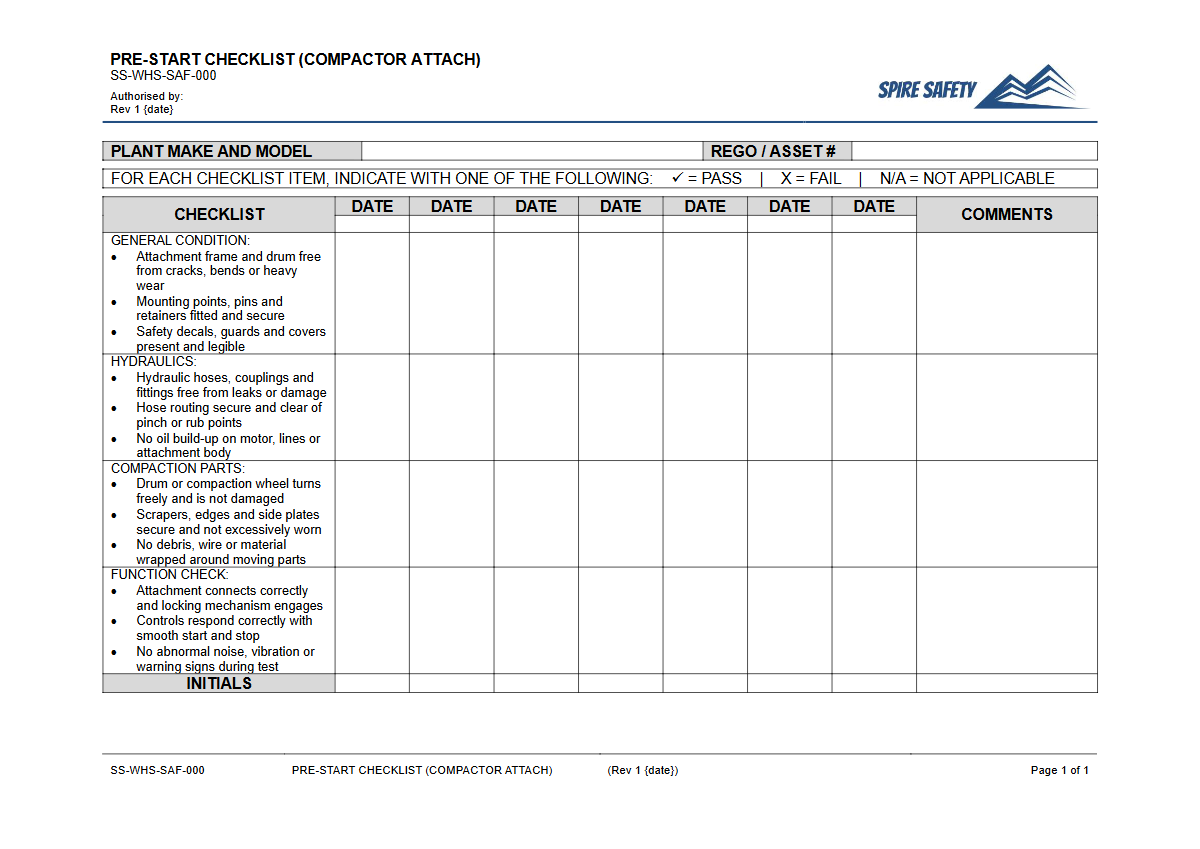
Download our free Pre-Start Checklist for Compactor Attachments. This template helps formalise daily safety inspections and manage WHS risks in your workplace.
Free Pre-Start Checklist (Compactor Attachment) Template
DOCX • 125 KB + PDF
Updated Oct 2026
No signup required
Purpose of the Free Pre-Start Checklist (Compactor Attachment) Template
Using a compactor attachment on mobile plant like an excavator introduces specific risks that must be managed. This Free Pre-Start Checklist (Compactor Attachment) Template provides a structured framework for operators to conduct thorough, documented inspections before each use.
Its purpose is to systematically identify potential faults, damage, or wear and tear—such as hydraulic leaks, structural cracks, or insecure fittings—that could lead to equipment failure or an incident. Formalising these checks helps your organisation meet its primary duty of care under WHS legislation and integrates a critical safety process into your broader WHS management systems.
Video walkthrough
How to use the Free Pre-Start Checklist (Compactor Attachment) Template
This template is designed for ease of use. First, download the document in your preferred format (DOCX for easy editing or PDF for direct printing).
The next step is crucial for its effectiveness: you must adapt the checklist to your specific operational context. This includes adding the make and model of the compactor attachment, the host machine it's used on (e.g., excavator model), and any unique site conditions or hazards.
For related equipment, you might also find our compactor chute pre-start checklist useful. Once customised, train all relevant operators on how to complete the checklist correctly, what each item means, and the procedure for reporting any identified faults.
Important: This is a template, not a finished document. We provide it as a starting point.
You are responsible for ensuring the final document is tailored to the specific plant, tasks, and risks in your workplace and is reviewed by a competent person.
When to use it
A pre-start checklist for a compactor attachment should be completed before the start of every shift or before the equipment is first used on any given day. It is also essential to conduct a check whenever the attachment is newly fitted to a host machine.
This ensures the connection points, hydraulic couplings, and safety systems are correctly engaged. Performing these checks consistently helps create a safety-first work culture and prevents the use of unsafe equipment, much like completing a pre-start checklist for a forwarder or other heavy machinery before operation.
Who should use it
The primary user of this checklist is the trained and competent operator of the machinery the compactor attachment is fitted to. They have the hands-on responsibility for ensuring the equipment is safe to operate.
Supervisors and managers also have a role in reviewing the completed checklists to verify that inspections are being performed correctly and to track any recurring maintenance issues. These records can be a valuable input for internal safety reviews and external WHS compliance audits, demonstrating proactive risk management.
Key Inspection Points for Compactor Attachments
While your customised checklist will be more detailed, key areas for any compactor attachment inspection should include:
- Mounting & Connection: Check the head bracket, pins, and keepers for security, wear, or damage. Ensure there is no excessive movement.
- Hydraulic System: Inspect all hoses, fittings, and cylinders for leaks, cracks, or abrasion. Check that hydraulic quick-connects are clean and securely locked.
- Base Plate & Structure: Examine the compaction plate (foot) for cracks, significant wear, or warping. Check all welds on the main body of the attachment for any signs of stress or cracking.
- Safety & Control Systems: Ensure any safety guards or features are in place and functional. Verify that the attachment responds correctly to the host machine's controls.
The principles of checking for structural integrity, secure fittings, and functional safety systems are common across many types of equipment, as seen in a bench grinder pre-start checklist, just applied to different components and risks.
Download Your Free Template Today
Taking a few minutes to complete a pre-start check is a small investment that pays significant dividends in safety and operational reliability. Download your template now to strengthen your equipment safety procedures. For more templates and safety documents, browse our complete free WHS resources library.
Common mistakes
Common mistakes to avoid
- Ignoring minor hydraulic weeps or leaks, which can indicate a future hose failure.
- Failing to physically check mounting pins and locking mechanisms, relying only on a visual check from the cab.
- 'Pencil-whipping' the checklist without performing the actual physical checks.
- Using a generic mobile plant checklist that doesn't cover the specific risks of the compactor attachment itself.
Legal references
Legal considerations
The following legal requirements may be relevant to this type of work.
- Work Health and Safety Act (Harmonised) — Provides the primary duties for protecting workers and other people from work health and safety risks.
- Work Health and Safety Regulations (Harmonised) — Sets out requirements supporting the management of workplace hazards and risks.
The following codes may be relevant to this type of work.
- Managing WHS Risks Code of Practice — Provides practical guidance on identifying hazards, assessing risks and applying effective controls.
- Work Health and Safety Consultation, Cooperation and Coordination Code of Practice — Provides practical guidance on consulting workers and coordinating with other duty holders.
- Managing the Work Environment and Facilities Code of Practice — Provides practical guidance on safe work environments, workplace facilities and related controls.
Did you know
High-Impact Forces
Excavator-mounted compactor attachments use a combination of vibration and downward pressure (impulse force) to compact soil or materials, generating forces that can be many times the static weight of the attachment itself.
Attachment Incidents
According to Safe Work Australia, a significant number of incidents involving earthmoving equipment relate to the unintended movement or failure of attachments, highlighting the importance of pre-start checks on pins, locks, and hydraulic systems.
FAQ
Frequently asked questions
01Why is a pre-start check necessary for a compactor attachment?
02How often should a compactor attachment pre-start check be performed?
03What happens if a fault is found during a compactor attachment pre-start check?
04Can this template be used for different types of compactor attachments?
Share this resource
Free Pre-Start Checklist (Compactor Attachment) Template
Browse Categories
How To Use It
- 1Download and open in Word or PDF.
- 2Replace the placeholders with your business details.
- 3Get it reviewed by a WHS specialist before rollout.
Need it customised?
Our WHS consultants can adapt this template to your site, run a gap analysis, or audit what you already have in place.
Book a Free Consultation WHS consulting servicesor call 1300 156 382