
Free Pre-Start Checklist (Compactor Chute) Template
Download our free Pre-Start Checklist (Compactor Chute) Template. This DOCX & PDF resource helps formalise equipment safety checks and recordkeeping.
Free Pre-Start Checklist (Compactor Chute) Template
DOCX • 125 KB + PDF
Updated Oct 2026
No signup required
Purpose of the Free Pre-Start Checklist (Compactor Chute) Template
Operating heavy machinery like a compactor chute requires stringent safety protocols to prevent serious incidents. Using a Free Pre-Start Checklist (Compactor Chute) Template provides a systematic way for operators to verify that the equipment is safe before each use.
This simple but critical process helps identify potential hazards such as damaged safety guards, hydraulic fluid leaks, malfunctioning emergency stops, or blockages that could lead to equipment failure or worker injury.
Formalising these daily inspections promotes a proactive safety culture within your organisation. It moves safety from an abstract concept to a tangible, daily task.
Consistent checks ensure the compactor chute remains in good working order, reduces costly unplanned downtime, and demonstrates due diligence in meeting WHS obligations. To reinforce these crucial daily habits, consider running a Pre-Start Checks and Plant Maintenance Toolbox Talk with your team.
Video walkthrough
How to use the Free Pre-Start Checklist (Compactor Chute) Template
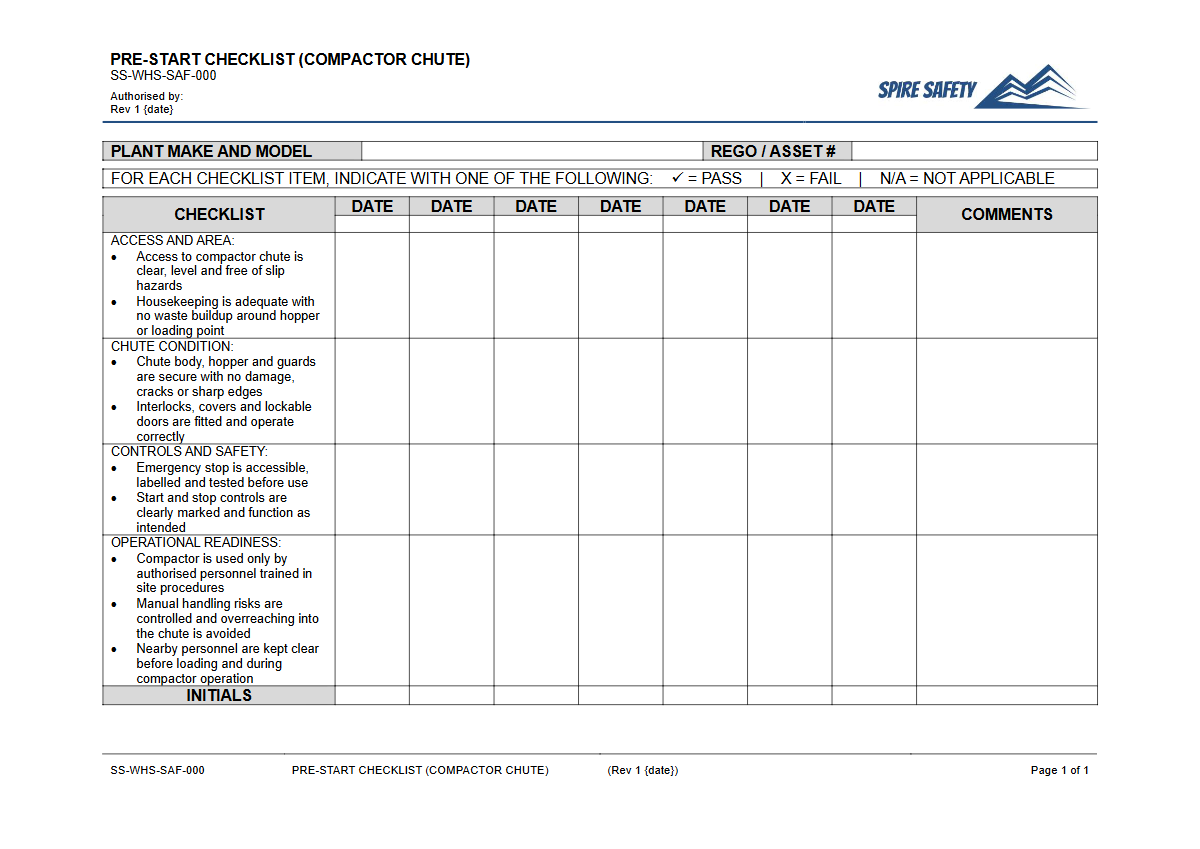
This resource is provided in two convenient formats. The DOCX file is fully editable, allowing you to tailor the checklist to your specific operational needs.
The PDF version is ready for immediate printing and use. The checklist guides the operator through a logical inspection sequence, covering critical components from safety interlocks and emergency stops to the condition of the chute and compaction chamber.
A key step in implementing this document is customisation. The information gathered from our Free Compactor Risk Assessment Template should be used to add or remove items from this checklist, ensuring it accurately reflects the risks associated with your specific equipment and work environment.
Important: This document is a template and serves as a starting point. We strongly advise that you customise it to reflect the specific make, model, and configuration of your compactor chute, as well as your site's unique operational risks.
A generic checklist cannot account for all variables, and site-specific customisation is essential for effective risk management.
When to use it
The pre-start checklist should be completed by an operator before the commencement of each work shift or before the equipment is used for the first time on any given day. If operators change over during a shift, the incoming operator should also conduct a pre-start check to verify the machine's condition before they take control.
Beyond daily use, completed checklists serve as a valuable historical record of the equipment's condition. This log can help identify recurring issues and provides important data for developing a preventative maintenance schedule. It forms the first practical step in a safe system of work, as detailed in documents like a Plate Compactor SOP (Safe Operating Procedure).
Who should use it
This Pre-Start Checklist must be completed by personnel who are trained, competent, and explicitly authorised to operate the compactor chute. Competency involves not only knowing how to operate the machinery but also understanding its specific hazards and how to properly conduct each inspection point on the checklist.
For related machinery, you can formalise this process using a Verification of Competency for a large plate compactor to confirm their skills.
Supervisors and managers also have a role. They are responsible for ensuring operators are completing the checks correctly, reviewing submitted forms, and taking prompt action to address any defects or hazards reported.
Integrating documented checks is a fundamental component of a robust WHS management system, ensuring accountability at all levels.
Integrating Pre-Start Checks into Your WHS System
Pre-start checks are more than just a daily task; they are a critical part of your overall safety framework. Completed checklists should be filed and retained as official WHS records.
These documents demonstrate a systematic approach to hazard identification and risk control, which is invaluable for compliance purposes.
These records provide valuable evidence of proactive safety management during formal WHS compliance auditing and can be crucial during an incident investigation. By embedding this practice into your daily operations, you strengthen your safety processes and protect your workers.
Explore our complete free WHS resources library for more templates to support your safety management system.
Common mistakes
Common mistakes to avoid
- "Pencil-whipping" the checklist without physically inspecting each item.
- Failing to immediately report and tag-out equipment with identified safety defects.
- Using a generic checklist that doesn't cover the specific controls and hazards of the machine model.
- Operators not receiving adequate training on what to look for during each check.
Legal references
Legal considerations
The following legal requirements may be relevant to this type of work.
- Work Health and Safety Act (Harmonised) — Provides the primary duties for protecting workers and other people from work health and safety risks.
- Work Health and Safety Regulations (Harmonised) — Sets out requirements supporting the management of workplace hazards and risks.
The following codes may be relevant to this type of work.
- Managing WHS Risks Code of Practice — Provides practical guidance on identifying hazards, assessing risks and applying effective controls.
- Work Health and Safety Consultation, Cooperation and Coordination Code of Practice — Provides practical guidance on consulting workers and coordinating with other duty holders.
- Managing the Work Environment and Facilities Code of Practice — Provides practical guidance on safe work environments, workplace facilities and related controls.
Did you know
Compaction Force
Industrial waste compactors can generate forces exceeding 25 tonnes, easily crushing materials but also presenting significant crush and amputation hazards if safety guards are bypassed or missing.
Leading Cause of Injury
According to Safe Work Australia, being hit by moving objects and being trapped between stationary and moving objects are leading causes of injury and fatality when working with industrial machinery.
FAQ
Frequently asked questions
01What are the most critical safety features on a compactor chute?
02How often should a compactor chute be inspected by a competent person?
03Who is responsible for locking out a faulty compactor chute?
04Can this template be used for other types of compactors?
Share this resource
Free Pre-Start Checklist (Compactor Chute) Template
Browse Categories
How To Use It
- 1Download and open in Word or PDF.
- 2Replace the placeholders with your business details.
- 3Get it reviewed by a WHS specialist before rollout.
Need it customised?
Our WHS consultants can adapt this template to your site, run a gap analysis, or audit what you already have in place.
Book a Free Consultation WHS consulting servicesor call 1300 156 382