
Free Pre-Start Checklist (Concrete Vib) Template
Download our free Pre-Start Checklist for concrete vibrators. This template helps formalise equipment checks and manage WHS risks. Get your DOCX & PDF now.
Free Pre-Start Checklist (Concrete Vib) Template
DOCX • 125 KB + PDF
Updated Oct 2026
No signup required
Purpose of the Free Pre-Start Checklist (Concrete Vib) Template
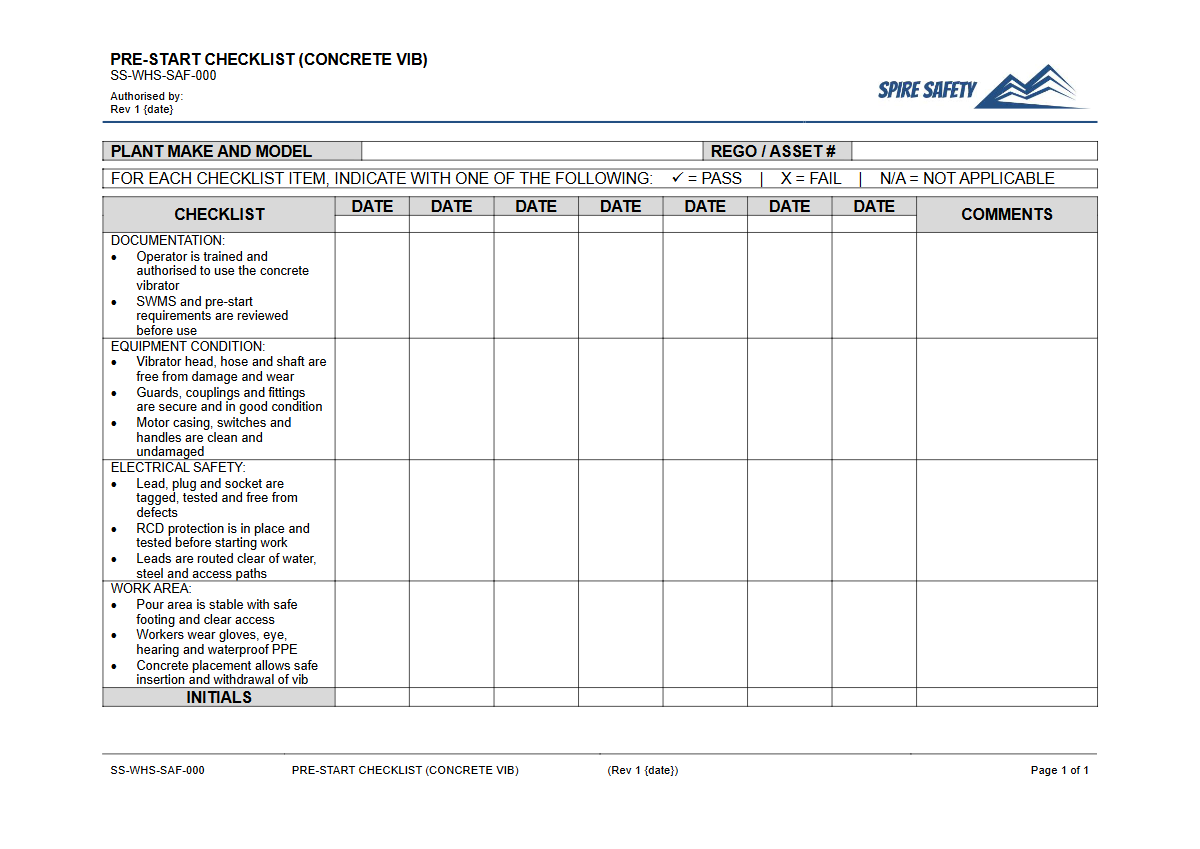
Using a concrete vibrator involves significant hazards, including electric shock, musculoskeletal injuries, and Hand-Arm Vibration Syndrome (HAVS). This Free Pre-Start Checklist (Concrete Vib) Template provides a structured format for operators to inspect the equipment for damage or faults before every use.
Regular pre-start checks are a fundamental part of any safe system of work, helping to identify and control risks before they cause injury or equipment failure. Formalising this process helps your organisation demonstrate proactive risk management and meet its duties under Australian WHS legislation.
A completed checklist serves as a daily record of the equipment's condition, aids in maintenance scheduling, and ensures that any identified faults are reported and addressed promptly. It is a crucial companion to a detailed Concrete Vibrator Safe Operating Procedure (SOP), which outlines the step-by-step process for using the equipment safely.
Video walkthrough
How to use the Free Pre-Start Checklist (Concrete Vib) Template
This template is provided in both DOCX and PDF formats for your convenience. The DOCX version is fully editable, allowing you to tailor the checklist items to the specific make and model of the concrete vibrators used in your workplace.
The process should be simple: an operator performs the visual and physical checks listed, ticks each item, and signs off that the equipment is safe to use. If any item fails the check, the equipment must be tagged out of service and the fault reported to a supervisor immediately.
Important Note: This document is a template and must be customised to your specific workplace. We recommend consulting with operators, maintenance personnel, and safety advisors to ensure it covers all relevant hazards and control measures for your equipment and operational context. Your finalised checklist should align with your risk controls, such as those documented in a Concrete Vibrator SWMS template.
When to use it
A pre-start check should be conducted before the first use of the concrete vibrator on every shift or every time a new operator takes control of the equipment. It is a quick but essential routine that should only take a few minutes to complete.
It does not replace the need for regular, scheduled maintenance by a competent person but acts as the first line of defence against workplace incidents.
Reinforce the importance of these checks with regular training, such as by using a Pre-Start Checks and Plant Maintenance Toolbox Talk to discuss common faults and reporting procedures. This helps embed safe behaviour and a positive safety culture within your team.
Who should use it
The pre-start checklist is designed to be completed by the person operating the concrete vibrator. The operator is best placed to notice any changes in the equipment's condition or performance.
Supervisors and managers also have a responsibility to ensure that the pre-start system is being implemented correctly, that operators are trained to conduct the checks, and that completed records are reviewed and stored. Documenting this process is an essential component of a comprehensive WHS management system, demonstrating proactive risk management.
Integrating with Broader Site Safety
A concrete vibrator is often one of many pieces of plant used during a concrete pour. The safety of all equipment must be considered as part of a holistic site safety plan. This includes not just the vibrator but also the delivery vehicle, which can be managed using a Concrete Truck Risk Assessment.
Alongside equipment safety, ensuring operators are competent is just as important. While this checklist confirms the plant is safe, operator skill can be formally assessed using specific tools. For example, similar principles can be applied to verify skills for other plant on site, as seen in a Verification of Competency for a stationary concrete pump.
By integrating equipment checks into your daily routines and broader safety framework, you create multiple layers of protection for your workers. Browse our full free WHS resources library for more templates to support your safety management system.
Common mistakes
Common mistakes to avoid
- Treating the check as a 'tick and flick' exercise without physically inspecting each item.
- Failing to immediately tag and remove faulty equipment from service.
- Using a generic, non-customised checklist that doesn't cover the specific model of vibrator.
- Not retaining completed checklists as records for maintenance tracking and safety audits.
Legal references
Legal considerations
The following legal requirements may be relevant to this type of work.
- Work Health and Safety Act (Harmonised) — Provides the primary duties for protecting workers and other people from work health and safety risks.
- Work Health and Safety Regulations (Harmonised) — Sets out requirements supporting the management of workplace hazards and risks.
The following codes may be relevant to this type of work.
- Managing WHS Risks Code of Practice — Provides practical guidance on identifying hazards, assessing risks and applying effective controls.
- Work Health and Safety Consultation, Cooperation and Coordination Code of Practice — Provides practical guidance on consulting workers and coordinating with other duty holders.
- Managing the Work Environment and Facilities Code of Practice — Provides practical guidance on safe work environments, workplace facilities and related controls.
Did you know
HAVS Risk
Prolonged exposure to vibration from tools like concrete vibrators can lead to Hand-Arm Vibration Syndrome (HAVS), a painful and disabling condition affecting nerves, blood vessels, and joints.
Concrete Settlement
A concrete vibrator works by generating thousands of vibrations per minute, which reduces friction between aggregate particles, allowing the mix to settle properly and removing trapped air pockets for maximum strength.
FAQ
Frequently asked questions
01What's the difference between a pre-start checklist and a SWMS?
02How often should a concrete vibrator be inspected?
03Who is responsible for ensuring pre-start checks are completed?
04Can I use this template for other vibrating tools like jackhammers?
Share this resource
Free Pre-Start Checklist (Concrete Vib) Template
Browse Categories
How To Use It
- 1Download and open in Word or PDF.
- 2Replace the placeholders with your business details.
- 3Get it reviewed by a WHS specialist before rollout.
Need it customised?
Our WHS consultants can adapt this template to your site, run a gap analysis, or audit what you already have in place.
Book a Free Consultation WHS consulting servicesor call 1300 156 382