
Free Pre-Start Checklist (Conveyor) Template
Formalise conveyor safety inspections with our free Pre-Start Checklist (Conveyor) Template. This structured DOCX & PDF resource helps manage WHS risks.
Free Pre-Start Checklist (Conveyor) Template
DOCX • 125 KB + PDF
Updated Oct 2026
No signup required
Purpose of the Free Pre-Start Checklist (Conveyor) Template
Using a structured Pre-Start Checklist (Conveyor) Template is a critical step in managing the significant risks associated with conveyor systems. These machines, common in industries from manufacturing and logistics to mining and agriculture, pose serious hazards such as entanglement, crushing, and abrasion if not properly maintained and operated.
This template provides a formalised method for operators to conduct daily inspections, helping to identify potential faults or damage before they lead to an incident. By documenting these checks, your organisation can demonstrate a proactive approach to safety, ensure equipment is fit for purpose, and maintain a safer working environment. Integrating regular, documented checks is a fundamental component of effective WHS management systems.
Video walkthrough
How to Use the Free Pre-Start Checklist (Conveyor) Template
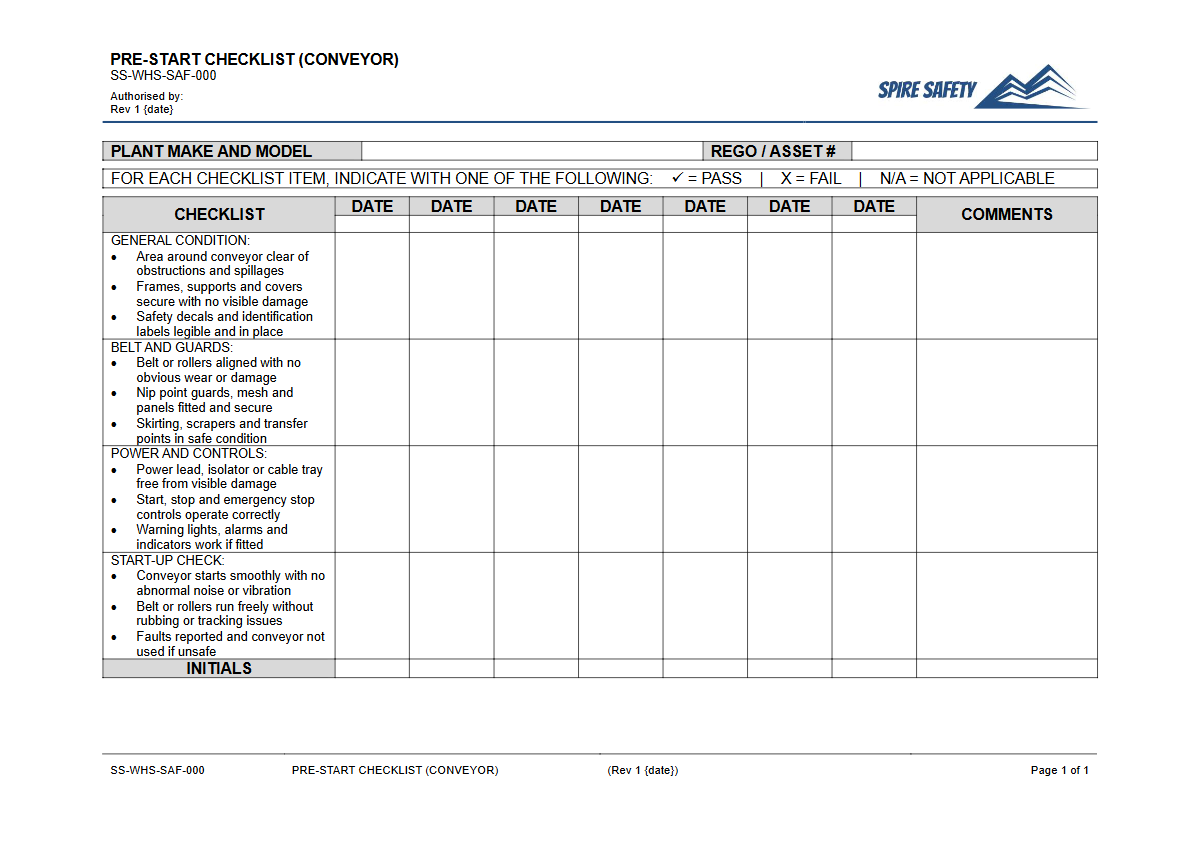
This Pre-Start Checklist is provided as an editable DOCX file and a print-ready PDF. The checklist guides operators through a logical inspection sequence, covering critical components like guards, emergency stops, belts, rollers, and the drive mechanism.
To implement it effectively, download the template and adapt it to your specific workplace needs.
Important: This template provides a structured starting point. You must customise it to suit the specific make, model, and operational context of the conveyors at your site.
Different types of conveyors (e.g., belt, roller, screw, chain) have unique components and failure modes. We recommend consulting with operators, maintenance staff, and reviewing manufacturer specifications to ensure your checklist is comprehensive. For specialised applications, such as in food processing, you may need additional checks, like those in our Pre-Start Checklist for Food Conveyors.
Implementing the Checklist
Once customised, the checklist should be integrated into your daily operational procedures. Operators should complete it at the beginning of each shift.
The process should involve a physical walk-around and visual inspection of the conveyor, with each item on the list being checked and signed off. Any identified faults or 'No' answers must trigger a defined escalation process, which should include taking the equipment out of service until it is assessed and cleared by a competent person.
Completed checklists should be retained as part of your safety records.
When to Use This Pre-Start Checklist
A conveyor pre-start inspection should be conducted at several key times to maximise its effectiveness:
- Before the start of each shift or workday: This is the most critical time, ensuring the equipment is safe before any work commences.
- After a change in operator: If a new operator takes over mid-shift, a quick handover inspection ensures continuity of safety awareness.
- Following any maintenance or repair work: Verifies that the conveyor has been returned to a safe operational state and no new hazards have been introduced.
- If the conveyor has been idle for an extended period: Checks for any degradation, nesting pests, or seizure of parts that may have occurred during downtime.
These documented checks form an important part of the evidence base reviewed during a formal WHS compliance auditing program.
Who Should Use This Pre-Start Checklist
This Pre-Start Checklist is designed to be used by personnel who are directly involved with the operation and supervision of conveyor systems. The primary user should be the authorised and competent operator of the equipment.
They have the hands-on familiarity to spot subtle changes or developing issues. Other personnel who should be familiar with this process include:
- Supervisors and Team Leaders: Responsible for ensuring operators complete the checks correctly and for actioning any reported faults. They should periodically review completed checklists for compliance and quality.
- Maintenance Personnel: The checklist provides valuable information for maintenance teams, highlighting recurring issues that may require more in-depth inspection or preventative maintenance.
- WHS Managers/Coordinators: They use the data from these checklists to monitor the health of plant safety procedures, identify trends, and provide targeted training.
This process of operator-led inspection is common across many types of fixed plant, such as those covered by our Pre-Start Checklist (Granulator) Template.
Common mistakes
Common mistakes to avoid
- Failing to physically test emergency stops and pull-cords.
- Ignoring subtle signs of wear, such as belt fraying, unusual noises, or excessive vibration.
- Ticking off checklist items without actually inspecting the corresponding component ('pencil-whipping').
- Continuing to operate a conveyor after identifying a safety-critical fault.
Legal references
Legal considerations
The following legal requirements may be relevant to this type of work.
- Work Health and Safety Act (Harmonised) — Provides the primary duties for protecting workers and other people from work health and safety risks.
- Work Health and Safety Regulations (Harmonised) — Sets out requirements supporting the management of workplace hazards and risks.
The following codes may be relevant to this type of work.
- Managing WHS Risks Code of Practice — Provides practical guidance on identifying hazards, assessing risks and applying effective controls.
- Work Health and Safety Consultation, Cooperation and Coordination Code of Practice — Provides practical guidance on consulting workers and coordinating with other duty holders.
- Managing the Work Environment and Facilities Code of Practice — Provides practical guidance on safe work environments, workplace facilities and related controls.
Did you know
Entanglement Hazard
Entanglement in moving parts is a leading cause of serious and fatal injuries involving conveyor systems. Even a small loose thread on a glove can be enough to pull a worker's hand into a machine.
Lockout/Tagout (LOTO)
A pre-start check is a visual inspection only. If a fault is found that requires maintenance, the conveyor must be isolated from its power source and locked out according to formal LOTO procedures before any work begins.
FAQ
Frequently asked questions
01What are the biggest WHS risks associated with conveyors?
02How often should a conveyor pre-start check be performed?
03Who is responsible for completing a conveyor pre-start checklist?
04Can this template be used for all types of conveyors?
Share this resource
Free Pre-Start Checklist (Conveyor) Template
Browse Categories
How To Use It
- 1Download and open in Word or PDF.
- 2Replace the placeholders with your business details.
- 3Get it reviewed by a WHS specialist before rollout.
Need it customised?
Our WHS consultants can adapt this template to your site, run a gap analysis, or audit what you already have in place.
Book a Free Consultation WHS consulting servicesor call 1300 156 382