
Free Pre-Start Checklist (Container Ramp) Template
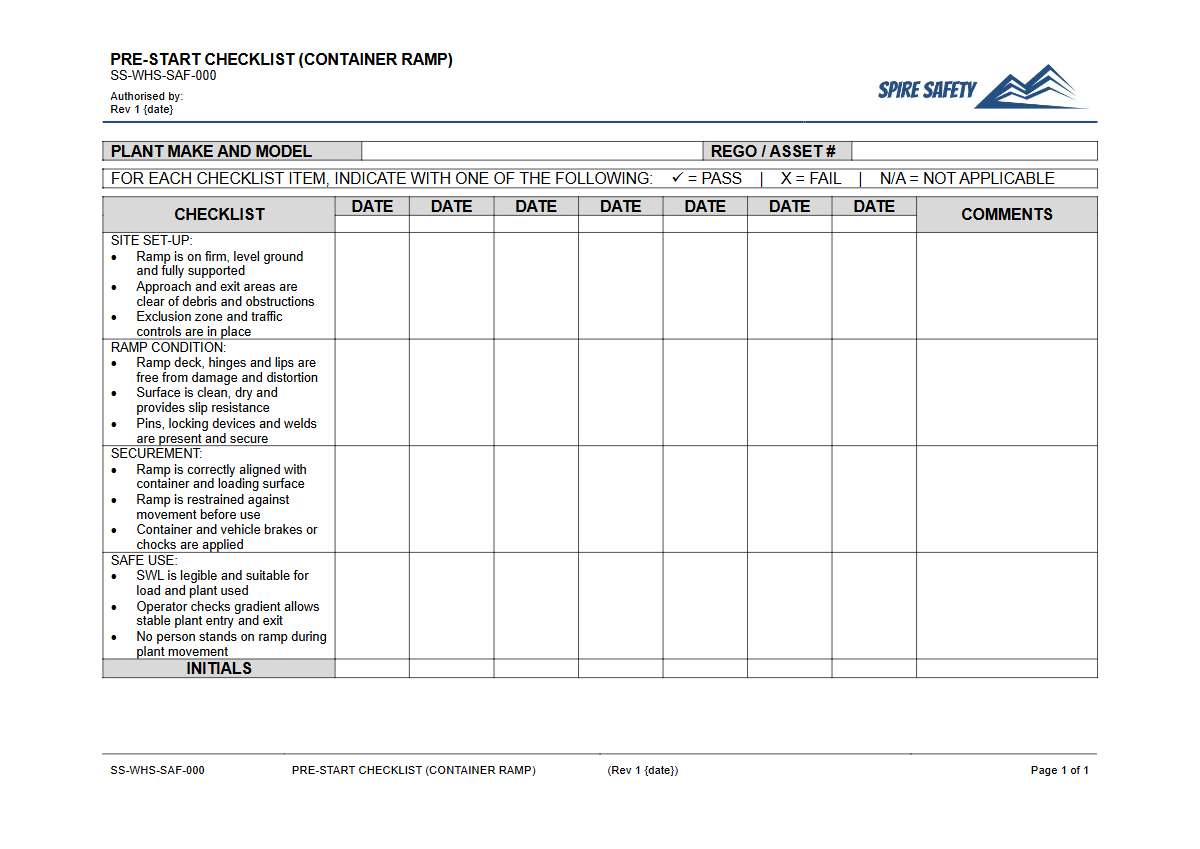
Download our free Pre-Start Checklist (Container Ramp) Template in DOCX and PDF. A structured starting point for your daily equipment safety checks.
Free Pre-Start Checklist (Container Ramp) Template
DOCX • 125 KB + PDF
Updated Oct 2026
No signup required
Purpose of the Free Pre-Start Checklist (Container Ramp) Template
Using a container ramp is a high-risk activity that requires careful management to prevent serious incidents. This Free Pre-Start Checklist (Container Ramp) Template provides a structured framework for operators to conduct thorough safety inspections before use.
A consistent pre-start process helps identify potential hazards such as structural damage, unstable ground, missing components, or unsafe surface conditions that could lead to ramp collapse, forklift instability, or other catastrophic failures. By formalising these checks, organisations can verify that critical safety features are functional and that the equipment is fit for purpose.
Implementing documented checks is a fundamental part of proactive safety management. These records serve as evidence that due diligence is being performed and can be invaluable for incident investigations and continuous improvement.
Integrating such procedures is a cornerstone of building robust WHS management systems that effectively control operational risks. Regular inspections ensure that maintenance issues are identified and rectified before they escalate, protecting workers and assets.
Furthermore, reinforcing the importance of these checks with staff is critical for building a strong safety culture. Regular training sessions can help communicate the 'why' behind the procedure.
You can use our Pre-Start Checks and Plant Maintenance Toolbox Talk to facilitate these important discussions and remind workers of their responsibilities.
Video walkthrough
How to use the Free Pre-Start Checklist (Container Ramp) Template
This checklist is designed as a starting point, available in both an editable DOCX format and a ready-to-print PDF. The DOCX version allows for full customisation to align with your specific operational needs and the particular models of container ramps used at your site.
A well-defined pre-start inspection process is a critical control measure for managing the risks associated with loading and unloading operations.
Important: This template provides a structured foundation based on common Australian WHS practices, but it is not a complete, off-the-shelf solution. We strongly recommend that you customise this document to address the specific container ramps, lifting equipment (e.g., forklifts, pallet jacks), and environmental conditions unique to your workplace.
You must add, remove, or modify checklist items to ensure all relevant hazards are covered.
Implementation Steps:
- Review and Customise: Download the DOCX file and have a competent person (such as a supervisor or safety manager) review the checklist. Modify it to include checks for manufacturer-specific components like locking pins, chains, or hydraulic systems.
- Integrate and Train: Incorporate the finalised checklist into your daily operational procedures. Ensure all relevant personnel (e.g., forklift operators, warehouse staff) are trained on how to properly complete the checklist and what to do if they identify a fault.
- Monitor and Review: Supervisors should periodically review completed checklists to ensure they are being filled out correctly and that any reported issues are being addressed promptly. These records are essential for demonstrating procedural compliance during a WHS compliance auditing process.
Documenting safety procedures for high-risk vehicle and plant interactions is crucial. A pre-start checklist for a container ramp is one part of a safe system of work, which may also include traffic management plans and specific operational instructions.
For other vehicle-related tasks, a similar level of formal documentation, like a Safe Work Method Statement (SWMS) for Concrete Truck Operations, may be required to manage risks.
When to use it
A container ramp pre-start checklist should be completed before the ramp is used for the first time each day or at the beginning of each shift. This frequency ensures that any damage or changes that may have occurred overnight or between shifts are identified before the equipment is put under load.
The check should also be repeated if the ramp is moved to a new location, repositioned against a different container, or after any event that could have potentially caused damage, such as a near miss or impact from mobile plant.
Who should use it
The pre-start inspection must be conducted by a person who is trained and competent to do so. This is typically the forklift operator or another worker responsible for setting up the ramp.
They must be familiar with the ramp’s specific features and understand the potential failure points to look for. Competency involves not just knowing how to fill out the form, but also recognising the significance of each check item.
Supervisors and managers also have a responsibility to ensure that operators are performing these checks correctly and to take action on any defects reported. They are accountable for ensuring the system is working as intended.
If you need help establishing competency frameworks or developing site-specific procedures, engaging external expertise through WHS consulting can provide valuable guidance and support.
Properly managing plant and equipment safety is a continuous process. We encourage you to explore our free WHS resources library for more templates and guides to support your safety management efforts.
Common mistakes
Common mistakes to avoid
- Using the ramp without checking that the ground beneath it is level, firm, and stable.
- Failing to ensure the ramp's connecting plate or lip has sufficient overlap onto the container floor.
- Overlooking small cracks or bends in structural members that can propagate and lead to failure under load.
- Not training operators on the specific procedures for the ramp model used on site, leading to incorrect setup or use.
Legal references
Legal considerations
The following legal requirements may be relevant to this type of work.
- Work Health and Safety Act (Harmonised) — Provides the primary duties for protecting workers and other people from work health and safety risks.
- Work Health and Safety Regulations (Harmonised) — Sets out requirements supporting the management of workplace hazards and risks.
The following codes may be relevant to this type of work.
- Managing WHS Risks Code of Practice — Provides practical guidance on identifying hazards, assessing risks and applying effective controls.
- Work Health and Safety Consultation, Cooperation and Coordination Code of Practice — Provides practical guidance on consulting workers and coordinating with other duty holders.
- Managing the Work Environment and Facilities Code of Practice — Provides practical guidance on safe work environments, workplace facilities and related controls.
Did you know
Ramp Gradient
The safe operating gradient for a forklift is specified by its manufacturer and is typically around 15% (a 1-in-6.7 slope). Using a container ramp that creates a steeper incline can lead to instability, loss of traction, or tipping.
Connection is Key
A significant number of incidents involving container ramps occur because the ramp was not securely attached to the container. The locking mechanisms, whether pins or chains, are critical safety features that must be inspected and engaged correctly every time.
FAQ
Frequently asked questions
01What are the main hazards associated with container ramps?
02Why is it important to check the container ramp's surface condition?
03How often should a container ramp pre-start check be done?
04Can this template be used for other types of loading ramps?
Share this resource
Free Pre-Start Checklist (Container Ramp) Template
Browse Categories
How To Use It
- 1Download and open in Word or PDF.
- 2Replace the placeholders with your business details.
- 3Get it reviewed by a WHS specialist before rollout.
Need it customised?
Our WHS consultants can adapt this template to your site, run a gap analysis, or audit what you already have in place.
Book a Free Consultation WHS consulting servicesor call 1300 156 382