
Free Pre-Start Checklist (Container Jack) Template
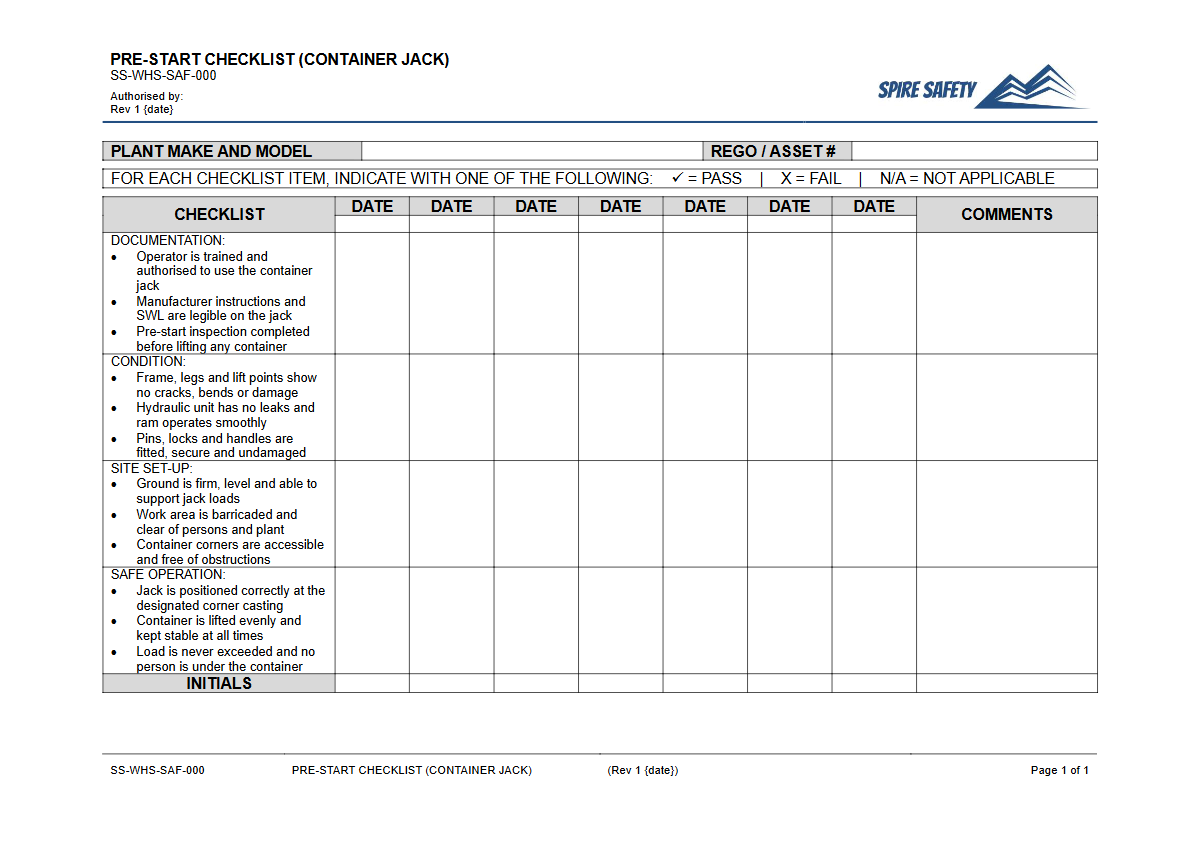
Download our Free Pre-Start Checklist (Container Jack) Template. This structured DOCX & PDF resource helps formalise safety checks for container jacks.
Free Pre-Start Checklist (Container Jack) Template
DOCX • 125 KB + PDF
Updated Oct 2026
No signup required
Purpose of the Free Pre-Start Checklist (Container Jack) Template
This free Pre-Start Checklist (Container Jack) Template provides a structured starting point for formalising your daily equipment safety inspections. Regular pre-start checks are a fundamental part of managing workplace health and safety, ensuring that plant and equipment like container jacks are safe and fit for use before operation begins.
Implementing this checklist helps your organisation identify potential faults, mechanical issues, or damage that could lead to incidents, equipment failure, or serious injury. By systematically inspecting critical components such as hydraulics, structural integrity, controls, and safety features, you proactively manage risks at their source.
It also serves as a valuable record-keeping tool, demonstrating due diligence in meeting WHS obligations related to plant safety. Consistent use fosters a stronger safety culture where operators take ownership of their equipment's condition.
To further embed these practices, you can reinforce the importance of these checks in team meetings, using a resource like a Pre-Start Checks and Plant Maintenance Toolbox Talk to guide discussion.
Video walkthrough
How to use the Free Pre-Start Checklist (Container Jack) Template
Using this template effectively involves more than just downloading and printing. Follow these steps to integrate it into your safety management processes:
- Download: Choose your preferred format, either DOCX for easy editing or PDF for straightforward printing.
- Customise: This is the most critical step. The provided template is a general guide aligned with Australian WHS principles. You must adapt it to the specific make, model, and configuration of the container jacks used in your workplace. Consult with operators, maintenance personnel, and supervisors to ensure all relevant components and potential hazards are included. We recommend adding your company branding and specific site information.
- Train: Ensure all relevant workers are trained on how to properly complete the checklist. This training should cover not just what to check, but also how to identify faults and the correct procedure for reporting them.
- Implement: Make the checklist readily available near the equipment. Establish a clear process for where completed checklists are stored and who reviews them.
- Review: Periodically review the checklist's effectiveness and update it as necessary, especially after an incident, near miss, or when new equipment is introduced.
A pre-start checklist is just one element of a complete safe system of work. It should be supported by other key WHS documents, such as a Pallet Jack Safe Operating Procedure for similar lifting equipment, which details the step-by-step process for safe operation.
When to use it
A container jack pre-start inspection should be conducted at the beginning of every shift or before the equipment is used for the first time on any given day. It should also be performed if a new operator takes over control of the jack mid-shift.
The condition of heavy equipment can change overnight or between uses due to factors like wear and tear, minor damage from previous operations, or environmental conditions. A daily check ensures that any new or developing issues are caught before they escalate into a serious hazard.
Integrating these routine inspections into your formal WHS management system helps create an auditable record of your organisation's commitment to plant safety and compliance.
Who should use it
The pre-start checklist should be completed by the person operating the container jack. This must be a worker who is trained, licensed (if required), and deemed competent to operate the specific piece of equipment. Placing this responsibility on the operator empowers them and reinforces that they are accountable for ensuring their equipment is safe before they begin work. Supervisors also have a role in the process. They should periodically review completed checklists, verify that inspections are being conducted correctly, and ensure that any reported faults are addressed promptly and effectively. Operator competency is a critical WHS requirement; it involves formal training, assessment, and documentation, similar to what you might use in a Verification of Competency for an electric pallet jack, adapted for your specific equipment. If you need assistance developing a robust safety framework for your plant and equipment, seeking expert WHS consulting can provide the guidance needed to meet your legal obligations. Explore our extensive free WHS resources library for more templates to support your safety management system.
Common mistakes
Common mistakes to avoid
- Using a generic, non-customised checklist that doesn't match the specific equipment.
- Rushing through the check ('pencil-whipping') without physically inspecting each item.
- Failing to immediately report, tag, and remove faulty equipment from service.
- Poor record-keeping or failing to have supervisors review completed checklists.
Legal references
Legal considerations
The following legal requirements may be relevant to this type of work.
- Work Health and Safety Act (Harmonised) — Provides the primary duties for protecting workers and other people from work health and safety risks.
- Work Health and Safety Regulations (Harmonised) — Sets out requirements supporting the management of workplace hazards and risks.
The following codes may be relevant to this type of work.
- Managing WHS Risks Code of Practice — Provides practical guidance on identifying hazards, assessing risks and applying effective controls.
- Work Health and Safety Consultation, Cooperation and Coordination Code of Practice — Provides practical guidance on consulting workers and coordinating with other duty holders.
- Managing the Work Environment and Facilities Code of Practice — Provides practical guidance on safe work environments, workplace facilities and related controls.
Did you know
Plant & Machinery Risks
According to Safe Work Australia, incidents involving machinery and fixed plant are a leading cause of workplace fatalities and serious injuries. Consistent pre-start checks are a key control measure to prevent these incidents.
Hydraulic Force
The hydraulic systems in container jacks operate under immense pressure. Even a pinhole leak in a hydraulic hose can release fluid at a velocity high enough to penetrate skin, causing severe injection injuries.
FAQ
Frequently asked questions
01What should be included in a container jack pre-start check?
02How often should container jack inspections be performed?
03Who is responsible for conducting a container jack pre-start checklist?
04Why is it important to customise a pre-start checklist template?
Share this resource
Free Pre-Start Checklist (Container Jack) Template
Browse Categories
How To Use It
- 1Download and open in Word or PDF.
- 2Replace the placeholders with your business details.
- 3Get it reviewed by a WHS specialist before rollout.
Need it customised?
Our WHS consultants can adapt this template to your site, run a gap analysis, or audit what you already have in place.
Book a Free Consultation WHS consulting servicesor call 1300 156 382