
Free Pre-Start Checklist (Cone Crusher) Template
Formalise daily equipment inspections for cone crushers with our free pre-start checklist template. A structured starting point for Australian businesses.
Free Pre-Start Checklist (Cone Crusher) Template
DOCX • 125 KB + PDF
Updated Oct 2026
No signup required
Purpose of the Free Pre-Start Checklist (Cone Crusher) Template
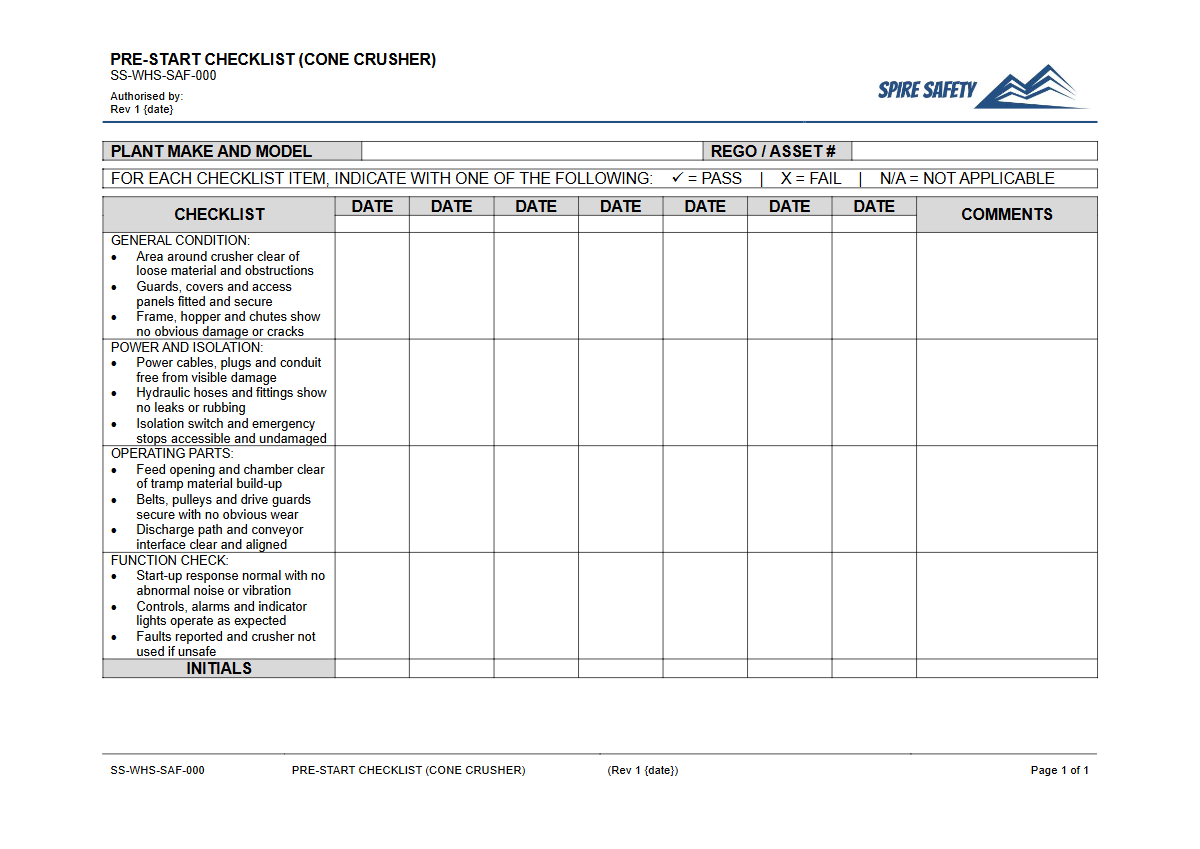
Operating heavy machinery like a cone crusher involves significant WHS risks. This free Pre-Start Checklist (Cone Crusher) Template provides a structured framework for operators to conduct thorough, consistent safety inspections before each use.
The primary purpose is to systematically identify and address potential hazards—such as worn components, fluid leaks, or missing guards—before they can lead to equipment failure, property damage, or serious injury. Integrating this checklist into your daily operations helps foster a proactive safety culture, demonstrates due diligence, and ensures machinery is in a safe condition for operation. Similar principles of pre-use inspection are vital for related machinery, as detailed in our crusher bucket pre-start checklist.
Key Inspection Areas for a Cone Crusher
While specific checkpoints vary by model, a comprehensive check should cover critical systems. This template guides the user to inspect areas such as the mainframe and adjustment ring, lubrication and hydraulic systems, drive components including belts and motors, and the crushing chamber itself (mantle and concave).
It also prompts checks on safety-critical items like emergency stops, guard rails, lock-out/tag-out provisions, and the general condition of the feed and discharge conveyors. A thorough check ensures all components are functioning as intended by the manufacturer.
For specific guidance on managing complex plant risks, seeking advice from a WHS consultant can provide clarity and expert direction.
Video walkthrough
How to use the Free Pre-Start Checklist (Cone Crusher) Template
Download the template in your preferred format (DOCX for easy editing or PDF for straightforward printing). Before implementation, it is essential to customise the document to your specific workplace.
This checklist is a starting point and must be adapted to the make, model, and configuration of your cone crusher, your site-specific risks identified through risk assessments, and your operational procedures.
Important: We are not WHS lawyers. This document is a template and must be customised to your specific machinery, operational context, and WHS management system.
Its use does not supports your compliance efforts with any law or regulation. You must ensure your finished document and its implementation are fit for purpose and meet all applicable WHS requirements.
Integrating the Checklist into Daily Workflows
For the checklist to be effective, it must become a non-negotiable part of the daily routine. Operators should complete it at the start of every shift or before the first use of the day.
Completed checklists should be reviewed by a supervisor and filed as a formal record of your safety procedures. This documentation is a vital component of robust WHS management systems, providing evidence that safety checks are being consistently performed.
When to use it
A pre-start checklist for a cone crusher should be completed before every shift. If the machine is used by multiple operators in one day, a new check or a formal handover process should be considered at the change of operator.
It is also best practice to conduct a full pre-start inspection after any maintenance or repair work has been performed to ensure the equipment has been returned to a safe operational state. Regularity and consistency are key to effectively managing the risks associated with this type of powerful machinery, with similar routines applied to equipment like a pre-start checklist for granulators.
Who should use it
The pre-start checklist must be completed by a person who is trained, competent, and authorised to operate the specific cone crusher. The operator needs to understand not just what to check, but why each item is important and what constitutes a 'pass' or 'fail'.
Supervisors or site managers are responsible for ensuring these checks are being completed correctly and for taking appropriate action when faults are reported. This includes removing the equipment from service until it can be safely repaired. The consistent use and review of these records may form part of a WHS compliance audit. To explore more templates and tools, you can browse our complete free WHS resources library.
Common mistakes
Common mistakes to avoid
- Operator 'pencil-whipping' the form without physically inspecting the equipment.
- Failing to report identified faults or continuing to use the machine despite a known defect.
- Using a generic plant checklist that doesn't cover the specific components and risks of the cone crusher model.
- Neglecting to train operators on how to perform a thorough and meaningful inspection.
Legal references
Legal considerations
The following legal requirements may be relevant to this type of work.
- Work Health and Safety Act (Harmonised) — Provides the primary duties for protecting workers and other people from work health and safety risks.
- Work Health and Safety Regulations (Harmonised) — Sets out requirements supporting the management of workplace hazards and risks.
The following codes may be relevant to this type of work.
- Managing WHS Risks Code of Practice — Provides practical guidance on identifying hazards, assessing risks and applying effective controls.
- Work Health and Safety Consultation, Cooperation and Coordination Code of Practice — Provides practical guidance on consulting workers and coordinating with other duty holders.
- Managing the Work Environment and Facilities Code of Practice — Provides practical guidance on safe work environments, workplace facilities and related controls.
Did you know
Immense Forces
Cone crushers generate immense compressive forces to break rock and ore. The main shaft can exert hundreds of tonnes of force, making routine checks on structural integrity and wear components absolutely critical for safe operation.
FAQ
Frequently asked questions
01What is the main purpose of a cone crusher pre-start check?
02How often should a cone crusher pre-start checklist be completed?
03Who is responsible for completing the cone crusher safety check?
04Can this template be used for other types of crushers?
Share this resource
Free Pre-Start Checklist (Cone Crusher) Template
Browse Categories
How To Use It
- 1Download and open in Word or PDF.
- 2Replace the placeholders with your business details.
- 3Get it reviewed by a WHS specialist before rollout.
Need it customised?
Our WHS consultants can adapt this template to your site, run a gap analysis, or audit what you already have in place.
Book a Free Consultation WHS consulting servicesor call 1300 156 382