
Free Pre-Start Checklist (Concrete Pump) Template
Formalise daily equipment checks for concrete pumps with our free Pre-Start Checklist template. Download the DOCX and PDF to manage risks and support safety.
Free Pre-Start Checklist (Concrete Pump) Template
DOCX • 125 KB + PDF
Updated Oct 2026
No signup required
Purpose of the Free Pre-Start Checklist (Concrete Pump) Template
Operating a concrete pump involves significant risks, from high-pressure line blockages to mechanical failure and structural collapse. A systematic pre-operational check is a critical control measure to ensure the equipment is safe to use.
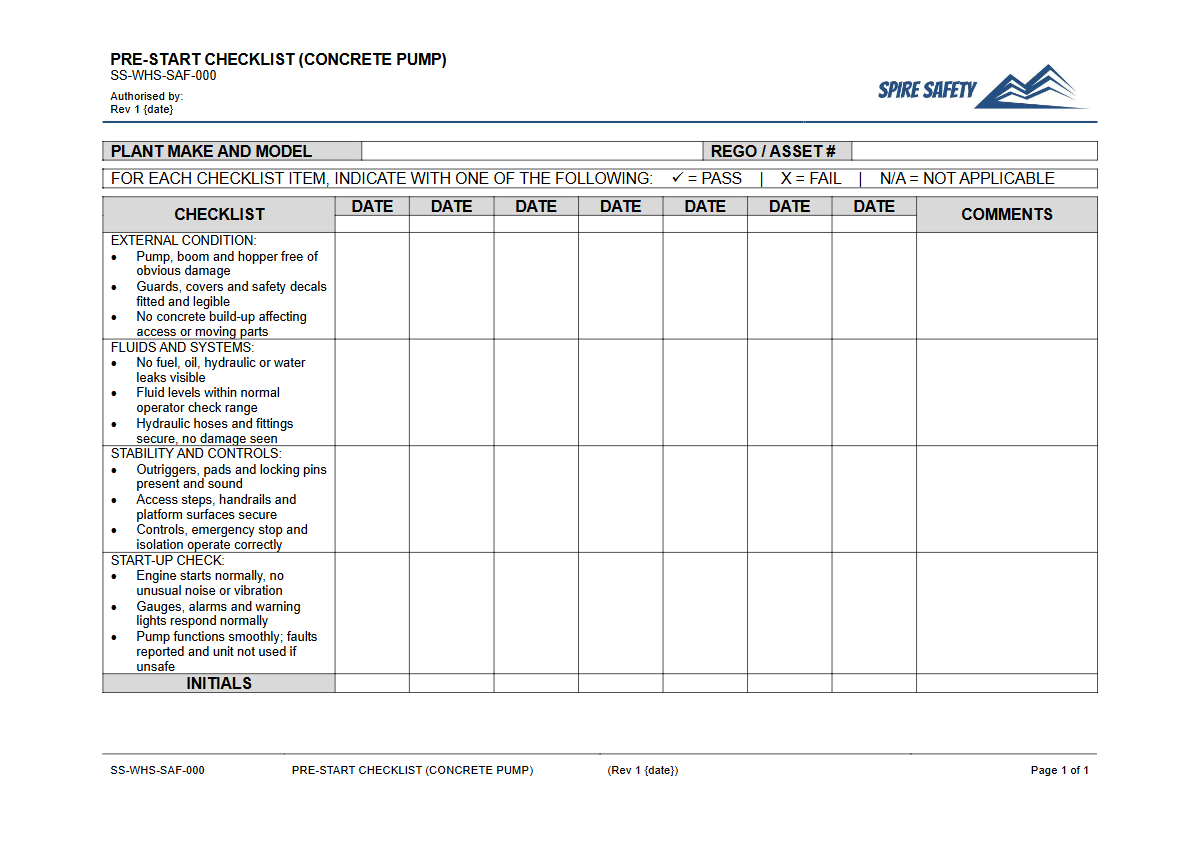
This Free Pre-Start Checklist (Concrete Pump) Template provides a structured framework for operators to inspect the machine before every shift. Using this checklist helps formalise the inspection process, identify potential faults or hazards before they escalate, and create a documented record of due diligence.
It prompts a thorough review of essential components like the hopper, agitator, delivery lines, outriggers, and emergency stops, aligning with Australian WHS best practices.
Regular inspections are fundamental to managing plant safety on site. While this document is specific to concrete pumps, similar principles apply to other machinery used in concreting and construction.
For example, ensuring the serviceability of smaller plant is just as important, which is why we also offer a Pre-Start Checklist for concrete vibrators. A consistent approach to pre-start inspections across all equipment helps build a stronger safety culture and reduces the likelihood of incidents.
Video walkthrough
How to use the Free Pre-Start Checklist (Concrete Pump) Template
This template is provided in both DOCX and PDF formats for your convenience. The DOCX file is fully editable, allowing you to tailor the checklist to the specific makes and models of concrete pumps used in your operations, as well as your site-specific risks and procedures.
A generic checklist may not cover all critical components or unique hazards associated with your particular equipment. Integrating this customised checklist is a key activity within broader WHS management systems, ensuring that safety processes are practical and effective.
To implement this checklist effectively:
- Customise: Add, remove, or modify checklist items to reflect the manufacturer’s instructions and the specific configuration of your concrete pump(s). Include company details and project information fields. Important: We provide this template as a starting point. You must customise it to suit the unique hazards, risks, and operational context of your workplace.
- Train: Ensure all operators are trained not only on how to operate the pump safely but also on how to conduct a thorough pre-start inspection using the customised checklist.
- Implement: Integrate the checklist into your daily routine. Make it mandatory for operators to complete and sign it before commencing work. Supervisors should periodically verify that checks are being completed correctly.
- Review: Establish a clear procedure for reporting and rectifying defects found during the inspection. The equipment must not be used if a safety-critical fault is identified.
When to use it
A pre-start check should be conducted at the beginning of each day or shift before the concrete pump is first used. It should also be performed after the equipment has been relocated on site, has undergone maintenance or repair, or if there is any reason to suspect its condition has changed.
For other heavy-duty equipment, the same logic applies; a Pre-Start Checklist for Floor Saws, for instance, should also be completed before every use to check blade integrity and guarding. This routine helps catch developing issues like hydraulic leaks, structural cracks, or worn safety decals before they contribute to an incident.
Who should use it
This checklist is designed to be completed by the person operating the concrete pump. Operators must be deemed competent, meaning they have the necessary training, experience, and knowledge to both operate the machine and recognise potential defects.
Supervisors or safety officers should also be familiar with the checklist content to effectively oversee the process and confirm its completion. They are responsible for ensuring operators are not only filling out the form but are actively and thoroughly inspecting the equipment.
In some organisations, maintenance personnel may also use this document as a reference when diagnosing reported faults.
Ensuring that these procedures are followed correctly is a key part of workplace safety governance. An independent review can help verify that your safety processes are being implemented as intended.
Undertaking periodic WHS compliance auditing provides assurance that your on-the-ground practices align with your documented procedures and legal obligations. This external perspective can identify gaps in your pre-start inspection process or other areas of your safety system.
If you need assistance in developing robust safety procedures, our WHS consulting team can provide expert guidance. You can also explore our extensive free WHS resources library for more templates and guides.
Common mistakes
Common mistakes to avoid
- Ticking boxes on the form without physically inspecting the corresponding component.
- Ignoring minor hydraulic fluid weeps or oil leaks that can indicate a future major failure.
- Failing to report, isolate, and tag-out equipment when a safety-critical defect is found.
- Using a generic, non-customised checklist that doesn't cover all features of a specific pump model.
Legal references
Legal considerations
The following legal requirements may be relevant to this type of work.
- Work Health and Safety Act (Harmonised) — Provides the primary duties for protecting workers and other people from work health and safety risks.
- Work Health and Safety Regulations (Harmonised) — Sets out requirements supporting the management of workplace hazards and risks.
The following codes may be relevant to this type of work.
- Managing WHS Risks Code of Practice — Provides practical guidance on identifying hazards, assessing risks and applying effective controls.
- Work Health and Safety Consultation, Cooperation and Coordination Code of Practice — Provides practical guidance on consulting workers and coordinating with other duty holders.
- Managing the Work Environment and Facilities Code of Practice — Provides practical guidance on safe work environments, workplace facilities and related controls.
Did you know
Extreme Pressure
The hydraulic systems on modern concrete pumps can generate immense pressure, often exceeding 85 bar (1,230 psi) at the material cylinder to push concrete through hundreds of metres of pipeline.
Record Breaker
The world record for vertical concrete pumping was set during the construction of the Burj Khalifa in Dubai, where a specialised system pumped concrete to a height of 606 metres (1,988 ft).
FAQ
Frequently asked questions
01What should be included in a concrete pump pre-start checklist?
02How often should concrete pump pre-start checks be done?
03Is a digital pre-start checklist better than a paper one?
04Who is responsible for ensuring concrete pump pre-starts are completed?
Share this resource
Free Pre-Start Checklist (Concrete Pump) Template
Browse Categories
How To Use It
- 1Download and open in Word or PDF.
- 2Replace the placeholders with your business details.
- 3Get it reviewed by a WHS specialist before rollout.
Need it customised?
Our WHS consultants can adapt this template to your site, run a gap analysis, or audit what you already have in place.
Book a Free Consultation WHS consulting servicesor call 1300 156 382