
Free Pre-Start Checklist (Concrete Saw) Template
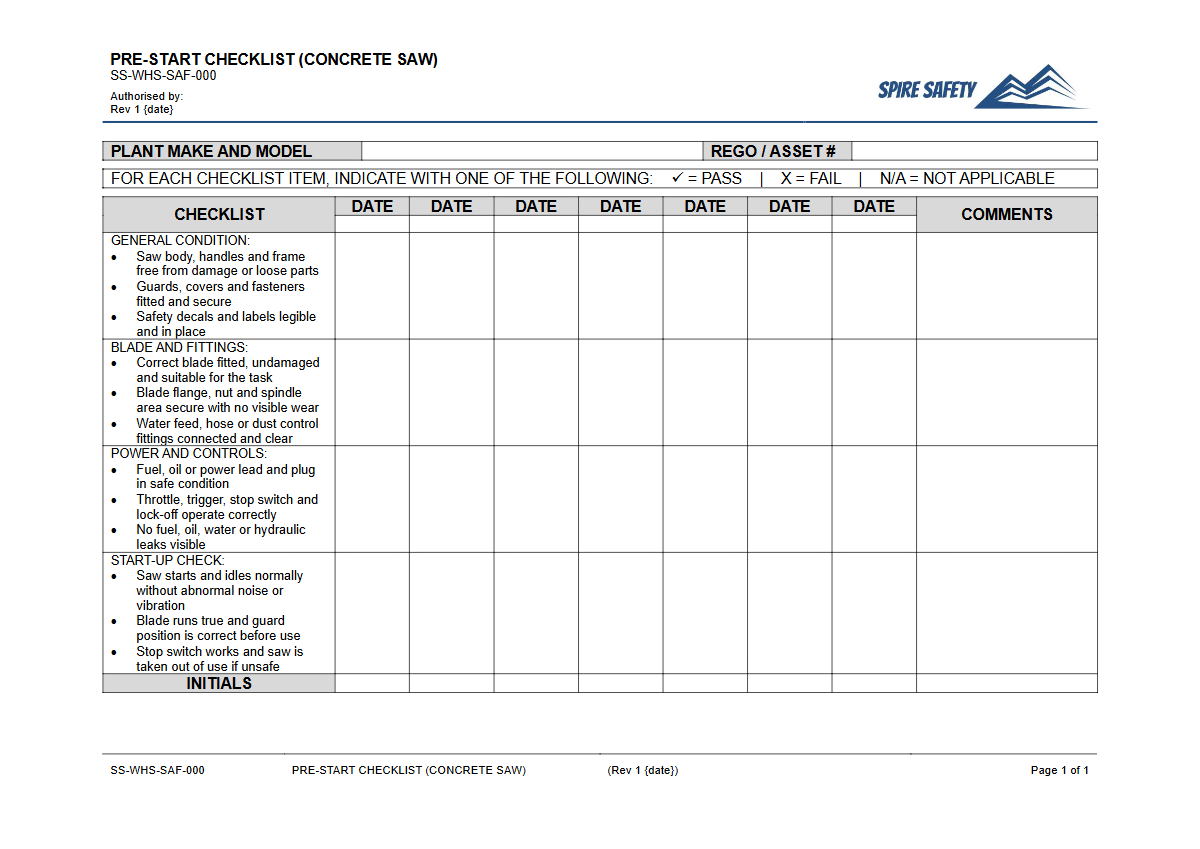
Download our free Pre-Start Checklist (Concrete Saw) Template to formalise daily equipment checks and manage WHS risks on your worksite.
Free Pre-Start Checklist (Concrete Saw) Template
DOCX • 125 KB + PDF
Updated Oct 2026
No signup required
Purpose of the Free Pre-Start Checklist (Concrete Saw) Template
Operating a concrete saw, whether a handheld cut-off saw or a larger walk-behind unit, introduces significant workplace hazards. These include kickback, blade failure, high levels of vibration, noise, and exposure to respirable crystalline silica (RCS) dust.
This Free Pre-Start Checklist (Concrete Saw) Template provides a structured framework for operators to conduct consistent, documented inspections before each use. Formalising these checks helps your organisation meet its duty of care, identify potential equipment faults before they lead to incidents, and maintain a clear record of your safety diligence.
A pre-start check is a fundamental component of safe plant operation. Systematically verifying the condition of the blade, guards, water suppression system, and engine controls is critical for risk management. Integrating this process into your daily operations demonstrates a proactive approach to safety, forming a key part of your broader WHS management systems.
Video walkthrough
How to use the Free Pre-Start Checklist (Concrete Saw) Template
This template is provided in both DOCX and PDF formats for your convenience. The DOCX file is fully editable, allowing you to tailor the checklist to the specific models of concrete saws used in your workplace and your unique operational risks.
It serves as an excellent starting point for any business looking to formalise its plant safety procedures.
To implement the checklist:
- Download the DOCX template.
- Customise the fields to include the make, model, and specific features of your equipment. Add or remove checks as necessary to reflect your site's risk assessment.
- Incorporate your company branding and specific safe work procedure references.
- Train all operators on how to properly complete the checklist and what actions to take if a fault is identified (e.g., tag out of service, report to a supervisor).
- Print copies for daily use or integrate the checklist into a digital system.
Please note: This document is a template and must be customised to your specific workplace. The checks provided are general in nature.
We cannot guarantee that the template covers every possible hazard for your specific model of saw or work environment. You must conduct your own risk assessment and adapt the document accordingly. The same principle applies when using other equipment-specific documents, such as a pre-start checklist for floor saws.
When to use it
A pre-start checklist for a concrete saw should be completed by the operator before the first use on every shift. It should also be completed if the operator changes during a shift or if the saw has been idle for an extended period and is being returned to service.
The purpose of this frequency is to catch any damage or defects that may have occurred since its last use, during transport, or overnight in storage. Consistent, pre-operational checks are a cornerstone of preventing equipment-related incidents.
Who should use it
This checklist must only be used by workers who are deemed competent to operate a concrete saw. Competency involves more than just knowing how to start the machine; it includes formal training, practical experience, and a thorough understanding of the specific risks involved, such as managing silica dust and preventing kickback.
Supervisors should ensure that only authorised and competent personnel are assigned tasks involving this high-risk plant. This focus on competency applies to all workshop and construction equipment, from a simple bench grinder pre-start checklist to more specialised tools.
Using this checklist helps reinforce the operator's responsibility to ensure the equipment is safe before they begin work. On a construction site with multiple concrete-related tasks, using specific checklists for each piece of equipment, including tools like a pre-start checklist for concrete vibrators, helps create a comprehensive safety culture.
Documented checks provide evidence that the organisation and its workers are actively managing risks. To verify the effectiveness of these processes, many organisations undertake periodic WHS compliance audits.
Common mistakes
Common mistakes to avoid
- Using a blade that is worn, damaged, or incorrect for the material being cut.
- Neglecting to check or use the water suppression system, leading to excessive hazardous dust.
- Failing to inspect the blade guard for damage and proper fitment.
- Skipping the pre-start check because the equipment 'worked fine yesterday'.
Legal references
Legal considerations
The following legal requirements may be relevant to this type of work.
- Work Health and Safety Act (Harmonised) — Provides the primary duties for protecting workers and other people from work health and safety risks.
- Work Health and Safety Regulations (Harmonised) — Sets out requirements supporting the management of workplace hazards and risks.
The following codes may be relevant to this type of work.
- Managing WHS Risks Code of Practice — Provides practical guidance on identifying hazards, assessing risks and applying effective controls.
- Work Health and Safety Consultation, Cooperation and Coordination Code of Practice — Provides practical guidance on consulting workers and coordinating with other duty holders.
- Managing the Work Environment and Facilities Code of Practice — Provides practical guidance on safe work environments, workplace facilities and related controls.
Did you know
Wet Cutting is a Control
Using a continuous flow of water (wet cutting) is a primary engineering control to suppress harmful silica dust at its source. It can reduce airborne dust by over 90% when used correctly, protecting both the operator and others nearby.
Blade Speed Matters
Every abrasive or diamond blade has a maximum safe operating RPM (Revolutions Per Minute) printed on it. It is critical to ensure this RPM rating is higher than the maximum RPM of the saw to prevent the blade from shattering during use.
FAQ
Frequently asked questions
01What is the most significant risk when using a concrete saw?
02Is a pre-start checklist for a concrete saw legally required in Australia?
03How often should a concrete saw be inspected?
04Can this template be used for both handheld and walk-behind concrete saws?
Share this resource
Free Pre-Start Checklist (Concrete Saw) Template
Browse Categories
How To Use It
- 1Download and open in Word or PDF.
- 2Replace the placeholders with your business details.
- 3Get it reviewed by a WHS specialist before rollout.
Need it customised?
Our WHS consultants can adapt this template to your site, run a gap analysis, or audit what you already have in place.
Book a Free Consultation WHS consulting servicesor call 1300 156 382