
Free Pre-Start Checklist (Compactor) Template
Formalise compactor safety inspections with our free Pre-Start Checklist Template. This DOCX & PDF helps operators identify hazards before use.
Free Pre-Start Checklist (Compactor) Template
DOCX • 125 KB + PDF
Updated Oct 2026
No signup required
Purpose of the Free Pre-Start Checklist (Compactor) Template
Regularly inspecting heavy machinery is a fundamental requirement of workplace health and safety. This Free Pre-Start Checklist (Compactor) Template provides a structured framework for operators to conduct thorough, documented inspections before using the equipment.
Compactors, used in waste management, construction, and civil works, pose significant risks, including crushing, entanglement, and mechanical failure. Using a formal checklist helps systematically identify potential hazards, verify safety controls are working, and prevent incidents before they occur.
Implementing this process is a key part of demonstrating due diligence and fulfilling your duty of care as a Person Conducting a Business or Undertaking (PCBU). It moves your organisation beyond informal checks to a documented, repeatable safety procedure.
This checklist serves as a practical tool within a robust WHS management system, helping to minimise operational risks, reduce costly equipment downtime, and foster a proactive safety culture.
Video walkthrough
How to use the Free Pre-Start Checklist (Compactor) Template
Using this template effectively involves more than just filling out boxes. The process begins with downloading the DOCX or PDF and adapting it to your specific needs.
It's designed as a comprehensive starting point aligned with Australian WHS principles.
Please note: This document is a template. We have designed it as a starting point, but it must be customised to suit the specific make and model of your compactor, your operational environment, and your organisation's specific risk profile.
Items may need to be added, removed, or rephrased to be relevant.
Once customised, train all relevant operators on how to use the checklist correctly and what each inspection point means. Completed checklists should be reviewed by a supervisor and stored securely as part of your safety records. These records are essential evidence that safety procedures are being followed, which can be verified during WHS compliance auditing.
When to use it
A pre-start check should be integrated into the daily routine of any operation using a compactor. The checklist must be completed:
- Before the first use of the compactor at the beginning of each workday or shift.
- When an operator changes during a shift.
- After the equipment has returned from major repairs or maintenance.
This consistent frequency ensures that any damage or faults that may have occurred overnight, during transport, or from previous use are identified before the machine is put into service. The principle is the same across different types of plant, whether you are using a compactor or require a pre-start checklist for a floor saw; the goal is always to catch issues early.
Who should use this Pre-Start Checklist
This checklist should be completed by a worker who is trained, licensed (if required), and deemed competent to operate the specific model of compactor. Competency means the operator not only knows how to use the machine but also understands the risks involved and how to conduct a thorough inspection.
Supervisors and managers also have a role; they are responsible for ensuring operators are trained, the checks are being completed correctly, and that any reported faults are addressed promptly.
Defining competency requirements and training programs can be complex. If your organisation needs assistance in developing these frameworks, consider engaging with specialist WHS consulting services to ensure your processes are sound.
What's included in this template
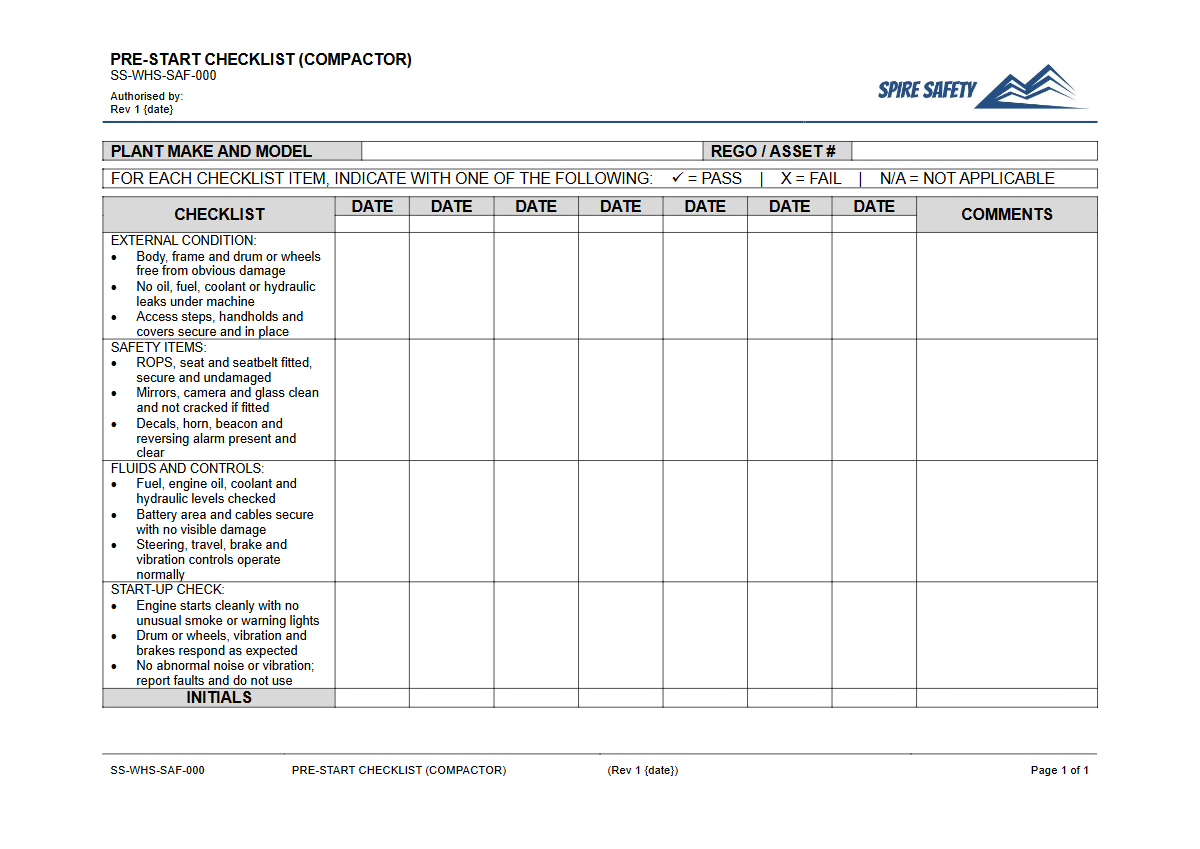
This Pre-Start Checklist is organised into logical sections to guide the operator through a comprehensive inspection. Key areas covered include:
- General Information: Fields for date, operator name, machine ID, and location.
- Visual & Structural Checks: Inspection points for guards, safety decals, access ladders, hydraulic lines, tyres or tracks, and the overall structure for cracks or damage.
- Fluid & Leaks: Checks for engine oil, hydraulic fluid, coolant, and fuel levels, as well as looking for any active leaks.
- Operator Cabin: Inspection of seatbelts, controls, horn, mirrors, and housekeeping.
- Functional Tests: Steps to test emergency stops, travel alarms, lights, brakes, and steering.
- Sign-off: A declaration that the machine is either safe to use or has faults that need attention, complete with a signature and section for corrective actions.
This checklist is specifically for mobile compactors. For fixed plant, such as a waste chute system, you will need a more specialised checklist like our separate Pre-Start Checklist for a compactor chute.
Beyond the Checklist: Next Steps
A checklist is only effective if it triggers action. A critical part of the process is having a clear procedure for what happens when a fault is identified.
The operator must know who to report the issue to and how to isolate the equipment to prevent its use. A simple 'lockout-tagout' system is often the most effective method.
All reported faults must be logged, tracked, and signed off once rectified by a qualified person. This creates a closed-loop system that ensures safety issues are resolved, not ignored. For more templates and safety guides, explore our complete free WHS resources library.
Common mistakes
Common mistakes to avoid
- "Pencil-whipping" the checklist without physically inspecting the item.
- Failing to customise the template for the specific make and model of the compactor.
- Not having a clear "tag out" and reporting procedure for when a fault is found.
- Inadequate record-keeping or supervisors not reviewing completed checklists.
Legal references
Legal considerations
The following legal requirements may be relevant to this type of work.
- Work Health and Safety Act (Harmonised) — Provides the primary duties for protecting workers and other people from work health and safety risks.
- Work Health and Safety Regulations (Harmonised) — Sets out requirements supporting the management of workplace hazards and risks.
The following codes may be relevant to this type of work.
- Managing WHS Risks Code of Practice — Provides practical guidance on identifying hazards, assessing risks and applying effective controls.
- Work Health and Safety Consultation, Cooperation and Coordination Code of Practice — Provides practical guidance on consulting workers and coordinating with other duty holders.
- Managing the Work Environment and Facilities Code of Practice — Provides practical guidance on safe work environments, workplace facilities and related controls.
Did you know
Compaction Force
Modern waste and soil compactors can generate immense forces, often exceeding 200 kilonewtons (kN), equivalent to over 20 tonnes of pressure. This highlights the critical importance of ensuring all safety guards and emergency systems are functional.
Historical Hazard
Early compactors lacked many of the safety features we now take for granted, such as interlocked guards and emergency stops. A significant portion of historical machinery-related incidents led to the development of modern regulations and engineering controls.
FAQ
Frequently asked questions
01What is the main purpose of a compactor pre-start checklist?
02How often should a compactor pre-start check be completed?
03Who is responsible for ensuring pre-start checks are done?
04Is this compactor checklist template enough for WHS compliance?
Share this resource
Free Pre-Start Checklist (Compactor) Template
Browse Categories
How To Use It
- 1Download and open in Word or PDF.
- 2Replace the placeholders with your business details.
- 3Get it reviewed by a WHS specialist before rollout.
Need it customised?
Our WHS consultants can adapt this template to your site, run a gap analysis, or audit what you already have in place.
Book a Free Consultation WHS consulting servicesor call 1300 156 382