
Free Pre-Start Checklist (Concrete Mix) Template
Download our free Pre-Start Checklist (Concrete Mix) Template to formalise daily equipment checks. This structured DOCX & PDF resource helps manage WHS risks.
Free Pre-Start Checklist (Concrete Mix) Template
DOCX • 125 KB + PDF
Updated Oct 2026
No signup required
Purpose of the Free Pre-Start Checklist (Concrete Mix) Template
A concrete mixer, whether portable or stationary, is a fundamental piece of equipment on many Australian worksites. However, it also presents significant WHS risks if not properly inspected and maintained.
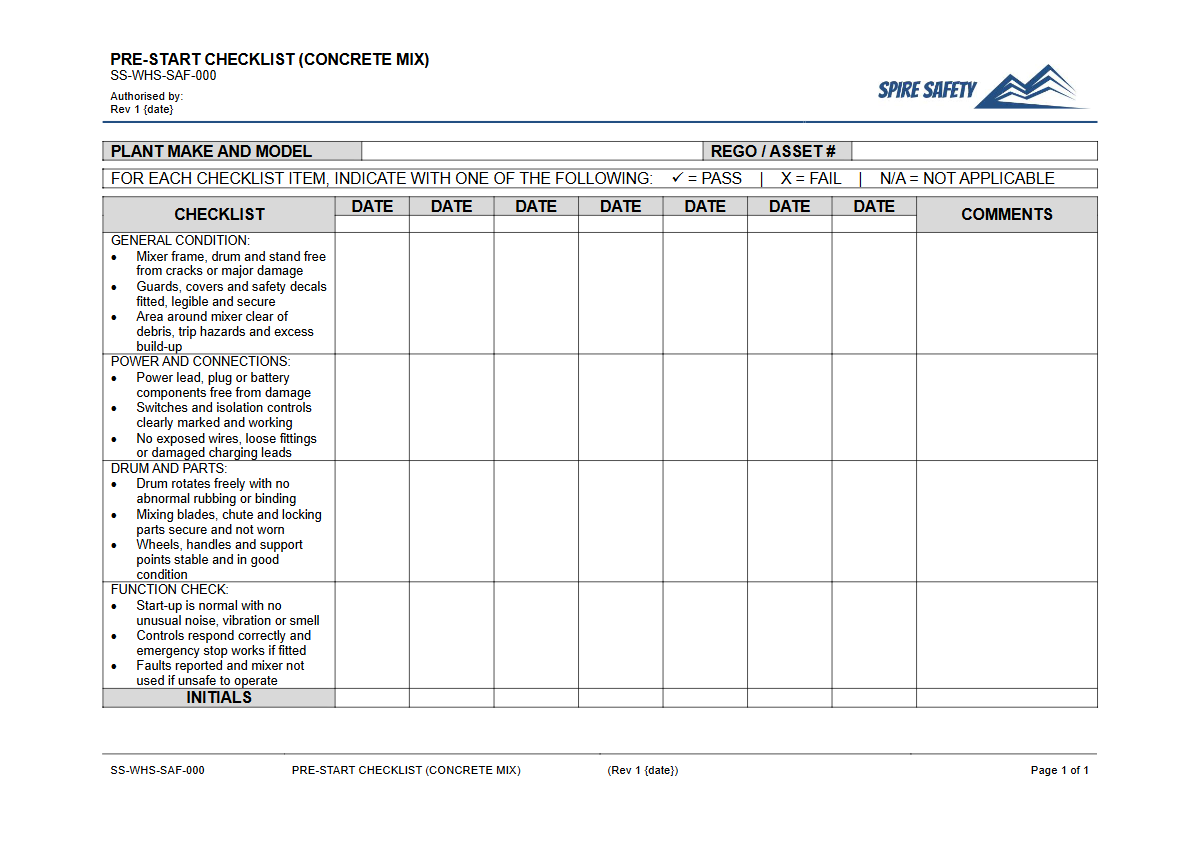
This free Pre-Start Checklist (Concrete Mix) Template provides a structured method for operators to conduct routine safety inspections before using the equipment. Systematically completing a pre-start check helps identify and control hazards such as entanglement in the rotating drum, guarding defects, electrical faults, instability, and exposure to hazardous substances like wet cement.
Using this checklist promotes a proactive safety culture by formalising the inspection process. It ensures that key safety features are checked consistently, reducing the likelihood of equipment failure, incidents, and injuries.
Documenting these checks also creates a clear record of due diligence, demonstrating an organisation's commitment to providing and maintaining safe plant and equipment.
Video walkthrough
How to use the Free Pre-Start Checklist (Concrete Mix) Template
This Pre-Start Checklist for a concrete mixer is designed as a user-friendly starting point. To integrate it into your safety procedures, download the template in your preferred format (DOCX or PDF) and follow these steps:
- Customise: It's crucial to remember that this is a template. We've designed it to be a strong starting point based on common practice, but you must customise it to reflect the specific make, model, and configuration of your concrete mixer, as well as the unique risks of your worksite. Add, remove, or modify checklist items as needed.
- Train: Ensure all operators are trained not only on the safe use of the concrete mixer but also on how to properly complete the pre-start checklist. They must understand what each checkpoint means and the procedure for reporting faults.
- Implement: Integrate the checklist into your daily operational workflow. Make it a non-negotiable step before any concrete mixer is used for the first time on a shift.
- Review: Periodically review the completed checklists to identify recurring faults or trends. This data is invaluable for refining maintenance schedules and improving your overall safety processes as part of your WHS management systems.
When to use it
The concrete mixer pre-start checklist should be completed before the first use of the equipment on every shift or workday. It should also be completed if a new operator takes over mid-shift.
The goal is to verify the equipment's safe condition immediately before it is put into operation, catching any defects that may have developed overnight or during transport. This proactive approach is far safer than waiting for a scheduled maintenance check, especially for equipment used frequently.
For related plant, you can also use our Pre-Start Checklist for concrete vibrators to ensure all your concreting equipment is inspected.
Who should use it
The checklist should be completed by the person operating the concrete mixer. This individual must be trained, competent, and authorised to use the equipment.
They have the most direct interaction with the plant and are best placed to identify any operational issues or defects. A supervisor or manager should periodically review the completed checklists to ensure they are being filled out correctly and that any reported issues are being addressed in a timely manner. These reviews are a key component of workplace safety oversight and can be validated through regular WHS compliance auditing.
What the Pre-Start Checklist Covers
This template prompts the operator to inspect several critical areas of the concrete mixer to confirm its fitness for use.
Mechanical and Structural Checks
The checklist guides the user to check for structural integrity, including the frame, wheels, and tow hitch (if applicable). It covers the condition of the mixing drum, checking for cracks or damage, and ensures all guards are securely in place to prevent contact with moving parts like belts, pulleys, and gears. This is similar to the guarding checks required for other workshop equipment, such as those found in a Pre-Start Checklist (Bench Grinder) Template.
Electrical and Power Source Safety
For electric mixers, the inspection includes checking leads, plugs, and sockets for damage, and verifying that the RCD (safety switch) is operational by performing a trip test. For engine-powered models, it prompts checks on fuel and oil levels and looks for any leaks.
This focus on the power source is critical for preventing fires and electric shock.
Operational and Hazard-Specific Checks
The checklist includes verifying the function of the emergency stop button and ensuring operating controls are clearly labelled and functioning correctly. It also reminds the user to check that the work area is clear, stable, and free from slip or trip hazards. This principle of ensuring a safe operating zone is common across many types of plant, including items covered by our Pre-Start Checklist for Floor Saws. Finally, it prompts a check for the availability of the correct Personal Protective Equipment (PPE) for handling cement products. For a wider selection of safety documents, browse our complete free WHS resources library.
Common mistakes
Common mistakes to avoid
- Failing to customise the generic template for the specific make and model of the mixer.
- Operators 'pencil-whipping' the form without physically inspecting each item.
- Not immediately tagging out and reporting faulty equipment identified during the check.
- Neglecting to provide operators with proper training on how to conduct the inspection effectively.
Legal references
Legal considerations
The following legal requirements may be relevant to this type of work.
- Work Health and Safety Act (Harmonised) — Provides the primary duties for protecting workers and other people from work health and safety risks.
- Work Health and Safety Regulations (Harmonised) — Sets out requirements supporting the management of workplace hazards and risks.
The following codes may be relevant to this type of work.
- Managing WHS Risks Code of Practice — Provides practical guidance on identifying hazards, assessing risks and applying effective controls.
- Work Health and Safety Consultation, Cooperation and Coordination Code of Practice — Provides practical guidance on consulting workers and coordinating with other duty holders.
- Managing the Work Environment and Facilities Code of Practice — Provides practical guidance on safe work environments, workplace facilities and related controls.
Did you know
Chemical Hazard
Wet cement is highly alkaline and can cause serious chemical burns to the skin, sometimes with delayed symptoms. It's crucial that workers wear appropriate waterproof gloves and other PPE.
A Sticky Situation
The first patent for a motorised concrete mixer was filed in 1916 by Stephen Stepanian. Before this invention, concrete was mixed manually in wheelbarrows or on mixing boards, a much more labour-intensive and inconsistent process.
FAQ
Frequently asked questions
01What are the key hazards associated with concrete mixers?
02How often should a concrete mixer pre-start check be performed?
03Is this concrete mixer checklist compliant with Australian WHS laws?
04What should happen if a fault is found during a pre-start check?
Share this resource
Free Pre-Start Checklist (Concrete Mix) Template
Browse Categories
How To Use It
- 1Download and open in Word or PDF.
- 2Replace the placeholders with your business details.
- 3Get it reviewed by a WHS specialist before rollout.
Need it customised?
Our WHS consultants can adapt this template to your site, run a gap analysis, or audit what you already have in place.
Book a Free Consultation WHS consulting servicesor call 1300 156 382