
Free Pre-Start Checklist (Compactor Bin) Template
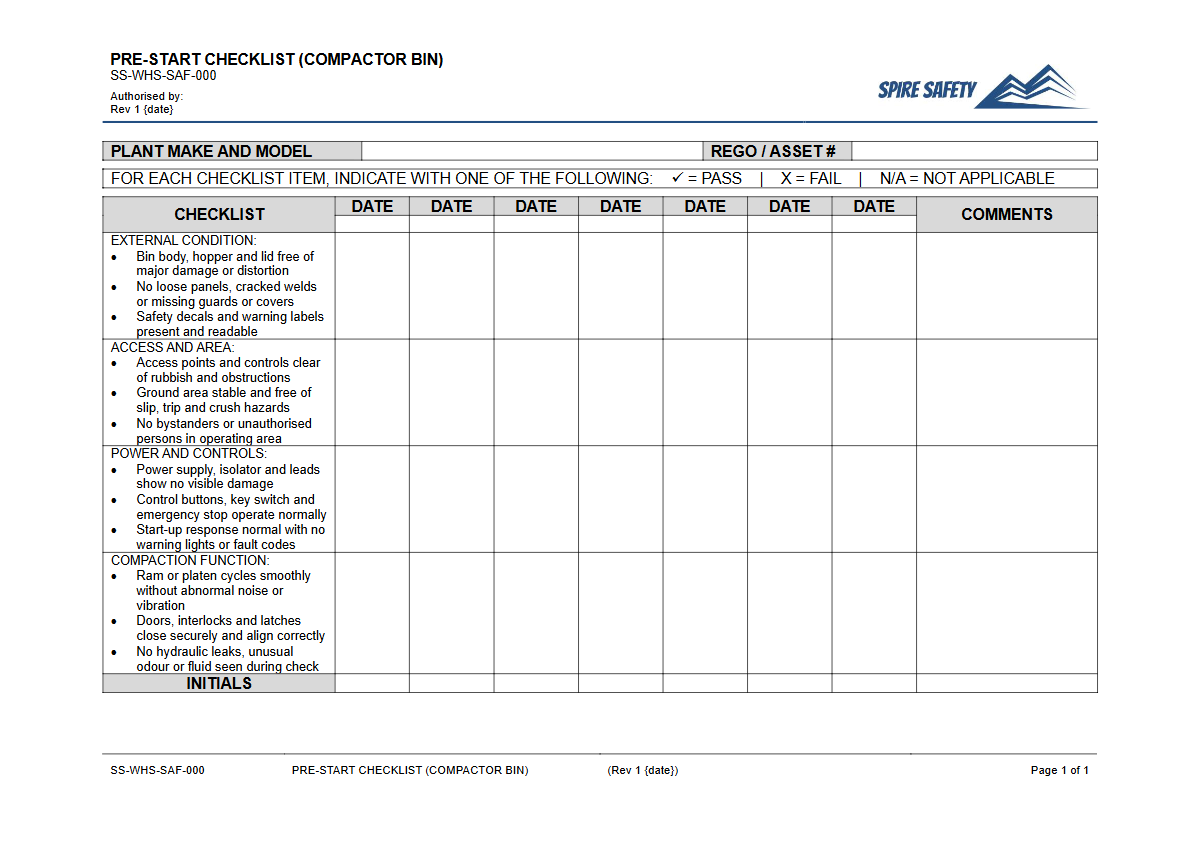
Download our Free Pre-Start Checklist (Compactor Bin) Template to formalise daily equipment checks. This DOCX & PDF resource helps manage WHS risks.
Free Pre-Start Checklist (Compactor Bin) Template
DOCX • 125 KB + PDF
Updated Oct 2026
No signup required
Purpose of the Free Pre-Start Checklist (Compactor Bin) Template
Implementing a routine inspection process is critical for managing the risks associated with waste management equipment. Our Free Pre-Start Checklist (Compactor Bin) Template provides a structured framework for operators to conduct consistent and thorough safety checks before each use.
Using a standardised checklist helps identify potential faults, prevent equipment failure, and reduce the risk of injury. This document serves as a practical tool to support your organisation's broader safety protocols and demonstrates a commitment to proactive risk management.
It encourages a systematic review of critical safety components, such as guards, emergency stops, and hydraulic systems, ensuring the compactor is in safe working order.
Formalising these checks is a key component of effective WHS management systems, helping to create a safer work environment for everyone involved in waste handling operations. This proactive approach aligns with the principles of hazard identification and risk control mandated by Australian WHS legislation.
Video walkthrough
How to use the Free Pre-Start Checklist (Compactor Bin) Template
This template is designed for ease of use. Operators should work through the checklist systematically before operating the compactor bin, physically verifying each item listed.
The checklist guides the user to inspect mechanical, hydraulic, and electrical components, as well as general cleanliness and structural integrity. Any identified faults, damage, or 'No' answers should be immediately reported to a supervisor as per your organisation's procedure.
The equipment must be tagged out and not used until it has been assessed and repaired by a competent person.
It is essential to adapt this document to the specific model of compactor bin used in your workplace and your operational risks. Note: We provide this template as a starting point. You must customise it to reflect your specific equipment, site conditions, and internal procedures. For related equipment, you might also find our pre-start checklist for compactor chutes helpful.
When to use a Compactor Bin Pre-Start Checklist
A pre-start checklist for a compactor bin should be completed before the first use on any shift. If the machine is used intermittently throughout the day by different operators, it is good practice for each new operator to conduct their own check before commencing work.
This ensures continuous oversight and accountability, and helps pinpoint when a fault may have occurred. Regular checks are fundamental to preventing incidents caused by equipment deterioration.
Consistent documentation of these checks also provides valuable records that are often reviewed during internal and external WHS compliance audits. These records serve as evidence that the Person Conducting a Business or Undertaking (PCBU) is taking practicable steps to ensure plant safety.
Who should complete the Pre-Start Checklist
This checklist is intended for trained and competent operators who are authorised to use the compactor bin. This includes waste management staff, facilities maintenance personnel, or any other workers whose duties involve operating the equipment.
Supervisors and WHS officers should also be familiar with the checklist to ensure it is being completed correctly and to follow up on any reported issues.
Proper training on both the equipment's operation and the inspection process is crucial to ensure the user understands what they are looking for during each check. The same principle of operator-led checks applies to other material processing equipment, for which a specific pre-start checklist for granulators would be appropriate.
Integrating Pre-Start Checks into Your Safety Culture
Making pre-start checks a non-negotiable part of daily operations helps build a strong safety culture. When every worker understands the 'why' behind the checks, they are more likely to perform them diligently.
This routine reinforces the idea that safety is a shared responsibility and that no task is so urgent that it can bypass a basic safety inspection.
This practice should extend to all equipment, not just heavy plant. Whether it's a large waste compactor or common workshop tools, a systematic check using a resource like a pre-start checklist for a bench grinder is a hallmark of a mature safety system.
By embedding this behaviour, you create a more resilient and safety-conscious workplace. You can find templates for other common items in our free WHS resources library to help standardise this practice across your organisation.
Common mistakes
Common mistakes to avoid
- Bypassing or disabling safety interlocks on doors and guards to speed up operation.
- Ignoring small hydraulic fluid leaks, which can indicate a pending system failure and create slip hazards.
- Overfilling the charge box, which can cause jams and place excessive strain on the compaction mechanism.
- Failing to properly document identified faults or 'tag out' unsafe equipment, allowing it to be used inadvertently.
Legal references
Legal considerations
The following legal requirements may be relevant to this type of work.
- Work Health and Safety Act (Harmonised) — Provides the primary duties for protecting workers and other people from work health and safety risks.
- Work Health and Safety Regulations (Harmonised) — Sets out requirements supporting the management of workplace hazards and risks.
The following codes may be relevant to this type of work.
- Managing WHS Risks Code of Practice — Provides practical guidance on identifying hazards, assessing risks and applying effective controls.
- Work Health and Safety Consultation, Cooperation and Coordination Code of Practice — Provides practical guidance on consulting workers and coordinating with other duty holders.
- Managing the Work Environment and Facilities Code of Practice — Provides practical guidance on safe work environments, workplace facilities and related controls.
Did you know
Compaction Force
Industrial waste compactors can exert immense force, often exceeding 25 tonnes. This power is necessary for reducing waste volume but also highlights the severe crushing hazard if safety guards and interlocks are not maintained.
FAQ
Frequently asked questions
01What are the main hazards of a compactor bin?
02Why is a pre-start check necessary for a compactor bin?
03How often should a compactor bin be inspected?
04Can this template be used for any brand of compactor bin?
Share this resource
Free Pre-Start Checklist (Compactor Bin) Template
Browse Categories
How To Use It
- 1Download and open in Word or PDF.
- 2Replace the placeholders with your business details.
- 3Get it reviewed by a WHS specialist before rollout.
Need it customised?
Our WHS consultants can adapt this template to your site, run a gap analysis, or audit what you already have in place.
Book a Free Consultation WHS consulting servicesor call 1300 156 382